
Knowledge has always been hard to transfer. AI can now enable knowledge amplification at scale.
Click on the image for the full report PDF.
Organizations have always lost expertise when people move on or change roles. The tacit judgment, contextual wisdom, and institutional memory never gets captured. The knowledge transfer from seniors to juniors has been ad-hoc and poorly managed.
AI entirely changes what’s possible. Expertise can now be elicited through conversation, accessible at the point of need, compressed into simulated practice, and extended across adjacent roles. The shift is architectural: knowledge is brought into the system while helping individuals to develop their own expertise and judgment.
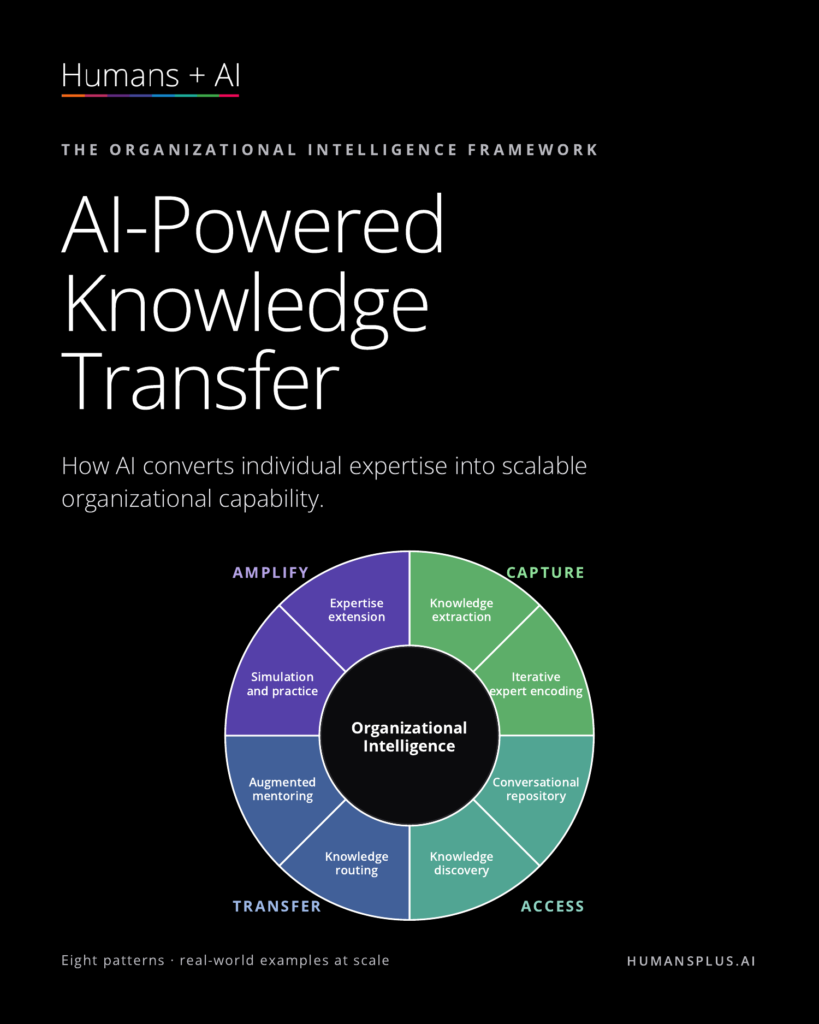
This framework maps eight ways AI can transform how organizations capture, access, transfer, and amplify expertise:
- Capture: Draw expertise out of people.
- Access: Make it findable at the point of need.
- Transfer: Route it to the right person, fast.
- Amplify: Scale it beyond the original expert.
Capture
1. Knowledge Extraction and Codification
AI actively draws expertise out of people through structured interviews, recorded walkthroughs, and conversational elicitation before it leaves the organization. Unlike asking someone to write a manual, AI handles transcription, thematic extraction, and structuring, transforming conversations into searchable assets that capture not just what people did but why they did it.
Case study, NASA JPL: Institutional Knowledge Graph. NASA’s Jet Propulsion Laboratory ran structured elicitation sessions with departing and transitioning staff to surface what its Chief Knowledge Officer Michelle Drabik described as “the stuff we don’t know that we know.” Recordings and transcripts fed into JPL’s Institutional Knowledge Graph, a semantic AI system that interconnected people, projects and expertise areas, making it possible to identify who held knowledge in specific technical domains before it left the organization. Built on pre-generative AI knowledge graph technology, the approach offered a way to transform tacit expertise into a persistent, queryable asset that could outlast any individual career.
2. Iterative Expert Encoding
An AI system is progressively trained on the knowledge, decisions, and reasoning patterns of subject-matter experts over time, not in a single capture exercise, but through ongoing interaction. Each expert contribution refines the system, which eventually encodes enough accumulated expertise to guide non-specialists through complex decisions without direct expert involvement on every occasion.
Case study, Wärtsilä: AI-driven product configuration. Wärtsilä, the Finnish marine and energy technology company, deployed an AI-driven Configure, Price, Quote (CPQ) system to optimize sales across its highly complex product range. The system iteratively captures knowledge from subject matter experts and engineers to refine its decision trees, ensuring configurations remain current and accurate. By eliminating configuration errors, it has ensured that bespoke, high-quality engines are specified accurately for engineering teams. The system has been delivering benefits for well over a decade and Wärtsilä developed in-house skills over time to maintain and improve it, reducing reliance on external providers.
Access
3. Conversational Knowledge Repository
Rather than storing expertise in documents employees rarely consult, this model embeds organizational knowledge inside an AI system queryable in plain language. The AI synthesizes information from across siloed sources (policies, past decisions, expert output) and delivers it to whoever needs it, without requiring them to know where it lives or who originally produced it.
Case study, Morgan Stanley: AI @ Morgan Stanley Assistant. Morgan Stanley built an internal AI assistant to make its vast library of research and intellectual capital accessible conversationally to its financial advisors. The tool expanded from being able to answer 7,000 questions to effectively answering any question from a corpus of 100,000 documents, with over 98% of advisor teams actively using it. The practical effect was a step change in how advisors engage clients. Document retrieval efficiency rose from 20% to 80%, dramatically reducing the time advisors previously spent searching for information and freeing them to focus on conversations rather than research tasks.
4. Knowledge Discovery
Before knowledge can be transferred, organizations need to know where it lives. This model uses AI to map expertise across the workforce, identifying who knows what, which knowledge is at risk, and where critical concentrations or gaps exist. Rather than relying on org charts or self-reported skills, AI analyzes behavioral signals, work patterns, and documented outputs to build a dynamic picture of organizational knowledge.
Case study, IBM: AI-powered skills inference. IBM built an internal AI skills inference system that automatically constructs and continuously maintains skills profiles for its entire workforce without requiring employees to self-report. The system draws on signals from work activity, project history and role data, with 80% of employees validating their AI-generated profiles as completely accurate when reviewed. The system gives employees access to their own profile through an expertise management interface, saves thousands of hours previously spent on manual skills inventories, and allows IBM to monitor its organizational skills landscape in real time and identify targeted interventions to close gaps.
Transfer
5. Knowledge Routing
Once expertise is mapped, the challenge shifts to delivery: getting the right knowledge to the right person at the point of need. This model uses AI to actively connect employees to the relevant expert, content, or resource when they need it, without relying on personal networks or knowing the right person to ask. The AI acts as an intelligent intermediary that surfaces answers from wherever they exist across the organization.
Case study, Siemens: Industrial Copilot at Electronics Factory Erlangen. Siemens deployed its Industrial Copilot on soldering machines at its Electronics Factory in Erlangen, Germany, giving operators and maintenance engineers a conversational interface for diagnosing machine faults. The copilot translates error codes into plain language, then searches across documents, manuals, and spare part lists to suggest solutions based on the machine’s details and operational history. Results include reduced machine downtime, faster resolution of bottlenecks, and more efficient shift handovers.
6. Augmented Mentoring and Tandem Learning
AI supports structured pairing between more and less experienced employees, helping identify optimal matches, surfacing relevant content at the right moment, and making the relationship itself more productive. The junior brings technical fluency; the senior brings contextual wisdom. AI acts as connector between them rather than a substitute for the human dynamic.
Case study, Unilever: FLEX Experiences. Unilever’s FLEX Experiences program uses AI to match employees to stretch projects outside their normal role, deliberately pairing people with adjacent expertise. Thousands of employees across 90+ countries contributed to projects outside their day jobs through the platform, with the AI recommending the skills employees need to build when they are not getting matched, creating a two-way learning dynamic rather than one-directional transfer.
Amplify
7. Simulation and Experiential Practice
AI creates realistic, low-risk environments where less experienced employees encounter complex situations that previously only came through years of exposure. The model compresses the experiential learning curve, letting people make mistakes, receive feedback, and build pattern recognition before facing those situations with real consequences.
Case study, Bank of America: Conversation simulators. Bank of America uses AI-powered conversation simulators to let employees rehearse a wide range of client interactions before facing them in practice. The simulators place staff in realistic scenarios from routine service inquiries to complex financial conversations, analyzing responses, language, and tone in real time and providing immediate coaching on where to improve. Employees have completed over one million simulations in a single year, with many reporting that the practice environment helped them deliver more confident and consistent service to real clients.
8. Expertise Extension
AI acts as a force-multiplier for employees whose skills are adjacent to a specialist domain, enabling them to do work that previously required deeper expertise, at sufficient quality. The key condition is proximity: AI narrows the gap between people who are domain-adjacent, but does not bridge wide domain distance. The recipient still needs some relevant foundation in the subject area for the transfer to be effective.
Case study, Moderna: Dose ID. Moderna built an internal tool called Dose ID to put large-scale data analysis capabilities in the hands of its clinical study teams. The tool automates analysis of optimal vaccine doses by applying standard dose selection criteria across thousands of pages of clinical data, generating charts and a referenced rationale. This allows clinical teams to comprehensively evaluate extremely large amounts of data efficiently, performing analysis that previously required specialist data science involvement, while keeping clinical judgment with the domain experts.
Download the report
Download AI-Powered Knowledge Transfer (PDF)