
Five layers at which an organization operates in a Humans + AI model, from individual augmentation up to ecosystem intelligence, each defined with concrete actions to build it.
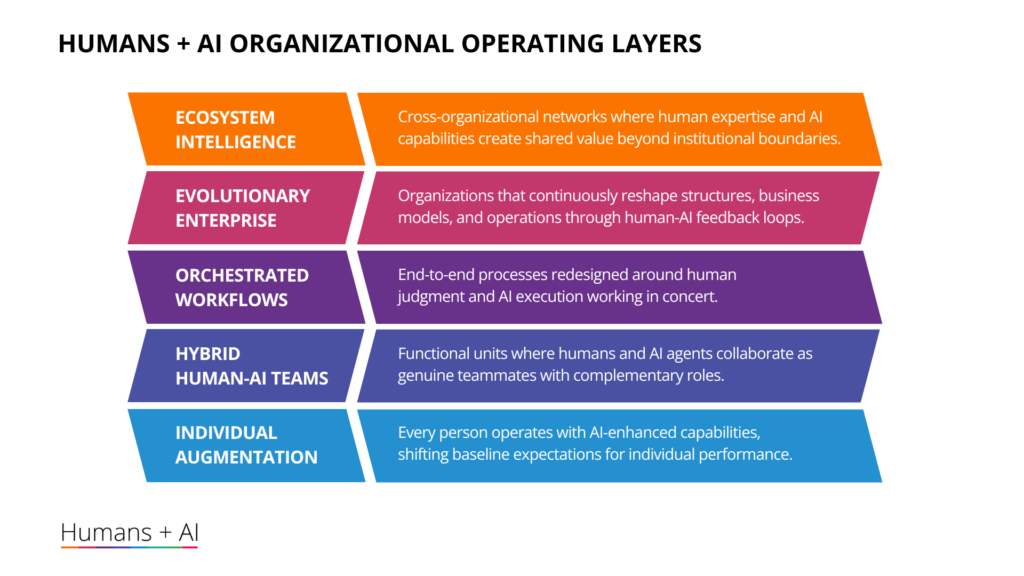
Click on the image for the full-size PDF.
Overview
A mature Humans + AI organization has to be designed at every level, not just equipped with AI tools at the bottom. This framework defines five nested layers at which an organization operates in a Humans + AI model, stacking from the most granular, the augmented individual, to the most expansive, cross-institutional ecosystems.
Each layer pairs a definition of what the layer is with four concrete actions to build it. Together the layers form an agenda for organizational design: augmenting every individual, forming hybrid human-AI teams, orchestrating workflows around human judgment and AI execution, evolving the enterprise continuously, and creating shared value across ecosystems.
The five layers
Ecosystem Intelligence
Cross-organizational networks where human expertise and AI capabilities create shared value beyond institutional boundaries.
- Determine where to collaborate and where to compete in emerging AI ecosystems
- Define trust frameworks for cross-institutional AI agent interaction
- Staff dedicated roles to manage ecosystem partnerships and AI interoperability
- Specify governance for data and intelligence sharing with external partners
Evolutionary Enterprise
Organizations that continuously reshape structures, business models, and operations through human-AI feedback loops.
- Deploy AI systems that sense shifts requiring structural or strategic response
- Generate and prioritize AI-driven hypotheses on organizational improvements
- Run rapid validation cycles for proposed structural and process changes
- Scale validated adaptations through dedicated acceleration pathways
Orchestrated Workflows
End-to-end processes redesigned around human judgment and AI execution working in concert.
- Map decision rights explicitly across human and AI actors
- Design escalation paths and exception handling into every workflow
- Define handoff protocols between humans and AI agents
- Track and optimize workflow performance as the primary metric
Hybrid Human-AI Teams
Functional units where humans and AI agents collaborate as genuine teammates with complementary roles.
- Assign accountability structures for shared human-AI work
- Specify complementary roles for humans and AI in all team activities
- Document team operating agreements for human-AI collaboration and learning
- Train team leaders to manage blended human-AI teams effectively
Individual Augmentation
Every person operates with AI-enhanced capabilities, shifting baseline expectations for individual performance.
- Provide AI tool access and training for every employee
- Rewrite job descriptions to focus on AI-augmented work and capabilities
- Embed structured programs for ongoing human-AI capability development
- Measure output quality and judgment, not activity volume
When to use it
Use this framework when setting an AI transformation agenda, when assessing how deeply AI is embedded in the organization beyond individual tool use, when deciding where the next phase of investment and capability building should focus, and in board and executive discussions on organizational design for AI. It provides a common language for locating initiatives at the right level and for seeing which layers remain unbuilt.
Related
- Framework: Levels of Humans + AI in Organizations
- Framework: Organizational Redesign
- Framework: Macro Workflow Roles