
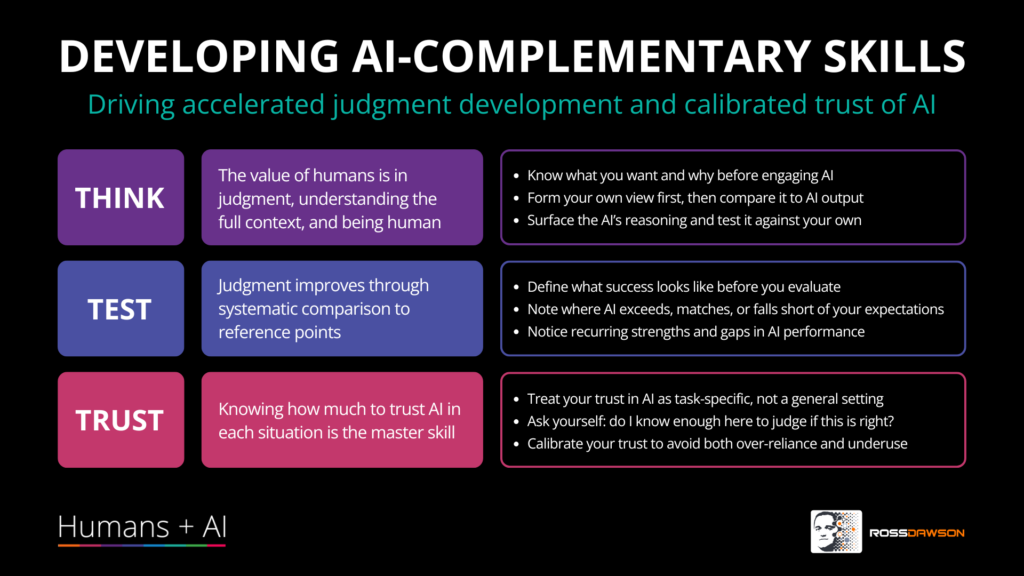
A three-stage model for building the human capabilities that complement AI, driving accelerated judgment development and calibrated trust of AI.
Click on the image for the full-size PDF.
Overview
As AI takes on more of the work of analysis, drafting, and execution, the capabilities that matter most for people are the ones that complement it. This framework sets out a three-stage progression for building those capabilities: Think, Test, Trust. The stages move from where human value sits, through the discipline that sharpens judgment, to the master skill of knowing how much to rely on AI in any given situation.
The progression is cumulative. Thinking for yourself first makes testing meaningful, and repeated testing against reference points is what makes trust calibrated rather than assumed. Each stage pairs a core principle with three practices that can be applied immediately in everyday work with AI.
The three stages
Think
The value of humans is in judgment, understanding the full context, and being human
- Know what you want and why before engaging AI
- Form your own view first, then compare it to AI output
- Surface the AI’s reasoning and test it against your own
Test
Judgment improves through systematic comparison to reference points
- Define what success looks like before you evaluate
- Note where AI exceeds, matches, or falls short of your expectations
- Notice recurring strengths and gaps in AI performance
Trust
Knowing how much to trust AI in each situation is the master skill
- Treat your trust in AI as task-specific, not a general setting
- Ask yourself: do I know enough here to judge if this is right?
- Calibrate your trust to avoid both over-reliance and underuse
When to use it
Apply this framework when designing AI capability development programs, when onboarding individuals or teams to new AI tools, when reviewing how people are actually working with AI, and when diagnosing over-reliance or underuse of AI in important decisions. It also serves as a personal practice guide for anyone who wants their judgment to improve rather than atrophy as they work with AI.
Related
- Framework: The Spectrum of Cognitive Impact of AI
- Framework: Domains for AI-Enhanced Thinking
- Framework: Success Factors: Humans + AI Teams