

Macro Workflow Roles maps the major roles that humans and AI each play in high-value knowledge work, distinguishing what to delegate to AI from what remains distinctively human.
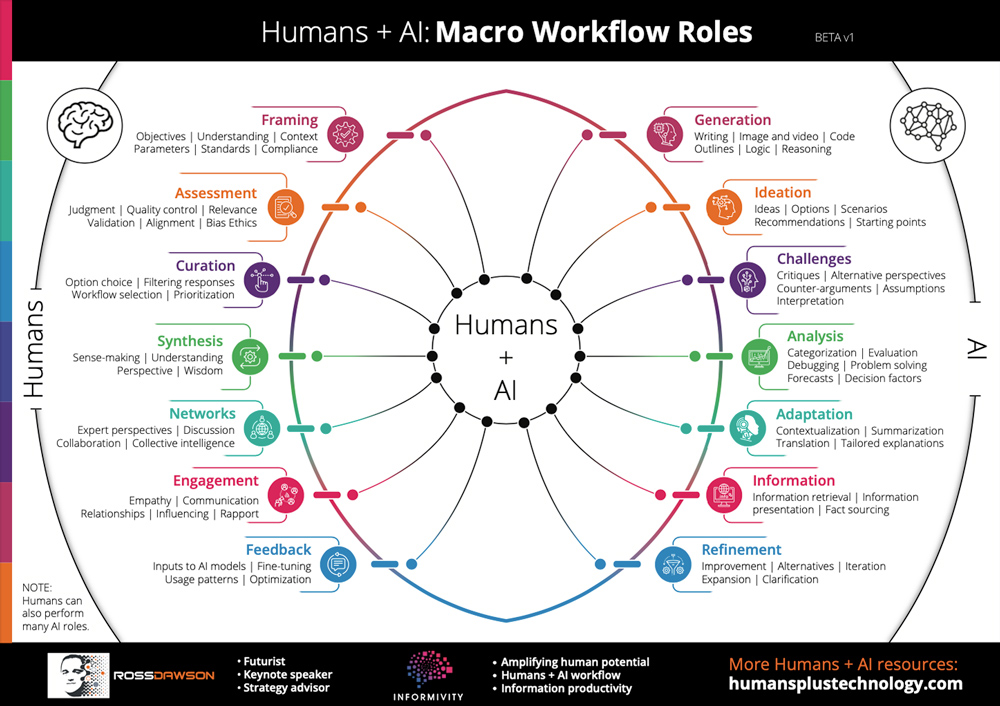
Click on the image for the full-size PDF.
Overview
Most conversations about applying AI to knowledge work move straight to tools and use cases without first establishing which kinds of work belong to the machine and which belong to the person. The result is either over-delegation, where judgment and context are handed to systems that lack them, or under-use, where AI is confined to trivial tasks well below its capability.
Macro Workflow Roles sets out the division of labour beneath high-value workflow. It groups what AI does well into seven roles and what humans contribute into seven complementary roles. The value lies in the pairing rather than in any single role: AI generates, analyses, and refines at scale, while humans frame the work, exercise judgment, synthesise meaning, and carry the relationships and accountability that AI cannot. Designing a workflow then becomes a matter of sequencing these roles deliberately rather than automating tasks piecemeal.
AI
Generation
Writing, Image and video creation, Code, Outlines, Logic, Reasoning
Ideation
Ideas, Options, Scenarios, Recommendations
Challenges
Critiques, Alternative perspectives, Counter-arguments, Assumptions, Interpretation
Analysis
Categorization, Evaluation, Debugging, Problem solving, Forecasts, Decision factors
Adaptation
Contextualization, Summarization, Translation, Tailored explanations
Information
Information retrieval, Information presentation, Fact sourcing
Refinement
Improvement, Alternatives, Iteration, Expansion, Clarification
Humans
Framing
Objectives, Understanding, Context, Parameters, Standards, Compliance
Assessment
Judgment, Quality control, Relevance, Validation, Alignment, Bias, Ethics
Curation
Option choice, Filtering responses, Workflow selection, Prioritization
Synthesis
Sense-making, Understanding, Perspective, Wisdom
Networks
Expert perspectives, discussion, collaboration, collective intelligence
Engagement
Empathy, Communication, Relationships, Influencing, Rapport
Feedback
Input to AI models, Fine-tuning, Usage patterns, Optimization
When to use it
Reach for Macro Workflow Roles when you are designing or auditing how AI fits into knowledge work: mapping an existing workflow to see which roles are already delegated and which are being neglected; deciding where to insert AI into a process without surrendering judgment or accountability; briefing teams on what to hand to AI and what to hold onto; and assessing AI tools or agents against the specific roles you actually need them to fill.
Related
- Insight: Applying the Meta-patterns of Humans + AI thinking
- Insight: 10 Case Studies: Humans + AI in Professional Services
- Framework: Workflow Principles
- Framework: AI Levels of Delegation