

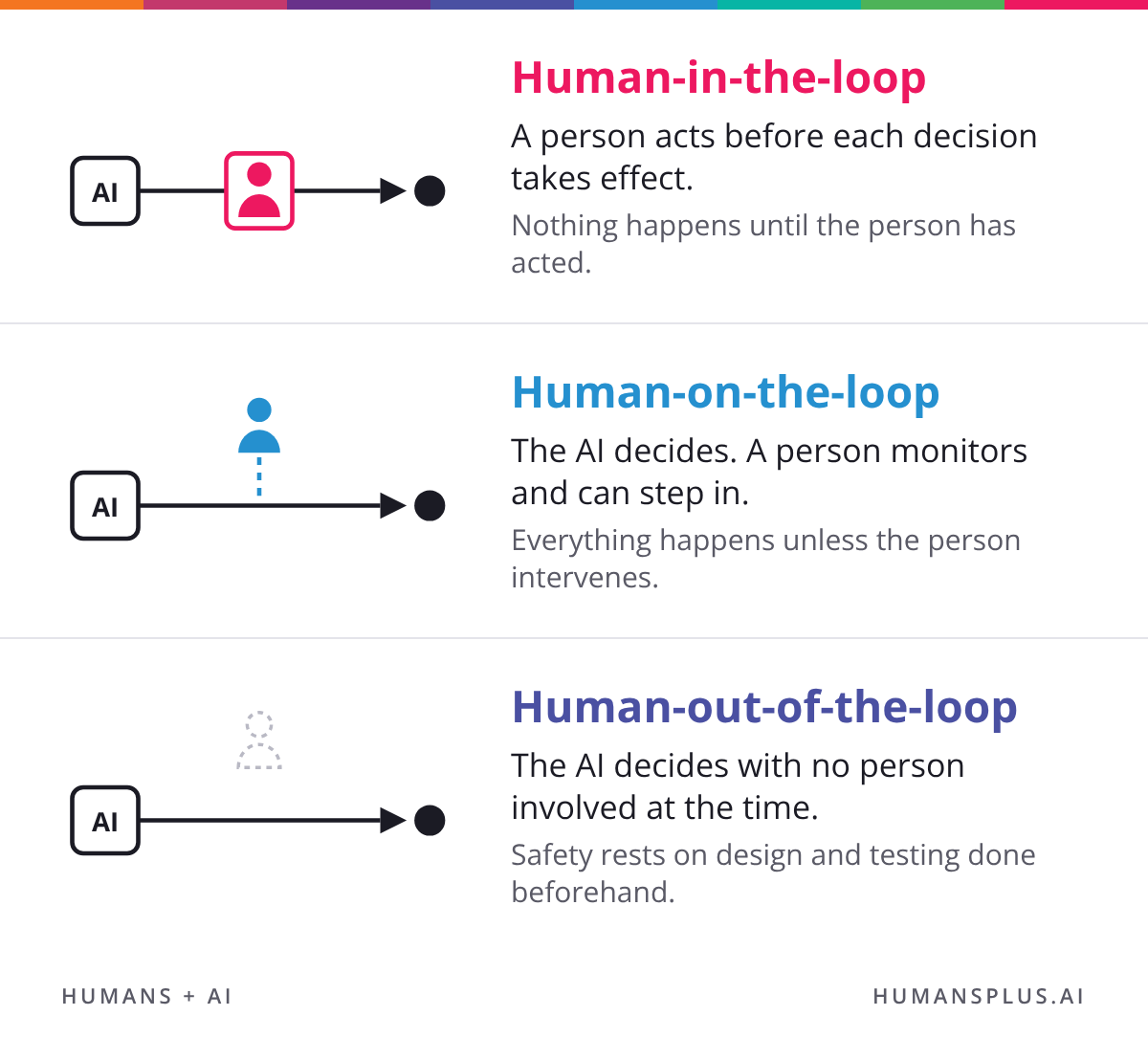
Human-in-the-loop (HITL) means a person takes part in each decision before it takes effect.
Human-on-the-loop (HOTL) means the AI decides and acts while a person monitors it and can step in.
The difference is when the person acts.
- In the loop: nothing happens until a person has acted.
- On the loop: everything happens unless a person intervenes.
- Out of the loop: the AI decides and acts with no person involved at the time.
The three positions side by side
| In the loop | On the loop | Out of the loop | |
|---|---|---|---|
| Who makes each decision | A person, or the AI with a person’s approval | The AI | The AI |
| When the person acts | Before the decision takes effect | Only when something looks wrong | Not during operation |
| What limits it | The person’s time and attention | The person’s ability to notice and react in time | The quality of the design and testing done beforehand |
| Where it fits | Decisions that are few, slow or hard to reverse | Decisions that are many, fast and recoverable | Decisions where an error is cheap and easily corrected |
Where the terms come from
The three terms came into wide use through the debate on autonomous weapons. A 2012 report by Human Rights Watch and Harvard Law School’s International Human Rights Clinic sorted robotic weapons into three kinds:
- those that act only on a human command
- those that act under a human supervisor who can override them
- those that act with no human input.
In 2019 the European Commission’s High-Level Expert Group on AI carried the terms into AI governance in its Ethics Guidelines for Trustworthy AI, which describe three levels:
- Human-in-the-loop: the capability to intervene in every decision cycle of a system. The group added that this is “in many cases neither possible nor desirable”.
- Human-on-the-loop: the capability to intervene while a system is designed and to monitor it while it runs.
- Human-in-command: the capability to oversee the whole activity of a system, including the decision on whether to use it at all.
The EU AI Act uses neither term. Article 14 of the Act requires that high-risk AI systems can be effectively overseen by people, then lists what those people must be able to do:
- understand the system’s limits
- stay aware of the tendency to over-rely on its output
- interpret that output correctly
- override it
- stop it.
The law asks what the person can do, which is a better test than which label applies.
In the loop usually means approval at the end
The phrase suggests a person woven through the work. In most deployments it describes one step: the AI finishes, then a person approves the result.
Those are different designs. The 12 Decision Levels in Decision Architectures run from a fully human call to a fully autonomous one. On the first six a person drives the decision. In the loop usually means one of the next two:
- Active approval: the AI produces a recommendation and a person actively approves it.
- AI with final approval: the AI produces the decision and a person confirms or blocks it before it takes effect.
A person who sees only the finished output, with no view of how it was reached, is in a weaker position to catch the errors that matter.
On the loop has a range of its own:
- AI with exceptions: the AI decides cases inside a defined band and hands a person anything outside it.
- AI with oversight: the AI decides every case and people control it by sampling.
At the last two levels, Autonomous within mandate and Full AI delegation, no person takes part in the individual decision. That is out of the loop.
How each one fails
Each position fails in its own way. One failure is common to both.
In the loop fails when approval becomes automatic. A person who approves hundreds of sound recommendations can stop examining them. This is automation bias. Article 14 names it. The control still exists on paper and no longer catches errors.
On the loop fails when monitoring is thin. The 2012 weapons report made the point early: supervision can be so limited that a system is out of the loop in effect. A person watching a fast system needs enough information, enough time and enough authority to intervene.
Both fail as skills fade. People who rarely do the work themselves lose the judgment that oversight relies on. A 2026 paper, AI Agents Push Humans Out of the Loop, by Margaret Mitchell and Avijit Ghosh of Hugging Face with Samir Passi of Data & Society, argues that current AI agent designs weaken human oversight, in part because extended use of AI erodes the abilities oversight requires.
Choosing between them
Four questions settle most cases.
- Can the decision wait for a person? If it cannot, in the loop is not available, whatever the policy says.
- How many decisions are there? A person can examine ten a day. Nobody examines ten thousand.
- Can a wrong decision be undone? The harder it is to reverse, the stronger the case for a person acting before it takes effect.
- Can the person tell right from plausible? A reviewer without the expertise to catch the error adds a signature and no safety.
The Expert Group’s rule of thumb still holds: the less oversight a person can exercise, the more testing and the stricter governance a system needs.
A better question than in or on
Both terms describe how far a person stands from a decision the AI makes.
The more useful design question is where human judgment adds most to the decision:
- in framing it
- in challenging it
- in choosing among options
- in approving the result.
That is a question about the division of labor between people and AI. It has more than three answers. The 12 Decision Levels in Decision Architectures set them out, with the rights, failures and safeguards at each level.
Related: Decision Architectures · Layers of Trust in Enterprise AI Adoption · Humans + AI Governance