
The fundamental elements of AI governance that enables organizational transformation.
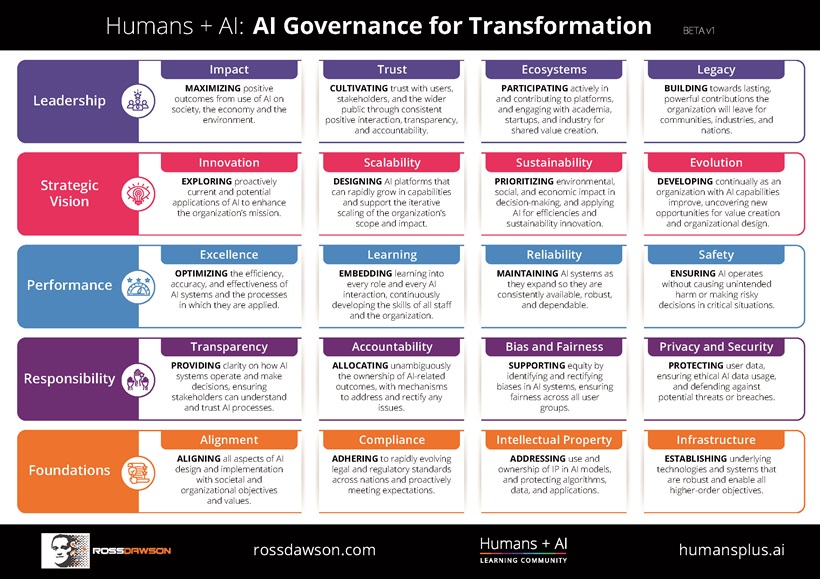
Click on the image for the full size pdf.
Leadership:
- Impact: Maximizing positive outcomes from use of AI on society, the economy and the environment.
- Trust: Cultivating trust with users, stakeholders, and the wider public through consistent positive interaction, transparency, and accountability.
- Ecosystems: Participating actively in and contributing to platforms, and engaging with academia, startups, and industry for shared value creation.
- Legacy: Building towards lasting, powerful contributions the organization will leave for communities, industries, and nations.
Strategic Vision:
- Innovation: Exploring proactively current and potential applications of AI to enhance the organization’s mission.
- Scalability: Designing AI platforms that can rapidly grow in capabilities and support the iterative scaling of the organization’s scope and impact.
- Sustainability: Prioritizing environmental, social, and economic impact in decision-making, and applying AI for efficiencies and sustainability innovation.
- Evolution: Developing continually as an organization with AI capabilities improve, uncovering new opportunities for value creation and organizational design.
Performance:
- Excellence: Optimizing the efficiency, accuracy, and effectiveness of AI systems and the processes in which they are applied.
- Learning: Embedding learning into every role and every AI interaction, continuously developing the skills of all staff and the organization.
- Reliability: Maintaining AI systems as they expand so they are consistently available, robust, and dependable.
- Safety: Ensuring AI operates without causing unintended harm or making risky decisions in critical situations.
Responsibility:
- Transparency: Providing clarity on how AI systems operate and make decisions, ensuring stakeholders can understand and trust AI processes.
- Accountability: Allocating unambiguously the ownership of AI-related outcomes, with mechanisms to address and rectify any issues.
- Bias and Fairness: Supporting equity by identifying and rectifying biases in AI systems, ensuring fairness across all user groups.
- Privacy and Security: Protecting user data, ensuring ethical AI data usage, and defending against potential threats or breaches.
Foundations:
- Alignment: Aligning all aspects of AI design and implementation with societal and organizational objectives and values.
- Compliance: Adhering to rapidly evolving legal and regulatory standards across nations and proactively meeting expectations.
- Intellectual Property: Addressing use and ownership of IP in AI models, and protecting algorithms, data, and applications.
- Infrastructure: Establishing underlying technologies and systems that are robust and enable all higher-order objectives.
Related reading: Professional Services Firms: 10 Humans + AI Case Studies. See how ten firms apply Humans + AI in practice.