
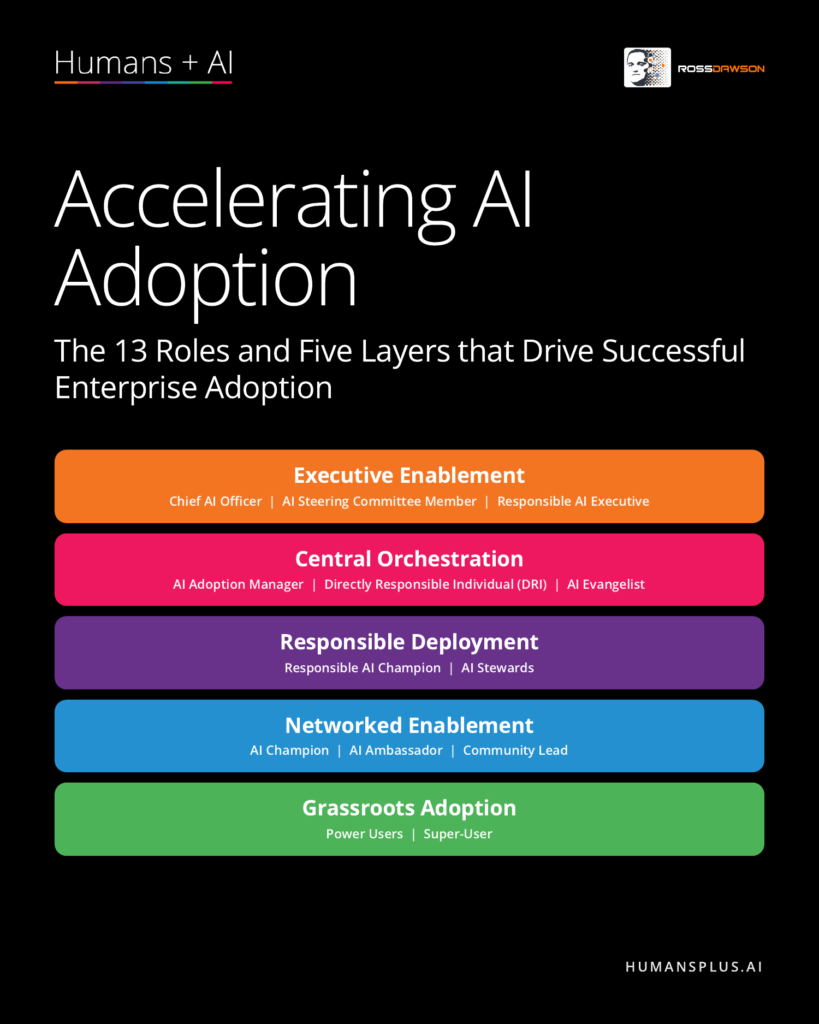
A framework mapping the thirteen roles across five layers, from executive accountability to grassroots power users, that make enterprise AI adoption work.
Click on the image for the full report PDF.
AI adoption is not about technology. It is about human and systems change, driven by leaders who set direction, owners who drive momentum, champions who spread practice, and early adopters who show what is possible.
This framework maps the five layers of roles that make enterprise AI adoption work. Together, they can turn experimentation into coordinated, responsible, organisation-wide change.
The five layers
- Executive Enablement: Accountable leaders and executives who own the strategic mandate for AI and carry ultimate responsibility for oversight.
- Central Orchestration: Adoption managers and directly responsible individuals who own the program and keep all other layers coordinated and accountable.
- Responsible Deployment: Roles defined by formal accountability for ethics, risk, and compliance, ensuring AI is deployed within organizational and legal boundaries.
- Networked Enablement: Formally recognized champions, ambassadors, and community leads operating within a structured adoption program.
- Grassroots Adoption: Organic early adopters and power users whose influence is self-directed rather than program-driven.
Layer 1: Executive Enablement
Accountable leadership and organizational oversight
This layer carries ultimate accountability for AI adoption. These are not program managers; they set strategic direction, ensure governance structures are in place, and are personally accountable for outcomes. The buck stops here.
Chief AI Officer
This role owns the organizational mandate for AI, ensuring it is resourced, prioritized, and aligned to business strategy. They are the visible champion of AI at board and leadership level, removing blockers that sit beyond the reach of program teams.
AI Steering Committee Member
These people provide cross-functional executive oversight, ensuring AI initiatives are coordinated across the organization and that risk, ethics, and investment decisions are made at the right level.
Responsible AI Executive
An important role that holds formal accountability for responsible AI at the highest level, signing off on governance frameworks and ensuring the organization can demonstrate compliance to regulators and stakeholders.
Layer 2: Central Orchestration
Program ownership and coordination
These are the program owners who translate strategic intent from the executive layer into consistent delivery across the organization. They design, coordinate, resource, and measure the adoption effort, keeping all other layers connected and on track.
AI Adoption Manager
This role commissions training, manages champion networks, tracks metrics, and reports progress to leadership. Hitachi’s structured AI adoption program pairs adoption managers with its ambassador and evangelist network to ensure central direction translates into consistent local delivery.
Directly Responsible Individual (DRI)
A named person with clear accountability for AI enablement outcomes, avoiding the diffusion of responsibility that often stalls programs.
AI Evangelist
A senior translator and storyteller who builds belief and momentum around AI at leadership level. Colgate-Palmolive’s global head of AI has been described in these terms, embodying a role that bridges executive intent and organizational action.
Layer 3: Responsible Deployment
Governance, ethics, and risk in practice
These roles are defined by formal accountability, not enthusiasm. Where Layer 4 spreads adoption, Layer 3 shapes and constrains it, ensuring AI is deployed within ethical, legal, and organizational boundaries. The mandate here is to flag risk, enforce policy, and maintain oversight.
Responsible AI Champion
These champions sit within product, technology, or business teams with a specific brief to ensure responsible use, providing policy guidance, identifying risk, and escalating concerns. Workday’s Responsible AI Champions are positioned across product and technology teams as the local accountability point for responsible AI practice.
AI Stewards
A role that carries broader formal responsibility for oversight, risk management, and lifecycle compliance across AI deployments. ServiceNow uses the AI Steward role to manage risks such as bias or data exposure across the full AI lifecycle.
Layer 4: Networked Enablement
Formally recognized peer and community roles
These individuals have been deliberately recruited or recognized as part of an organized adoption effort, with a remit and a connection back to central orchestration. Program membership is what distinguishes them from Layer 5, where adoption is self-directed.
AI Champion
This is the most common label for a formally recognized peer enabler, acting as a local go-to resource within their team, running demos, sharing tips, and feeding insight back to the center. Microsoft reports a community of nearly 10,000 Copilot Champions, while EPAM created a Champions of Change program with 50 regional Champions.
AI Ambassador
Ambassadors have more reach than champions, positioned as a visible messenger across functions or regions rather than a purely local helper. HSBC’s AI Ambassador Network is designed to build understanding of AI and responsible AI use across the bank.
Community Lead
Community Leads convene and sustain communities of practice that give the network its connective tissue, running internal channels and curating use cases. BCG operates a network of 1,200 employees dedicated to gathering AI feedback and sustaining peer-to-peer adoption momentum across the organization.
Layer 5: Grassroots Adoption
Organic early adopters and informal experts
These individuals have not been recruited into a program or given a formal remit. They are simply the people who adopt AI earliest and use it most heavily, becoming the informal go-to resource for colleagues. They are the natural pipeline into Layer 4.
Power Users
Power users are identifiable through usage data as the individual logging the highest engagement and pushing tools furthest. Vizient identified its formal AI champions directly from a pool of power users across departments, using usage data as the foundation for its structured network.
Super-User
This is closely related to a Power User, often describing someone who has begun informal peer-support behavior without yet being part of any formal program. Sumitomo’s Champion initiative drew on existing super-users across its workforce to seed a structured Copilot adoption program.
Download the report
Download Accelerating AI Adoption (PDF)