
The factors and principles that drive the success of human-AI collaboration in organizations.
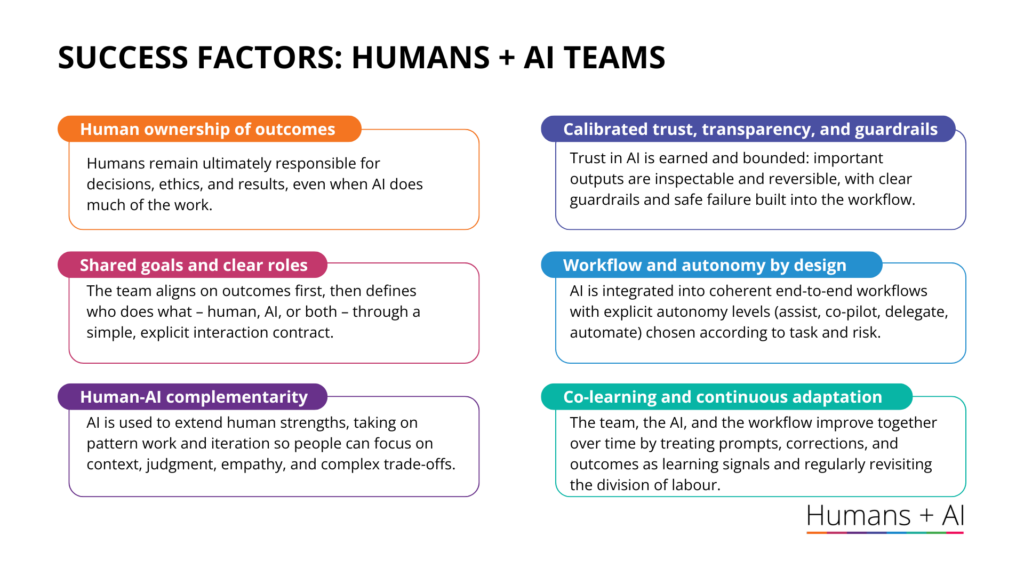
Click on the image for the full size pdf.
Success Factors: Humans + AI Teams
Human ownership of outcomes
Humans remain ultimately responsible for decisions, ethics, and results, even when AI does much of the work.
Calibrated trust, transparency, and guardrails
Trust in AI is earned and bounded: important outputs are inspectable and reversible, with clear guardrails and safe failure built into the workflow.
Shared goals and clear roles
The team aligns on outcomes first, then defines who does what – human, AI, or both – through a simple, explicit interaction contract.
Workflow and autonomy by design
AI is integrated into coherent end-to-end workflows with explicit autonomy levels (assist, co-pilot, delegate, automate) chosen according to task and risk.
Human-AI complementarity
AI is used to extend human strengths, taking on pattern work and iteration so people can focus on context, judgment, empathy, and complex trade-offs.
Co-learning and continuous adaptation
The team, the AI, and the workflow improve together over time by treating prompts, corrections, and outcomes as learning signals and regularly revisiting the division of labour.