
The Humans + AI Prompt Library is a curated set of 63 prompts for professional thinking work: framing a problem, analyzing a strategy, running research, shaping a story, and specifying software. Each prompt hands the model a method to work through rather than a question to answer. All of them are free to copy and use.
Most prompt collections are lists of requests. This one is a set of methods. A request asks the model for an answer and gets you whatever it produces first. A method tells the model how to work: what to decompose, what to challenge, what to hold constant, what to hand back to you undecided.
That distinction is the whole point. Used well, an AI model is not an oracle you consult but a thinking instrument you operate. These prompts are the operating instructions. They come out of the Humans + AI research program and the practice of the Humans + AI Explorers community.
Browse the library
- Problem Solving and Decision MakingFraming, investigating, generating options, stress testing a choice, and acting on it. The largest part of the library.33 prompts
- Strategy and Strategic AnalysisReading a situation, mapping a landscape, building scenarios from real uncertainties, and testing the path you choose.9 prompts
- Research and SynthesisStructuring a question, finding where to look, judging whether a source deserves trust, and pulling out implications rather than summaries.7 prompts
- Storytelling and CommunicationProfiling an audience, finding the one message that matters, shaping a narrative, and preparing for the hard questions.8 prompts
- Better PromptingPrompts that work on the prompt itself: role, audience, output shape, and self-critique before you read the answer.5 prompts
- Building Software with AIThe thinking that comes before the code: brief, personas, user flow, what a first version needs, and the build sequence.6 prompts
How to use these prompts
Copy a prompt into any capable AI model, then add your own material underneath it. Most of them are written to work on whatever you paste in: a plan, a draft, a decision you are weighing, a set of notes. The ones marked Assistant run as a conversation rather than a single exchange, so expect the model to ask you questions before it produces anything.
The prompts are deliberately short. They carry a method, not a script. Adapt the wording to your situation and the model you use.
How the library is organized
The prompts are grouped into six topics, which is how most people arrive at them. Underneath that sits a second structure that matters more: every prompt is tagged by the cognitive function it performs (framing, analysis, ideation, evaluation, synthesis, communication, research, cognition, action) and, where it applies, by the phase of work it belongs to.
The five phases run Frame, Investigate, Generate, Validate, and Act and Learn. Hard thinking moves through them in roughly that order, and it is usually the skipped phase that produces the bad outcome. Teams that jump from Frame to Act generate confident, untested decisions. Teams that never leave Investigate never decide anything. Each cluster page carries filters for both facets so you can find a prompt by the work it does rather than by its name.
Every prompt in the library
All 63 prompts, alphabetically. Each link opens the prompt in full on its topic page.
- Action Plan
- After-Action Review
- Assumption Audit
- Audience Profile
- Build-Prompt Generator
- Circuit Breaker
- Combinatorial Ideation
- Competitive Landscape
- Constraint Design
- Constraint-Driven Innovation
- Core Message Distiller
- Criteria Matrix
- Critique Me
- Devil’s Advocate
- Distillation
- Diverse Ideation
- Engagement Techniques
- Feature Prioritizer
- First Principles Breakdown
- Hook Generator
- Idea Improver
- Idea Synthesis
- Insight Extractor
- Knowns & Unknowns
- Landscape Map
- Mental Model Generator
- Output Designer
- Pattern Detection in Qualitative Data
- Persona Panel
- Perspective Debate
- Pilot Design
- Pre-Mortem
- Problem Decomposition
- Problem Diagnosis
- Problem Framing
- Problem Reframing
- Project Brief Builder
- Prompt Generator
- Prompt Improver
- Proof & Credibility
- Q&A & Objection Prep
- Research Question Tree
- Reversibility Check
- Role & Audience Setter
- Root Cause Analysis
- Scenario Analysis
- Scenario Stress-Test
- Second-Order Effects
- Self-Critique Loop
- Situation Analysis
- Source Credibility Check
- Source Discovery
- Spec / PRD Writer
- Stakeholder Analysis
- Stakeholder Critique
- Story Structure
- Strategic Options Generator
- Systems Analysis Sequence
- The Architect’s Lens
- Useful Metaphors
- User Flow Mapper
- User Personas
- What’s Missing
AI skills
Alongside the prompts, the library holds a curated set of AI skills for human augmentation: larger reusable capabilities you install into a model rather than paste into a chat, each with a note on why it is worth your attention.
Common questions
What is an AI prompt library?
A prompt library is a curated set of reusable instructions for AI models, organized so you can find the right one for the task in front of you. This one holds 63 prompts for professional thinking work, grouped by topic and tagged by the cognitive function each performs.
Are these prompts free to use?
Yes. Every prompt on these pages is free to copy, adapt, and use in any AI model, including in commercial work. Attribution is welcome but not required.
Which AI model do these prompts work with?
All of them. The prompts specify a method rather than exploiting features of a particular model, so they work in ChatGPT, Claude, Gemini, and any other capable model. Prompts marked Assistant are written to run as a conversation, so they suit models that hold context well across a long exchange.
How do I choose the right prompt?
Start from where you are in the work rather than from the topic. If you cannot state the problem cleanly, you need a framing prompt. If you have too few options, you need a generation prompt. If you have a decision you are uneasy about, you need a validation prompt such as Pre-Mortem or Devil’s Advocate. Each cluster page lets you filter on exactly that.
Can I contribute a prompt?
Yes. Prompts contributed by members of the Humans + AI Explorers community are published here with named attribution. The community is where contributions are gathered and discussed.
Contribute to the library
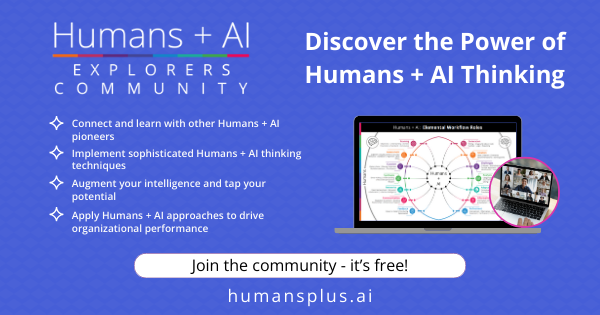
- Members of the Humans + AI Explorers community share prompts that are published here with named attribution. Join to contribute yours.