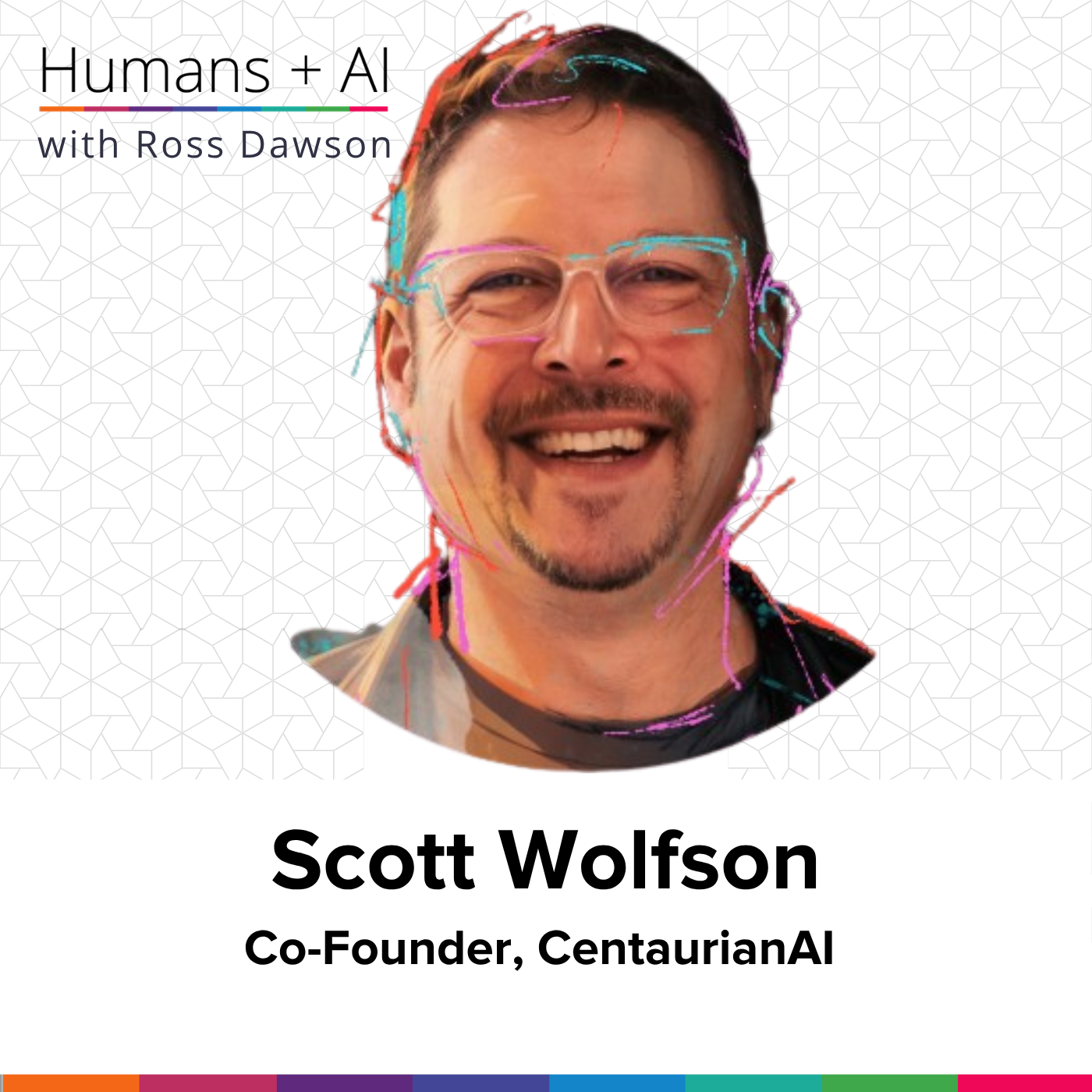


"Our mission at CentaurianAI is to help as many people as possible not get replaced by AI, and we call that becoming unbottable."
–Scott Wolfson

About Scott Wolfson
Scott Wolfson is Co-Founder and Chief Culture Officer of CentaurianAI. Previous roles include Managing Director of consulting firm Valize, Senior Strategy Director at BCG, and guest lecturer at Columbia Business School and Harvard Business School.
What you will learn
- Why becoming 'unbottable' matters in the age of AI and how to future-proof your skills
- How the concept of Centaur chess inspires productive human-AI collaboration
- The importance of cognitive fitness vs. cognitive atrophy when working with intelligent machines
- Practical cognitive exercises like brain dumping and ignorance mapping to boost independent thinking
- The 'think, prompt, check' process for effective AI integration and decision making
- How mastery skill games and playful learning can unlock deeper engagement and skill acquisition
- The role of motivational intelligence in uncovering your unique value and leveraging AI tools
- Why collective, connected intelligence will shape a protopian, wisdom-driven future alongside AI
Episode Resources
Transcript
Ross Dawson: Scott. It is so good to have you on the show.
Scott Wolfson: It is an absolute pleasure and privilege to finally have this conversation on the record with you, Ross.
Ross Dawson: Awesome, so you have a mission you were just saying to help make people unbottable. So, what does that mean?
Scott Wolfson: Well, you know, this is, I think, the existential crisis that so many people have been facing and feeling and fearing since at least ChatGPT dropped, and maybe not, you know, November 30 of 2022 but in the ensuing years people have become afraid that they are going to be replaced by AI, and so, as you said, our mission at CentaurianAI is to help as many people as possible not get replaced by AI, and we call that becoming unbottable.
Ross Dawson: So, Centaurian, that's so... that's, I mean, yeah, I think most people are familiar with the term, but let's just dig into that for a minute.
Scott Wolfson: Well, let's be honest, Ross, it's difficult to spell, and it's difficult to say, and for some... and I dare say I think your audience is probably familiar with the origin story of Centaur chess, you know, Garry Kasparov getting beat by Deep Blue back in 1997. Maybe there was some funny business going on—IBM has still not released those records—and in that notion, when he created this freestyle chess tournament that allowed any chess grandmasters to join with any computer, the winner was not Garry Kasparov with the best AI. It was two average chess players with three average chess computers. It was humans plus AI. It was humans plus a better process that actually beat a grandmaster.
We believe as we enter the wisdom economy from the knowledge economy that people are going to need to become grandmaster-level thinkers at all sorts of cognitive domains, because more and more of the lower-level cognitive work is being offloaded, rightfully so, to machines. But it's the difference between cognitive fitness and cognitive surrender, or cognitive atrophy, as you've been talking about, and as we like to say, we're giving birth to the cognitive fitness industry. You talk about cognitive fiction, cognitive friction. What we talk about is you've got to feel the learn—flow is not learning. If it's easy, you're not learning. You've got to earn dopamine to really feel the learn.
Ross Dawson: So just—I mean, I do have to bring this up—that the, yes, I don't, I do talk about the centaur chess, and the point there was the process was the process, and the way that you pulled them together, but I mean, there's still the, the unfortunate point is that eventually they were beaten by AI alone, and I guess part of the point there was that even, yes, centaur chess did beat human or AI for a while, but then AI transcended it. But it was a bounded domain, and so that's just the domain of chess, which is a narrow area, but I mean, I still think we need to be—there are plenty of naysayers out there who just say AI is just gonna beat us on everything anywhere. So, what's your response to that?
Scott Wolfson: Look, chess is still not beaten—AI has not beaten chess. Yes, AI has beaten human chess players, AI has beaten human Go players. Neither chess nor Go is solved, even though they are bounded and closed systems. They are games, they're good thinking games, as Demis Hassabis says. What AI has enabled us to do, especially when you look at something like AlphaZero, and you have someone like Magnus Carlsen, who has discovered new kinds of moves by playing against and losing to AI—same with Lee Sedol. So that hasn't been solved, and to me it proves the point that Humans Plus AI, the name of your podcast, which is totally aligned with our mission around helping people become unbottable, that appears to be the best path to the future.
Ross Dawson: Yeah. Oh, you know, I completely agree with that. So, so there's a lot of phrases being bandied around, you know, with cognition in them and cognition, cognitive fitness. I think I really like that. So, tell me more. What are the exercises? Or what do we need, or what are the pills we need to take to get us going into fitness?
Scott Wolfson: Ross, I sure wish there were just some pills we could take, or something like the Matrix that we could just directly and immediately download into our brains without the buffering speed. Even listening to an audiobook at 3.5x is good, but it's not quite what they showed us in the Matrix, and honestly, I don't want to just take a pill.
And when we talk about the cognitive fitness industry, when you think about the origins of the physical fitness industry, it came out of the industrial revolution. When we got machines that could take care of physical labor, well, look, we couldn't have foreseen, or we didn't foresee, the unintended consequences of an obesity epidemic. And now when we've got these intelligent machines, these smart machines—we call it System Three, to complement System One and System Two in our brains—as we are seeing in research studies, and you're putting a lot of these out there, if you offload thinking to machines, your brain essentially gets fat, lazy, and stupid.
So when you ask about the exercises you do, this is why we talk about think, prompt, check, and we say you've got to spend 45% of your time thinking, a little bit, 10% of your time prompting, and 45% of the time checking. It's not about being the human in the loop—the human is the loop. And so it's exercises, especially the thinking of brain dumping and ignorance mapping and question storming, and using things like retrieval practice and interleaving and spaced repetition and elaboration and dual encoding—things that we know have been shown and proven to help increase what we call cognitive fitness.
Ross Dawson: Fantastic. So, you reeled off this long list of techniques. So, let's unpack one or two of those.
Scott Wolfson: Well, let's go with the first two, because they are our tried and true. As Kes Sampanthar, my co-founder and my best friend, but my co-founder of CentaurianAI, our CEO, likes to say, this notion of brain dumping and ignorance mapping— it's like the burpees of physical fitness, but for cognition. We also liken it to the real Feynman technique.
So, before you ever touch a keyboard—and I will make a play for System Zero, writing things down outside of your brain, the extended mind, like Andy Clark talked about—do brain dumping and ignorance mapping. I've got to recommend doing it with a pen or something that you hand write. There have been some studies that show that increases engagement, and before you ever touch a keyboard, spend a little bit of time brain dumping the things that you know and that you think you know about your problem. Then spend some time ignorance mapping, writing down the things you know you don't know—that's the real Feynman technique.
Unfortunately, Scott Young kind of watered it down when it was like, "Oh, just teach it to somebody like you're five." Now what you're doing is you're actually tapping into System One, you're pulling up from the unknown known, as Polanyi said. We know more than we can tell. What we have found, and neuroscience and cognitive science and evolutionary psychology bear this out, is that when you do brain dumping—the known known—it starts tapping into what else do I know about this, and while you're incubating that, you write down the things you know you don't know, your known unknowns.
You intentionally create information gaps, and writing questions—that's the best way to communicate between System One and System Two. Questions, we like to say, are like the API to our brain's more powerful processes. So those are two that I do on the daily, multiple times a day. This is what we teach and preach, from Columbia Business School to KPMG.
Ross Dawson: Excellent. So, this is then the starting point. So, again, talking about process, I think that, you know, the sequence is very important, and I think, you know, varying the sequence as well. So, I talk about the Humans Plus AI workflow, as in, sorry, what is the alternation? What does humans do? What does AI do? And, yeah, yeah, there are things in parallel, but basically, time is relatively sequential, so it's like, say, well, if you are a human, single human, as you're talking about, you're getting your own fitness going, it's a sequence of things. So what you're suggesting is this is before you touch a computer, or before you're touching AI, you are doing these exercises?
Scott Wolfson: Exactly. It is, you know, being the human loop, not just being the human in the loop, or as you noted recently, you know, just being a checker, you know, just like approaching AI like it's an answer machine, and then looking at what it gives you, and then going, "Yeah, all right, yeah, seems legit." It's easy enough to get fooled by that, because this is one of the most incredible tools for self-reflection I think we've yet created. It is a fascinating mirror, but you've got to put your thinking in, tap into the large language model in between your ears, if you're going to get anything of value out of generative AI. Otherwise, you are going to get AI slop.
Ross Dawson: So, let's go to that. So, you've obviously got some, you know, you've heard something about what I've been saying around human in the loop or human at the end, and so I'd love to just hear your thoughts around if we've got a process. Let's say you've got a decision—you know, the world is full of decisions, small and large, and basically for every single decision humans should be involved, and very likely AI should be involved as well. So do you have any reflections on any aspect at all of that process, on where it is good for humans to be placed within that, within the decision, obviously, depending on the decision?
Scott Wolfson: Well, again, my strong opinion, loosely held, is that humans should be the ones making the decisions and taking action. But to your question about decision making, in the work that we've been doing with leaders, this notion of leading with machines, it comes down, in my humble opinion, to jobs to be done. What kind of decision are you trying to make? What are you actually trying to do? And for leaders, there's usually three sorts of things that they're trying to do. Are you trying to build understanding? Are you shaping your choices, or are you making decisions?
And when you get to that third and final step, if you've done the work ahead of time—right, this is think, prompt, check at almost a fractal level—when you are making decisions, AI, the way that we've been using it, three key ways: explore, simulate, and test. Because what AI gives us the ability to do—we call them strategic imagination machines, simulations, or sims—it is using the hallucinations, it is exploiting the feature of this incredible new general purpose technology to help us imagine what could be, and do that at a scale and speed that our primate brains can't quite do. So that's how we've been using it, how we've been teaching, how we've been coaching the leaders that we've been working with.
Ross Dawson: Love to dig into that. So, you know, you've mentioned in passing the workshops you do with senior leaders, where you take them through processes involving AI and talking about these simulations. So, let's bring this to life. What's it like sitting in that room? Because I've got these physical things, okay, sitting there, and you run a simulation, so what's that experience like?
Scott Wolfson: Well, before we run the simulation, it's think, vibe, check in this case, because we got them hands-on with some of the more advanced frontier tools like Manus and Lovable to show them what's actually capable, and these were tools that were not currently available inside the walls of their organization. And I've got to tell you, Ross, to see some of the most successful and most intelligent consultants on the planet—you know, these are not just big leaguers, these are hall of fame level leaders—to see them experience the same kind of giddiness that I have experienced on a regular basis since early December of 2022 when I first got hands-on. It's extraordinary.
And what we do with them, it is think, vibe, check, and they do the thinking on canvases, on physical canvases, not on keyboards. We saw them glazing over and getting lost, so we actually have them hand write stuff, take photos of these canvases that they fill out, upload them into GenAI, and then they've done the thinking, and then they actually get to experience that magical feeling. You know, as Kez and I like to say, AI is not magic, but it sure does feel magical if you use it in the right way, and then they check the outcomes, so they get that experience, and it has been transformative, Ross, because these are folks who are making business cases for very significant investments in AI, and to see the unlock and not only what it could mean for their organization and for their people, but for them personally in their professional, in some cases personal lives. That's when I get goosebumps. My KPIs are, "Oh, wow," like, "holy shit," like those are the moments I live for. When you see those light bulbs not just light up but just explode.
Ross Dawson: So what you're saying is you're getting these people to have some poster or something, and you're writing on it or drawing on it, and you're creating this landscape of what it is you're working on. Then you take a photo of it, then you upload it to the machine and get it to give you some—then a simulation from that, or what?
Scott Wolfson: So then that's where we add in a little bit of the scaffolding, and we've developed a lot of very complex—we call them meta prompts, all those self-unpacking prompts. So then, you know, and these are leaders who don't have time to learn the latest in prompt hacking or prompt engineering, so we have them do the hard part, do the thinking, engage in the cognitive friction, feel that, learn, then do something that's nice and magical, upload a photo. We actually have them take photos, or they can copy the text in a soft copy into a generative AI tool, and that's where the magic comes together.
And then it guides them through a few more questions. This is, you know, like those self-reflective prompts again, unpacking, and it brings in more of their thinking, their expertise, their experience, and then it will create any kind of simulation that they've guided it towards. So they've been able to, in the matter of, you know, not weeks or days, but literally hours, go from thinking about an idea for a new strategy or a new value-added service, and then actually running a simulation of how it might perform in the market.
Ross Dawson: Okay, fantastic. So it's not a scenario, it is actually a simulation tool where you can go in and do what-ifs within it.
Scott Wolfson: Yeah, this is—we like to say it's like scenario planning on steroids, you know. Pierre Wack with his four, you know, two by two. I think this is the kind of thing that he dreamed of when he was doing scenario planning at Shell.
Ross Dawson: So, one of the other themes that you talk about a lot is play, which obviously we've already been talking about in many ways. So there's plenty of people saying, you know, how do I learn to use AI, you know, or I'm already good and trying to work out what to do next, so—well, I mean, maybe, maybe putting words in your mouth and talking about play there, but what, how—what are the things that people should be doing, or how do we, how do we make this something which we want to be doing as well?
Scott Wolfson: Well, you know what we're doing with it in particular is we are creating what we call mastery skill games. Ultimately, we're building out this creator platform for something along the lines of Roblox for skills or roadblocks for learning games, because our brains are evolutionarily hardwired to learn skills through play. When you look at mammals, you know, when you look at lion cubs play fighting, or you look at bunny rabbits doing the zoomies, what they are doing—it looks like play. It is training their unconscious, their System Ones to be able to elude predators when they're prey, and to be able to attack when they are predators.
And so we've taken the neuroscience, the cognitive science, the evolutionary psychology, and the science of learning, and realized that we took a hard turn from learning and teaching knowledge, and that has worked very well until knowledge got commoditized. And so what we have realized is that the best way to learn both knowledge and skills, and in particular skills that are unbottable, is through play. So in terms of how do I get people to engage more with AI, I invite them to bring their curiosity, to bring their sense of playfulness, and engage with it, and ask it, "How can I use you?" Right, it amazes me that generative AI— I've likened it to Gutenberg creating the printing press that also taught people how to read at the same time—that would have been remarkable, but it was hundreds of years before we hit literacy rates.
Ross Dawson: Yeah, yeah, and so on one level it seems very straightforward, but people still—many adults find it difficult to play, and so it's one thing to say, you know, play with it, and I think that's very, very sound advice. But we also need to get people to shifting their frames, and I guess, you know, that's part of a bit of a macro thing—seems almost beyond the AI, where we need to, as a society, be one where we can play more, because the old being in the groove, which has been given to you by a job or whatever, is not going to get us to where we need to get to.
Scott Wolfson: Well, you know, I love that saying—I think it was George Bernard Shaw who said, you know, we don't stop playing because we get old, we get old because we stop playing. Play absolutely engages our brain. The best thing that you can do to increase your longevity is to constantly learn new things, and when we talk about games and we talk about play, we're talking to some of the senior-most leaders of some of the largest organizations on the planet, and we walk them through the rationale and the business case for play, and once they experience it, that is, you can't not feel it.
So, you know, that notion of fool around and find out, you know, ask yourself, what are the things that you do that you don't have to do? A lot of people will say, "Oh, I'm not a gamer." Well, what kinds of games do you like to play when you get together with friends? Do you play games? "Oh, yeah, yeah, I play mahjong or canasta, or I like Settlers of Catan, or I like Connections from the New York Times." Let's start there. You know what AI can help you do? It can help you create a game like Connections or Mahjong, based on a subject matter that you're interested in. Create your own game. What is it you want to learn? What questions do you have? It is just... it's such a fun tool.
And to me, you know, if you want to know, like Steven Johnson talked about Wonderland, if you want to know where the future's going, go to where people are having the most fun. So, yeah, there's serious work going on, and people finding all sorts of agentic workflows to spin up, but look at the fun that people are having with generative art, and videos, and games, and vibe coding. That's where we try to help entice people too, because once they experience it, they start to realize how you can think differently with this technology, how you can learn, and how you can play to actually increase your value and create more value in the world.
Ross Dawson: Yeah, that's—I have a very, very deep belief in a human uniqueness, that we're all far more unique than we, and most people have an inkling of, you know, and society sort of just makes us, you know, pushes us all the way through to be more and more the same, but that papers over our uniqueness, and it is very likely in play that, you know, we start to uncover more of what is unique about us, which is what will be valuable in this emerging world, because having a bunch of drones might have been useful back in the last century for organizations, but that's not really going to be very helpful moving forward.
Scott Wolfson: No, no, absolutely not. You know, I like to say your weird is your wow, especially in the wisdom economy, and we help people understand something that we call motivational intelligence. The underlying driver of all human behavior is motivation. We've got five motivational drivers—two are social and three are learning, right? We've got social competition and social cooperation, and we love, we are driven by mastery, curiosity, and exploration, and the shadow side. There are offsetting fears, and what we found is when we help people understand what motivates them, you know, what their approach and avoid drivers are, what is underneath their seeking system, then guide them towards helping to understand how the games that they love map to their motivations.
Again, these are things that—you know, we play games and sports, recreation, hobbies. Those are things that we don't have to do. You know, human needs, they're finite, but wants are infinite. And if you can understand why you want what you want, you can start to better understand how you can really use this remarkable new technology to augment yourself, to amplify your cognition, and be a human that is the loop with AI.
Ross Dawson: So we've been talking about individuals and organizations. Let's pull it up to the bigger level of society and humanity. So, you know, I think everything you've been talking about applies at that level, but let's think about the journey of what we must become, or how do we get there, how do we shift ourselves as a society, or societies, to one which is necessarily humans plus AI? And we certainly got the humans, and we definitely got the AI, and it's not going away. So we do live in a humans plus AI world. So, how do we make that as positive as possible?
Scott Wolfson: Well, that's where we like to say that we're doing our best to start a protopian movement. You know, the future is not black or white, it's not dystopian Terminator Skynet, it's not that—well, what is utopian for some, like in Wall-E, where we're just floating around on a cruise ship in the sky. It is like Kevin Kelly talks about, it is protopian, it is through incremental steps that we will collectively create the future.
Another strong opinion loosely held: the future has always been and always will be better than we can possibly imagine. And the way we do it is exactly what you're doing, Ross, with your podcast, with the work that you do, with the community that you create. If you want to go fast, go alone. If you want to go far, go together. And so, to me, like Joe Henrich talked about, the secret of our success is that we are humankind, and we are both, you know... yeah, there are some outliers, but you know, there's a very tiny percentage of the population that is cynical and sociopathic, but at least 80 percent of us are good. I believe in the better angels of our nature, and I know that collectively the future that we co-create, this wisdom economy, as we're calling it, is going to be so much more awesome than I can possibly imagine. So the way that we do it, I think, is exactly again what you're doing and what we're trying to do with CentaurianAI.
Ross Dawson: As in bring, bring people together on the journey?
Scott Wolfson: Exactly—find ways to help people think, learn, and connect together. Those are three things that, unfortunately, our industrial era education system didn't really teach us how to do right. It didn't teach us how to think or how our brains work, not what to think—I think a lot of schools try to do that. It didn't teach us how to learn or how our brains learn, not really. Rote memorization, come on, testing is the best learning tool, not one to grade people on. Pooja Agarwal has been trying to get retrieval practice to be a thing for a couple of decades just in education, and we weren't taught how to connect, how to meaningfully connect as humans, and we've seen some of the casualties with this anxious generation coming out of Covid that was cut off socially for a few years.
And so part of what really excites me about the promise of this new technology is the potential to bring people together and help us really expand this, what we call System X, our augmented collective intelligence. You know, we've wired up our prefrontal cortex on the global brain. Let's kick it into high gear, and let's give it, you know, maybe an Ironman suit, not just a bicycle for that mind.
Ross Dawson: So, so, so that's, you know, that's another level again, in terms of the collective intelligence, collective intelligence structure. So, a lot of what you've been talking about is around how the individuals use the tools. So, what are some of the structures—again, I think it is process and structure, and that enables it. What are some of the tools? How do we enable that collective intelligence? Because, for example, decisions—many decisions should be made collectively, and if they are designed well, they will be better made collectively. So, how can we best tap that?
Scott Wolfson: Well, before I fast forward into the web3 world of my dreams, where we've got permissionless decentralized trust systems that help take care of things that we've tried to solve with all sorts of systems and monetary policies and governance policies—I think I don't know what it's going to look like. I will share something, though. This is a nascent hypothesis. I like to call it a thoughtlet. And Ross, you're somebody who saw social networks, you know, back in the early 2000s. You saw how that could play out. Now we saw social networks transform into social media. I've got this initial nascent hypothesis that we're seeing the birth of what I'm just calling learning networks, and I do think that we're actually already seeing learning media—you know, the future is already here, it's just not evenly distributed.
Look at the growth of learning media on YouTube, the amount of time that kids and people of all ages are spending with Duolingo, that people are learning so they can build stuff on Roblox. Roblox has taken up 65% of Netflix's streaming time. It is mind-boggling. So, we believe that, and this is why Kez and I are finally going out—we've hit the point where we can't bootstrap anymore. We've got to blitzscale, and we've got to fund this creator platform that we're going to build, so that we can democratize genius. We like to say GenAI plus us is democratizing genius, not just democratizing knowledge and expertise like GenAI has done already. So that's how I think we're going to get there. I don't know what that looks like, but I know that we're going to build it together.
Ross Dawson: So you are envisaging a platform, and you're raising money for it.
Scott Wolfson: Yep!
Ross Dawson: So tell me a little bit more.
Scott Wolfson: Well, it's a multi-sided platform business model, and we are just whipping up our first pitch deck. We've bootstrapped for two and a half years, and we've hit the point where, look, there is no such thing as bad publicity, and we got some unexpected, really amazing publicity with an article in Business Insider and Fortune magazine about Tax Sim, the simulation platform and games that we're building with KPMG, and now that that's out, we realize, okay, we might finally start to have some competition.
So we're at the point where we are starting to raise, so that we can build out this platform, which is going to include new kinds of world models. You know, we've got these amazing LLMs, but they're just word models, they're like the shadows on Plato's cave, and we see that there are other brilliant minds chasing after world models—you know, Demis Hassabis and DeepMind down to the cellular level and trying to build truly artificial life, Fei-Fei Li, Yann LeCun—and as I like to say, Ross, they forgot about the people, and so those are the world models that we're going to model out, modeling out and simulating out things, you know, working with folks like Santa Fe Institute and Doyne Farmer to build out full-scale capital markets simulations and environments, along with those that are based on how humans actually behave. We've got enough compute that we can actually simulate the entire economy down to individually motivationally driven agents, and that's what we're going to build out. That will be a part of building out this platform for very realistic sims, so that people can learn, practice, and master the new kinds of skills that are necessary in the wisdom economy.
Ross Dawson: That sounds awesome, and I expect to, and look forward to hearing more about it.
Scott Wolfson: You absolutely will. If there's anything I think you know about us, Ross, when it comes to being loud, it's not just my shirts—Kez and I love to share what we're working on. We believe that ideas should be free, and we are trying to create as much unfair value as we possibly can. That's how we enable mass flourishing and radical abundance. It's through shared wisdom, it's through games and tools that help us think and learn and connect and lead and create the future together.
Ross Dawson: Yeah, well since first time I came across you, you and Kez's work very early in the journey here, I've been great admirers, you know, very much kindred spirits. Absolutely love what you're doing and how you're doing it. So, how can people find out more about what you're doing?
Scott Wolfson: Well, they can certainly go to centaurianai.com. Again, tricky to spell, tricky to say, but easy to love. If you want to try an example, an early proof of concept of one of these mastery skill games that we've created, we created one to give us reps on what we're actually doing—we like to say everything's better when it's meta. So, we created something we call Startup Valley. So, startupvalleygame.com is a complement to centaurianai.com.
At centaurianai.com you can create your own motivational intelligence profile for free, that'll help you better understand what it is that motivates you and what is uniquely you that you bring to thinking with machines, and startupvalleygame.com can drop you in what it's like to do what we're doing and create something from nothing, go from zero to one, and see if you can survive the 12 weeks of Startup Valley. So, a couple of ways that folks can learn a little bit more, and of course, as you know, we love asynchronously collaborating with you on LinkedIn. Kez and I are both very, very active on LinkedIn, so check us out there as well.
Ross Dawson: Fantastic, thanks so much.
Scott Wolfson: Thank you, Ross.
Podcast: Play in new window | Download