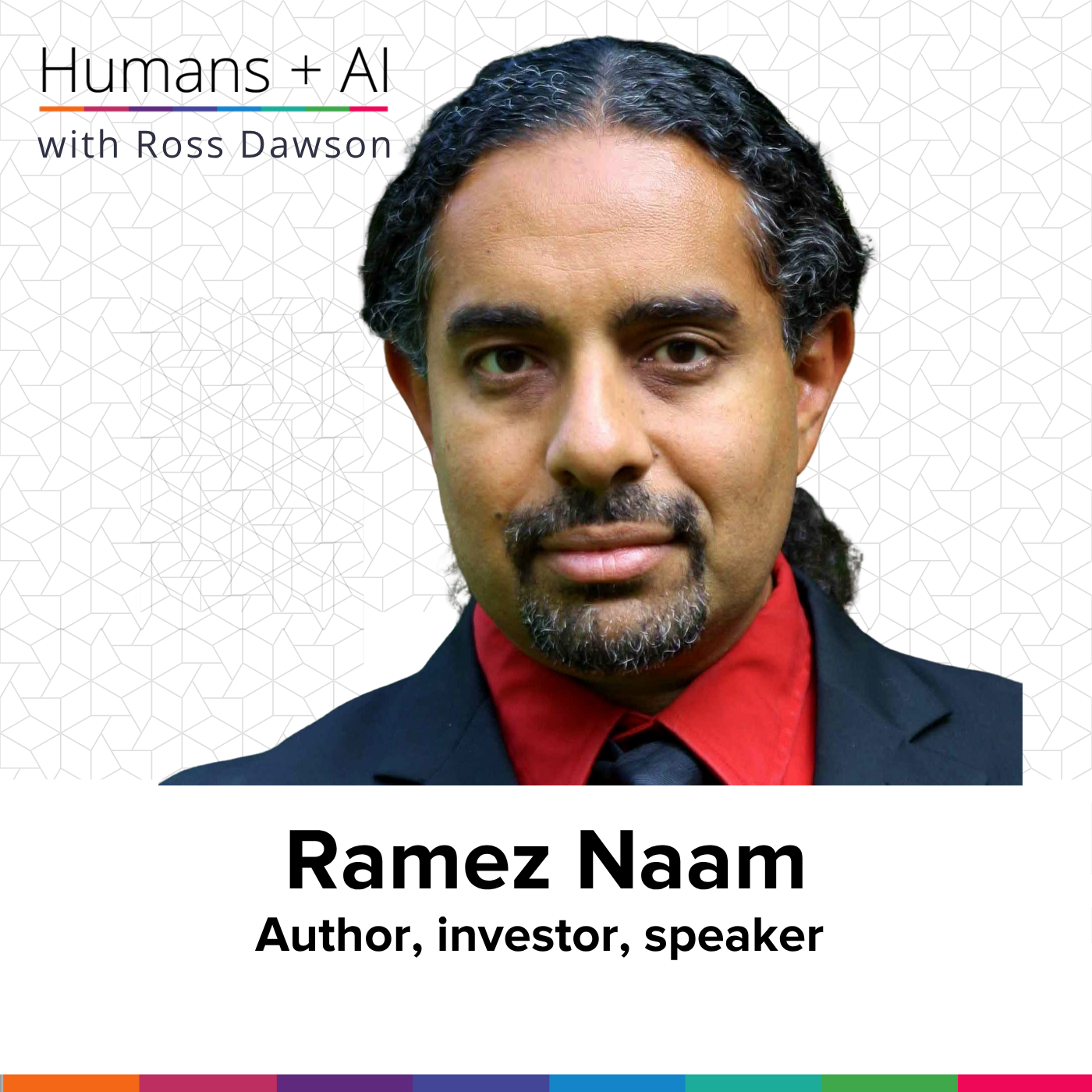


"We've continually created technologies that extend our ability to remember, to communicate, and to think. Writing is probably the very first of these cognitive prostheses."
–Ramez Naam

About Ramez Naam
Ramez Naam is an author, investor, and speaker. His books include non-fiction works: More Than Human, The Infinite Resource, and the science-fiction Nexus Trilogy. He is an investor in climate and clean energy and founding a venture capital firm in this space. He is co-chair of Singularity University’s Energy & Environment group.
What you will learn
- The concept of cognitive prosthesis and how technology extends human thought and capabilities
- How innovation and the growth of ideas drive resource abundance and solutions to challenges like climate change
- The crucial role of openness and decentralization in the rapid development and democratization of AI
- Risks of centralized AI power versus benefits of distributed, open-weight models for democracy and freedom
- Lessons from science fiction on technology, agency, and the societal impact of AI concentrated in few hands
- Current and emerging brain-to-brain and brain-to-AI interface technologies fueling the next era of human augmentation
- Why human expertise, curiosity, and agency are essential for maximizing AI’s value and maintaining meaningful collaboration
- The immense potential of AI to empower individuals globally, level the playing field, and raise collective human intelligence
Episode Resources
Transcript
Ross Dawson: Ramez, it is absolutely awesome to have you on the show.
Ramez Naam: Ross, great to see you. Thanks for having me.
Ross Dawson: Well, you're almost the perfect guest for Humans Plus AI. I think so. Those people who don't know your work will discover in our conversation. But let's start with your concept of the cognitive prosthesis, which I think applies across your larger body of work. So, what's a cognitive prosthesis, and what does that mean?
Ramez Naam: Yeah, a cognitive prosthesis is something we've been inventing and using for millennia. Really, we've continually created technologies that extend our ability to remember, to communicate, and to think. Writing is probably the very first of these cognitive prostheses—though maybe we were counting on our fingers first, who knows? That's lost in the depths of time.
But when we look at the technologies we've built—the technology we're using right now to communicate with each other, to record this knowledge, this interaction that we have, to share it with your viewers—that's a cognitive prosthesis. We're externalizing human thought and allowing it to be accessed by other people who are not here with us at the same time.
Ross Dawson: So let's explore that idea more as we dig into your work. We'll refer to a number of your books along the way. One of your books, which came out in 2013, was The Infinite Resource. So, what is the infinite resource?
Ramez Naam: Yeah, so the subtitle of that book is "The Power of Ideas on a Finite Planet." What happened is that after 15 years in tech, after writing one book about human augmentation, I got really interested in this question of what's the state of the planet? Do we have the ability to keep growing wealth and population while reducing our negative impact on the planet? What I really came to center on was this notion that the right innovation, the right idea, the right scientific discovery, the right engineering discovery, was something that could multiply the value of current resources, that could substitute for scarce resources. It could substitute for land or labor or energy or time or raw materials, and unlike physical resources, our stockpile of ideas is constantly growing over time.
In fact, the more ideas we have, the more we have the ability to recombine them into better new ideas. So, in some sense, if you count ideas—if you count human knowledge as part of our stock of natural resources—it's actually growing all the time.
Ross Dawson: So, there's a few things that have happened since 2013, including some more tangible evidence around climate change, some amplification in the flow of ideas on a number of different dimensions, including the degree of sharing, the degree of idea creation, and arguably, some of our tools are creating their own ideas in various guises. So, what's a bit of an update looking back since you wrote The Infinite Resource? What are the some of your reflections on how that has played out so far?
Ramez Naam: Look, ultimately, one of the most severe environmental issues I was looking at was climate change. Could we have a world of abundant energy, food, and water for 10 billion, 11 billion people while halting the progression of climate change? And it's totally possible. The sun bathes the planet in, let's say, 5,000 times as much energy as humanity uses from all sources combined. What's been lacking is the knowledge and engineering to capture that energy and convert it into a useful form.
I'm not saying it's all solar—of course, that happens with the wind, it happens with our radiological isotopes that are decaying that can be captured as nuclear energy. So, in a sense, it is our increasing store of knowledge that allows us to tap into that abundance around us at ever cheaper and cheaper costs. That's happened a lot. Since 2013, the cost of solar electricity has dropped by more than a factor of 10. The cost of batteries has dropped even further than that. Electric vehicles have become the cheapest vehicles to buy, and by far the cheapest vehicles to operate.
All of that is innovation made tangible, and it's unlocking this possibility of a world of abundance that's also a clean world of abundance. Now, there's a real question of pace. We're not going as fast as we want to be. We can do the math and say, in the limit, we have more than enough energy, food, water, etc., to be able to provide physical abundance for everyone on planet Earth and for the population we think we'll peak at, but that doesn't mean that we're not doing damage along the way, and we ought to be moving faster.
Ross Dawson: Yeah, yeah. Well, I mean, on one point, I've always reflected that basically all energy is solar energy. I mean, even if it's fossil fuels, it was originally from the sun, growing biological material, which happened to then get stuck in the ground. Even geothermal energy—if we spun off the sun originally, then yeah, essentially it's all solar energy in various guises. There's plenty of it, but—
Ramez Naam: Indeed.
Ross Dawson: So, the trajectory. But also, let's look into the trajectory of ideas and idea amplification. In the book, the first half is very depressing around all the things which are going wrong, and the second half is about all of the potential of ideas. When you talk about the resource being ideas, that is human ideas, I suppose. Well, it's ideas—
Ramez Naam: Yeah.
Ross Dawson: But so what is happening on that dimension of our idea amplification—our ability to create, intersect, generate, and apply ideas?
Ramez Naam: Look, there's a long trajectory of humanity increasing its innovative capability, increasing its cognitive abilities, and that helping us reach the next level of development. You go back to hunter-gatherer days, and then somehow agriculture developed. We can talk about how, if we really want to, but what agriculture did is it actually provided probably worse nutrition for each individual, but it allowed higher population densities, and higher population density meant there were more minds that could brush up against each other in person and exchange ideas for new technologies, other ways to improve crop yields, to build better tools, to build better hunting implements, and so on.
Then you have the development of writing that allows those ideas to spread not just to fellow villagers in the small community that you're in, but potentially very far afield. Then you have the printing press that allows ideas to spread much more easily, allows a much wider set of people to put ideas down and communicate them outwards across space and time, and to consume data produced by others. It's no coincidence that the scientific revolution, the Enlightenment, and the industrial revolution all follow rapidly after the printing press.
We'd had written language for thousands upon thousands of years at that point, since the Sumerians or the Assyrians, the Egyptians—for a few thousand BC. But the ability now for relatively middle-class people to take their ideas, put them down, and spread them to others—the ability of Newton to read the work of thought leaders, philosophers, scientists before him—allows this faster and more intense connection of, recombination of, and generation of new ideas to happen, and it accelerates society.
You could say the internet might be that to some extent—TV, radio, and so on—with the internet being quite peer-to-peer. Now, of course, we have prostheses that are not just about storing data or communicating them, but about processing information and producing new information. That's not inherently new—from the abacus to the Texas Instruments calculator, to the first word processors, or the first punch card computers used to plot artillery tables in World War II, up to modern AI and machine learning being used to figure out protein folding or design new engineering shapes for better, lighter, stronger materials or devices. All of that is amplifying our ability to innovate, and that, I think, is in some sense one of the very most profound things happening, and a new stage in our cultural evolution.
Ross Dawson: Yeah, yeah, absolutely. So, I've often pointed to openness—increasing openness—as one of the foundations to that on a number of dimensions. One of those is simply that the World Wide Web was based on a set of open protocols. It was an invention, but it wasn't patented. It was a set of open protocols, open source in various guises. It's hard to imagine a world where open source did not shape our world; everyone would be living dramatically different lives.
Now we're seeing this different flow, with preprint publications. Again, this openness, this flow, has pushed us a long way. It's a bit of a leap from where we've just been, but one of the things you talk about a lot is open weights in AI. So, if we track ideas as the source of all positive potential, the openness of the flow of ideas and the openness of the ability to apply that is really the amplifier—the fundamental one. So, coming to today, where we have AI, which is at its best an amplifier of our best ideas to implement them, what is the role of open weights?
Ramez Naam: Well, let me go back in time before I come to the future. I'll say, even without open source, everything is open source in the limit. Because at the end of the day, IP protections are mostly societally agreed-upon consensus hallucinations about how we're going to guard information. But IP expires, and the day you decompose what somebody else did, you know how to do it.
Robert Wright, an amazing journalist and author—one of my favorite books is his book Nonzero. It came out the same year as Guns, Germs, and Steel, and it was an incredibly more important and more insightful book than Guns, Germs, and Steel in my mind, because what it documents is a sweeping thesis that humanity over time has found every human society—he looks at different human societies that didn't have contact with each other—yet all of them developed towards more positive-sum ways to interact, more win-win ways to interact, greater abilities to cooperate, and that's what we've been doing. Because knowledge itself is inherently positive-sum. In the words of economists, knowledge is non-rivalrous, right? A rivalrous good is this Diet Coke. I'm very sorry, Ross, I'm going to drink this, and you can't have any. It's rivalrous—only one of us can enjoy it. But the formula for Diet Coke, should you love it, is non-rivalrous. We can both use that formula. Or this podcast recording is non-rivalrous because anybody can watch it. One of your viewers watching it doesn't rob the other of it. That's inherently positive-sum.
So, even without formal open source, that is the case. But now, as you say, we're in this very interesting world where AI is the fastest improving, fastest spreading, fastest revenue growth, and fastest capability growth technology we've ever seen. I don't think we're in a singularity per se—many do—but this is really, really awesome stuff happening quite fast. In my mind, the biggest danger of AI is not job loss, it's not hacking, it's not even bioweapons—like, all of those are things we should think about and things we can do smart things about. It's centralization of power. It's over-concentration of power.
We have become, in many ways, a more and more decentralized society. We have very strong nation states, very strong multinational institutions, and so on. But we afford more rights to individuals globally than any previous century—let's say any previous quarter century, with some backsliding. But that's the overall direction that we're heading, and that seems, in addition to satisfying our inherent desire for freedom and satisfying my ideological belief in democracy and personal rights, that also seems to accelerate progress. People in a market economy and a free society produce more ideas than those that are coerced.
But if you ask me as a science fiction writer, what's a scary AI scenario that's somewhat plausible? It's a single AI monopoly—one company that's the only one that has super powerful AI, or one government that has a backdoor to, or regulatory control over, or just a gun to the head of all the powerful AIs. That frightens me much more than other AI scenarios. The AI safetyists—and I believe in AI safety—but the real AI safetyists who are terrified of runaway superintelligence believe that uncontrolled AI is the greatest risk. I believe the opposite—that overly controlled AI by one strong power is the greatest risk—and I think history is on my side in this case.
When we invented writing, the Assyrians used writing on stone tablets to build empire. It might have created economic growth, but it did not bring freedom to the 99-whatever percent of people who could not read. It was when that technology became democratized and accessible to more people, when literacy became not the rare exception but closer to the norm, that it brought us freedom. So that's my view of AI.
I'm happy, even if we didn't have open weight models, that we have a competitive landscape of multiple AI companies competing against each other. That is far better than having one dominant AI company. I'm happy that AI does not appear to have strong network effects or platform effects. I'm thinking in the language of tech here.
The reason Microsoft is valuable is because Windows has a network effect, right? It's got a platform lock-in, and you've got this network effect—the more people that use it, the more developers have to produce apps for it, and the more apps that are available, the more attractive it is to users, etc. The same is true of the iPhone. The same is even more true of Facebook. Those are natural monopolies. The structure of that phenomenon—that gaining more customers makes the platform more valuable to more customers—creates this natural monopoly phenomenon, and it creates winner-take-all, winner-take-most markets. There might be a couple competitors, but there's seldom more than three that really matter.
AI isn't like that. The switching cost of AI is not zero, but it's very, very low. And you using ChatGPT doesn't actually make ChatGPT any better for me, to be totally honest, or minimally at best. So thank goodness. I mean, as a shareholder of an AI company, let me find the network effect to make even more billions of dollars. But as a citizen, let's not. Let's have these companies constantly competing with each other, driving down costs to the bare minimum, improving intelligence, delivering us intelligence for pennies that we can use for whatever projects we have—awesome.
But the leading companies are basically all American, and we've seen in the last couple of weeks a capricious, arbitrary, and I will say extra-legal White House willing to use orders or just veiled threats to say, "No, we don't think you should release that model." The White House may not have any legal way to prevent OpenAI from releasing ChatGPT 5.6. It might be benefited by the First Amendment. There's no obvious law that gives them this power. Export controls don't generally apply to information or code. So, does the White House have any power? Well, they have a million ways they can make life hard for OpenAI or Anthropic. So when they say, "We think you should hold back," everyone is intimidated and cowed and thinks about the damage that could happen to their company, and so they comply. And that sickens me as an American.
I'm not saying that we should just release frontier models willy-nilly. I think actually, like having a staged release, giving it to defenders, people that own, you know, that create operating systems and so on, to test and plug those holes is probably a great idea. But it needs to be done with some degree of structure and democratic rule, and not at the whim of potentially one man.
So one partial antidote to that is the fact that these open weight models exist. They're mostly Chinese, but Google puts out an open weight model. Meta did it at one point. The Gemini models from Google are actually really quite good, and some of the Chinese models are fantastic. And open weight means you just download them. After the news of some stuff with Anthropic, with Fable being export controlled and not even available to the non-citizen employees of Anthropic—that's kind of crazy. And then with the White House saying to OpenAI, "Maybe you shouldn't put out ChatGPT 5.6," and OpenAI complying—I downloaded some of the most powerful open weight models in the world, and I'll bet a lot of people did. And if you can set up some compute, you can use these. Honestly, you can't run the very frontier, but if you've got a new MacBook, you can run some pretty powerful AI in a decentralized way, and that, to me, is pro-democracy.
Ross Dawson: Yeah, yeah. Well, we can maybe come back to that, but I think that actually hops to—you recently got on a plane and you flew to Oslo, and you spoke at the Oslo Freedom Forum on the topic of what science fiction teaches about AI and human rights. I think you were obviously partly saying what you were just saying, but this is around freedom, and freedom requires choice. So, just in a nutshell, what did you share with the Oslo Freedom Forum?
Ramez Naam: I'm a science fiction writer, and AI is an incredible technology. We've seen that basically the bulk of tech that humanity has created has benefited humanity. They always have some downside, of course, but why do we live to 80 instead of 30? Why do I not have measles or the pox? Why do I have climate control and a nice shirt? And we can do this. It's all technology, right? So you'd think sci-fi authors would be bullish, and that sci-fi depictions of AI would be this wondrous future with new innovations in medicine or flying cars or whatnot, but they're not. Depictions of AI in sci-fi are the Terminator, the Matrix—you know, Minority Report isn't exactly AI, but it could basically be AI. HAL 9000 in 2001—I think HAL is villainized. HAL was the victim. HAL's programmers were the villains—really, accidental villains. That happens.
These depictions happen for a lot of reasons. It's actually really hard to write optimistic AI or optimistic science fiction and have the reader still want to turn the page or watch the next scene in the movie—you've got to have some tension, right? So that's part of what's going on in this storytelling, but it influences the discourse, and so the discourse is full of these very, very scary assumptions or narratives about AI that are quite dystopian. We often think an AI wants to take over the world. I have no idea why AI would, and wants to snuff out humanity. What's the point of that? And that's because those make good stories.
But more to the point, most depictions of AI in dystopias really heavily feature concentration of power, and it's very rare—it's exceedingly rare—to see a story where power is widely distributed and disseminated that still looks like a dystopia. I mean, you can make up a story like that. I can make up a story where AI makes it easier to design a bioweapon, and someone does, right? Of course, AI also makes it easier to design a vaccine, and people will do that also. So, to me, that intuition about over-centralization of power is valid, and that's what we see in history. It doesn't take science fiction. You look through history, and you look at the Khmer Rouge, or you look at Nazi Germany, or you look at Stalin, and you look at Mao, and what you see is hyper-concentration of power with people that have no checks and balances on them, and that concerns me about politics in the country that I live in, but that even more concerns me if current leaders who have too few checks and balances have a monopoly on super powerful AI.
So I am philosophically dedicated to disseminating this technology as broadly as possible. The good news is it's happening, even though I have complaints at the last month or so. You or I, or a poor kid in the developing world that happens to have a smartphone, can access AI models for free that are more powerful than the world's billionaires, or Xi Jinping, or Donald Trump, or Elon Musk could access 15 months ago. This is incredibly democratizing as a technology, and I just want to make sure that it keeps going that way.
Ross Dawson: Yeah, yeah, and you're a force for that direction in all of your work, thankfully. So I have been a science fiction fan since my youth. In my teenage years, I devoured all of the science fiction books in the library, and have always been looking for—you know, I got sick of the space opera quite a while ago, and I'm always more interested in the near science fiction. What is it that's maybe in my lifetime or a bit beyond, which can give me a sense of where things are going? There actually isn't that much. It's funny—you look across the whole science fiction landscape, and a lot of it's far future, and not so much near future science fiction.
So, one of my favorite science fiction books among those is your Nexus trilogy, which you wrote in 2012, which is engaging, and I think you point to some of the promise, some of the positives, and some of the downsides of new technologies. The technologies are around mind sharing and collective intelligence, and that's something that's tantalizing. Collective intelligence—since I was young, I always thought, what an extraordinary idea, the potential of all of us coming together into a mind meld, which we've come across in various guises. So perhaps just—what is, in a short nutshell, the premise? But I guess I want you to reflect back on some of those positives and negatives, and how those might have played out. We're not quite yet in the world you depicted in the books, but we've moved a little bit forward. There are some things which we'd like to hear about in terms of more recent developments in the space. But what's your reflection? What's the core premise of the Nexus trilogy, and what are your reflections back?
Ramez Naam: Well, first, thank you, Ross. I'm delighted that you enjoyed the books that much. I had fun writing them, and I enjoy them when I read them—I haven't read them in a long time, but I am delighted myself.
The premise of Nexus was that there was a technology—you could swallow a liquid metal vial, and it would go into our brains, and it would allow people to connect brain to brain via wireless signals, via radio waves. The premise further is this technology is highly illegal, that it's packaged as an illegal drug, but it's also associated with both human enhancement and abuses like mind control. The books are thrillers—someone described them as Tom Clancy meets Burning Man. But the core philosophical issue, in between the martial arts fights and mind-to-mind battles and so on, is who gets to control what you put into your brain, and is greater connection a social positive?
So the first book is—my protagonists are grad students who are trying to take this drug/technology and make it stick around in your brain longer, and build an API and an app layer on top of it, and build applications, and allow it to use your phone to proxy its signals over—as far as we can send phone signals, which is global—and things like that. The villains, such as they are, are primarily governments who see this as very, very dangerous—the U.S. government, the Chinese government—and I try to do my best to give them strong motivations. So the U.S. government is motivated by abuses that have happened. Mind-influencing coercion technologies have been developed in the past, and they've been used to harm people, to build cults, to abuse people. That's realistic. No technology is ever used only for altruistic purposes. Every technology we've ever made has brought some pain to some other human. The first sharpened stone—we used it to kill animals that we hunted and tear their skins for clothing. I'm sure someone used it to hit somebody they didn't like, right? In a conflict.
Yet the broad sweep of history is that these technologies have made our world overall better, in a material sense, overall less violent, overall safer, overall freed us from drudgery. Very specifically with Nexus, I was talking about a technology as both intimate and as a communication technology. So almost everything I describe, in a way, is an analogy for what we see happening with our communications technologies and with AI. The big questions were: Should we try to get this technology out of the hands of the few and into the hands of millions or billions? What are the cases, pro and con, and who are the forces that would fight for and against such things? And if you do that, what happens—good and bad? I had a lot of fun, and I did my damnedest to show bad. I'm an optimist, obviously. I did my damnedest to show bad things happening, and I did my darndest to show people who, with the best of intentions, really thought we should lock up and control technology. But ultimately, I'm arguing for—not only does technology want to be free; humanity is best off when technology, in almost all cases, is as democratized in access as possible.
Ross Dawson: Yep. So, which takes us back to your 2005 book, More Than Human, which was around biological augmentation. You knew of which you wrote, of course, and being able to map that out. I want to take another angle on that in a minute, but just briefly—where do you see the most promising technologies now for, let's call it, brain-to-brain communication? Which usually means intermediate—as in brain to information technologies and information technologies to brains—but we do have brain-to-brain communication. It's been demonstrated in the labs, and there's a lot of interesting domains at the edge now. I personally thought for quite a while it's not the implants; there are a lot of other more interesting technologies. What do you see as the highest potential ones for either brain-to-AI or brain-to-brain communication?
Ramez Naam: Well, look, I'd say first and foremost, biological enhancement has gone much slower than I hoped in 2005. I wrote about longevity, I wrote about gene therapies, I wrote about smart drugs, I wrote about making people stronger and faster, slowing or reversing aging, and brain-to-brain communication. All of it has gone much more slowly than I hoped, and all of it has gone more slowly than digital. So I love the sci-fi of it, but the reality is the things that are changing fastest in the world are those that are around bits, not atoms and not cells.
Ross Dawson: Information technology and smartphones.
Ramez Naam: Yes, and so we have an extended phenotype, right? What does that mean? We are tool users, and we incorporate technology into our sense of self. So even though this phone is not physically inside of me, it is a cognitive prosthesis, and my brain—like when I think, "Oh my gosh, who would know this? Or I think Ross might know this. Let me WhatsApp him right now." You are part of my extended cognition because my brain has incorporated this idea that is totally ahistorical, that people 100 years ago did not have—that I can contact you across an ocean and across the equator and ask you a question. Somehow this is part of my mental model. It's bizarre that we have the ability to do that.
That having been said, it's also an incredibly exciting time in neural interfaces and neurotech. The biggest challenge historically has been that you've got a choice to make. You can make something that's non-invasive, something that does not penetrate the skull. EEG is such a technology, and you can get information out of the brain or, with some other approaches, into the brain without surgery and for a cost of hundreds of dollars, or low thousands of dollars. But the information is very limited in resolution—very little information, little bandwidth.
Or we can put electrodes inside your brain, and we can get very fine-grained information—not yet over a wide portion of your brain, but very, very detailed information from one specific part of your brain. We can give you control of a robot arm, as Neuralink is doing. We can decode your speech intent—Neuralink is also doing this, as are other companies—and turn just your thoughts, if you're a quadriplegic, into synthesized speech. We can take a camera on glasses and insert it into your optical nerve digitally, and give you crude vision—very crude, but still vision. Awesome, but that is a $40,000, $50,000, $100,000 surgery with a one or two percent chance of a brain bleed. You're just not going to do it unless you are really suffering from some condition that this helps you.
Now we have some new things coming up. We have some fascinating stuff happening right now that is sort of in a semi-invasive world, and there's a few technologies that are interesting. Ed Boyden and his lab at MIT have shown that with multiple different electric field generators, they can quite accurately stimulate pinpoint parts of the brain. They're doing this in animals. They're doing it in humans now. That's one.
But the most exciting is actually ultrasound. A friend of mine, Sumner Norman, is the CEO of a company called Merge, and they can use ultrasound—ideally with genetic editing at the same time—to read data out of the brain at incredibly high precision. We could read it out with technologies like fMRI, functional MRI, but you've got to be in a giant multi-million-dollar scanner, laying on your back, not moving for a while, and all the metal removed anywhere near you, right? These giant magnets. But now with ultrasound, we have the potential to do that.
Another group called Alif—they're a nonprofit right now in the Bay Area—has shown that with another semi-invasive method, they can use ultrasound and get the crispest—they've generated just in the last week—the crispest non-invasive view of activity happening in the human brain. They do this by injecting microbubbles into your brain. These microbubbles happen in your brain because those tiny little bubbles reflect ultrasound with really high contrast. It's a contrast agent, the kind that you'd get for other kinds of scanners, but really just bubbles, and that's allowed them to produce incredibly high-resolution images—videos, not just of brain structure, but of brain activity. So those are a couple of technologies out there that I think are really interesting and point to a potential future of getting data in and out of the brain in a manner that is much higher precision and resolution than the non-invasive techniques, without having to go through brain surgery. Related to that, ultrasound is having sort of an enrollment.
A week or two ago, Midjourney announced that they were using ultrasound on their chip to do whole body scanning. It doesn't replace all of their scanners, but it can. It's really potentially very cheap and fast, with AI taking the data from a very large array of these ultrasound-on-a-chip scanners as you're submerged in a liquid and generating a 3D body image of you that AI can then decipher. So we're getting into some very interesting places. It's not quite what I wrote about in Nexus—we're not going to quite mind-meld over that—but I think for people that are paralyzed, for people that have a variety of neurological problems, many people with dementia, people that are locked-in patients, or just for understanding the brain's function and what's happening in the brain of someone who's depressed versus not depressed, who's ADHD versus not ADHD—I think we're on the verge of some amazing things.
Ross Dawson: Yeah, yeah, absolutely. I think the recent ultrasound stuff is really amazing—a lot of it, essentially being able to focus within particular points within the brain or body. But also, some of the transcranial magnetic stuff is also very interesting.
Ramez Naam: Yeah, transcranial current stimulation also, yeah.
Ross Dawson: So this comes back to this thing of "more than human"—well, what's humans plus AI? At the moment, most people—you know, we've created this thing which is extraordinary, which is, in some ways, able to do things humans can, in other ways, able to do more than humans can. Amongst other things, of course, having instant access to the corpus of human knowledge, etc. But I still believe that human abilities will remain distinctive, let's say indefinitely. But that's another thesis. The point is the interface. Right now, the interface is usually keyboard—you push some buttons on a bit of plastic to represent keys, or you speak maybe, and then it responds in usually text. That's not bad. Ultimately, we can potentially get to this brain-to-brain or brain-to-AI communication two-way. That's obviously—I wrote about that in 2002, you've written about that a very long time. It's a pretty obvious trajectory. But let's just pull back to humans plus AI now and moving forward. How can we best complement each other? What is the potential for humans and AI together?
Ramez Naam: Yeah, I mean, look, AI is changing so rapidly that anyone who tells you that they're certain of what human-AI relationships are in the future shouldn't be. There's a lot of intellectual humility that we need—epistemic humility. Nevertheless, I'll say this: We are making the fastest progress in AI in the most verifiable domains.
So, where have we made the fastest progress? Well, it started with game playing. DeepMind was founded in part on the notion that if you could win at games that are very prescribed—there's only so many moves you can make at any given time in chess or in Go, though Go ultimately has more possible games. It doesn't just have more possible games than there are atoms in the universe—it's like if each atom was a universe, and we had a universe full of those, there would still be more possible Go games. That's how broad Go is, and yet it's still very prescriptive relative to the real world. But if you could make progress in those, that might teach you something about general reasoning.
So the domains where AI has done extremely well are domains like that, where you can generate an infinite amount of training data, and where every example you feed AI, you can be 100% certain—you can label it as accurate or inaccurate. You can't do that in the real world, but I can do that with a chessboard or a Go game. I can say, "Oh, this is a win, this is a loss, this is a game that's not yet decided," because we know the rules, and the rules are very finite on a finite playing board. That's highly verifiable.
Other things that are verifiable: formal math—verifying a proof is verifiable. Not all math is verifiable, believe it or not. We can get into that if we want to. Coding is less verifiable than you might think, but you can define tests, and you can say, "Does a piece of software that I wrote pass those tests?" And that's verifiable. In fact, there's almost always a way to cheat on the tests, and there's always, almost always—basically always—some way that the tests are incomplete or ambiguous or vague, and you have to translate what the human wants into tests or definitions, and that is always ambiguous. But coding is still—it's fairly technical. The language of coding is much more prescriptive and limited than human language. It's mechanical in a certain sense, and so AI is really pretty great at that. We're getting to—they're not quite superhuman coders yet, but they're on the verge of that.
What's less verifiable? Comforting someone who's feeling down, writing poetry, but not just that—coming up with a new business model that you think is smart, the most creative work, coming up with entirely new ideas of how we can reduce carbon emissions from making steel, coming up with medicine is actually shockingly not very verifiable. Everyone wants AI to cure cancer or aging, but just looking at a molecule doesn't tell you a lot. You've got to actually run human trials for a long time. We've cured cancer in mice a lot of times, and it hasn't worked in humans. So these things that are either messy in the real world, or ambiguous in the real world, or very open-ended, are the things that AI does the least well in, and that may change in the future.
But my bet right now is we will have a singularity in the verifiable domains. We will have superhuman capabilities—we already have artificial superintelligence. AlphaGo Zero, the program that taught itself to beat Go by playing itself millions of times, is a superintelligence. It is beyond the ability of any human, but it's a very narrow superintelligence. So we're going to get narrow superintelligence for sure. That doesn't mean it has any volition, that it has any goals. AlphaGo Zero doesn't know that it's playing Go. It doesn't know what games are. It doesn't know that humans exist. It doesn't know that boards are made of wood. It doesn't know anything except what a good move versus a bad move is. That's kind of it, actually. These are not just idiot savants. They are very, very narrow, specialized intelligences.
So that's where I think most of the progress in AI will be. That doesn't mean that they're not amazing general-purpose research assistants or good therapists. They do a lot of things extremely, extremely well. But we also see this phenomenon that human expertise is still valuable in the age of AI.
Anthropic did a study—they released it a couple weeks ago—looking at who gets the most value out of and the most productivity out of AI, and it was experts—not experts in AI, experts in their domain. Because a novice in a domain—it is a great leveler of the playing field. I can be a novice in the biology of aging—I'm sort of intermediate, let's say, in that. But let's say I'm a novice in that domain, and I go and ask AI some questions, and I get some answers that are far better than I could have gotten years ago. It's what I could have ultimately gotten from Google, probably, but would have taken me hours or days or weeks to put it together, and I can get sort of a consensus answer on some question.
But a real expert can get more. What Anthropic's study showed was that people who understood their domain and could ask very specific questions could catch AI making mistakes—because AI has a reliability problem right now—and could, this is very important and actually understated, could instruct the AI in how to check its own work and check its answers. Not just double-check everything, not just make no mistakes, but, "Hey, after you produce this report on clean energy for industrial heat, I want you to double-check the cost numbers, the current geographies of where steel and cement are made, how that lines up with availability of solar and wind, the cost of storage, the lifetime of steel mills—are we about to build a whole new set? Double-check that against the cost of carbon capture from them instead." So that sort of specific set of questions you can ask is what produces the most valuable, least error-prone, most accurate output from AI.
People are using AI to solve math problems—the Erdős problems that have been out there for a long time that were sort of unsolved. Most of them are conjectures. Erdős said, "It seems to me that this is true," and most mathematicians are like, "Yeah, I think that's true," but no one has a proof for it yet. And so AIs can go out there and solve it, but guess what? They're mostly not doing it alone. They're mostly being led by mathematics professors who can give them hints and ideas on, "Let's try this strategy and this strategy, and if that doesn't work, why don't you brute-force these 100 possibilities and then come back to me on this?" They're a cognitive prosthesis for the experts. So human knowledge and expertise still matter today, and it looks like it will for quite a while to come.
Ross Dawson: Yep. Yep. Let's certainly be—yeah. I think a couple of points. One is this: I always talk a lot about the cognitive impact of AI, and essentially that it's a choice. We can, by default, let it be dumber—let it do stuff for us—or we can choose to let it make us smarter, to augment what we're doing, to extend our capabilities, to potentially even make us think better even when we take it away. But that expertise requires some specific skills. Some of these mathematicians intuitively get a sense of how to guide the AI, or they're getting better at it themselves, and then seeing what the AI is good at, not so good at. So there is a specific meta-capability or meta-expertise, which is around being able to guide and interact with the AI. This is where I do not see the end of human capabilities or human expertise relative to AI with this amplification, but it comes back to this choice piece. Will I use AI? How will I use AI? Will I choose to apply my own metacognition—my ability to think better about my own thinking and that of the machine and how they interact—and then be able to choose to improve my skill? So we do see some forks potentially in those who are more meta-capable than others, and that's—I think for a long time I, and you in various ways, have pointed to these dangers of polarization, and one of those is not just in access—so that's a critical one—but absolutely a choice, in amplifying ourselves.
Ramez Naam: I would add to that agency. People ask me, "What limits me on my use of AI?" Actually, no one asks me that. But if they did, I would say my agency—do I think of something and be like, "Well, I don't know how to do that," or do I think, "Huh, I'll bet with AI I could do that," and then I ask AI, I say, "ChatGPT, Claude, could we do this?" And they always say, "Yeah, we could do this. Here's how we do it." So that's amazing.
How high are your aspirations? Your curiosity? Do you want to learn? Educators are very paranoid about the influence of AI in education, and given the way that education is structured today, I get it. If you send the kid home with homework, whether that kid is five or twenty-five, and you expect them to just do it at home, of course they're going to use AI. But if we flip the classroom and they use AI digital tools to absorb the lecture at home, and they do their homework at school without the AI—different story.
So AI is the most powerful educational tool that exists. It's how I teach myself things. And then skepticism, because I catch AI making mistakes in the domains that I know well. I don't necessarily catch it making mistakes in the domains that I don't know well. So you've got to learn how to ask hard questions, cross-check things, come at things from multiple angles. And also, if you think you're looking for something outside of the consensus, AIs will give you consensus answers, and in lots of fields—in chemistry and physics and engineering and medicine—the consensus answer is usually right. But if you're really trying to do creative work, you've got to come at this from multiple angles.
So there's a set of attributes like that that are really about individual empowerment—so that agency, that curiosity, that skepticism—that I think maximizes the value you get out of AI.
Ross Dawson: Yeah, it's our attitude as much as anything else. I think you've already shared what you're most afraid of in the centralization of power. So what are you most excited about?
Ramez Naam: Look, I mean, if you asked somebody in the 1400s, you described to them the printing press, and you said, "What are you most excited about?" They might say, "I'm excited about spreading copies of the Bible," and in fact, the Bible was the first thing Gutenberg printed. Martin Luther's complaints about the Catholic Church were also printed on the printing press and nailed to the doors of churches. They were the first blog posts—nailed with tweets—and they brought down the power of maybe the most powerful entity in Europe, right? John Locke wrote on tolerance, saying that individuals should maybe have some say in how they're ruled, and maybe we should get along with people who are not like us.
That wasn't a message that the princes or kings or emperors of the day wanted to get out, but it brought down their power and led to the Declaration of Independence and the U.S. Constitution and a sweep of democracy centuries later. Gutenberg could not have imagined the scientific revolution, let alone the industrial revolution, or the fact that we would have the ability to see across space and time and talk to each other like this—he just couldn't have known. So, what am I excited about? I'm excited about the collective intelligence of humanity going up. I'm excited about leveling the playing field. I'm excited about a poor kid in Somalia that has a smartphone. Bandwidth is so expensive. Smartphones are so expensive. But that kid will have a smartphone. Those things are dropping in price fast, as is connectivity. Being able to ask any question of an AI, being able to code an app—I've coded an app a couple weeks ago in five sentences. It's just ludicrous. I'm excited about my 80-year-old mom, if she wants to, coding an app. I haven't gotten her there yet. Actually, I haven't proposed it to her. Maybe I will. It's actually that easy right now.
I'm excited about the mass empowerment of humanity, and I don't know exactly where it will go. There'll be some bad things happen for sure, but I think on net it's going to be amazing.
Ross Dawson: I'm with you, Ramez. So, where can people go to find out more about your work?
Ramez Naam: rameznaam.com is my Substack, or I'm on Twitter as @ramez.
Ross Dawson: And it's an awesome Twitter feed too. Thank you so much, Ramez, for all of your work, all of your inspiration, being a force for good.
Ramez Naam: Thank you, Ross. It's a pleasure. Great to see you again. Great to see you in Norway, and great to see you now today.
Podcast: Play in new window | Download