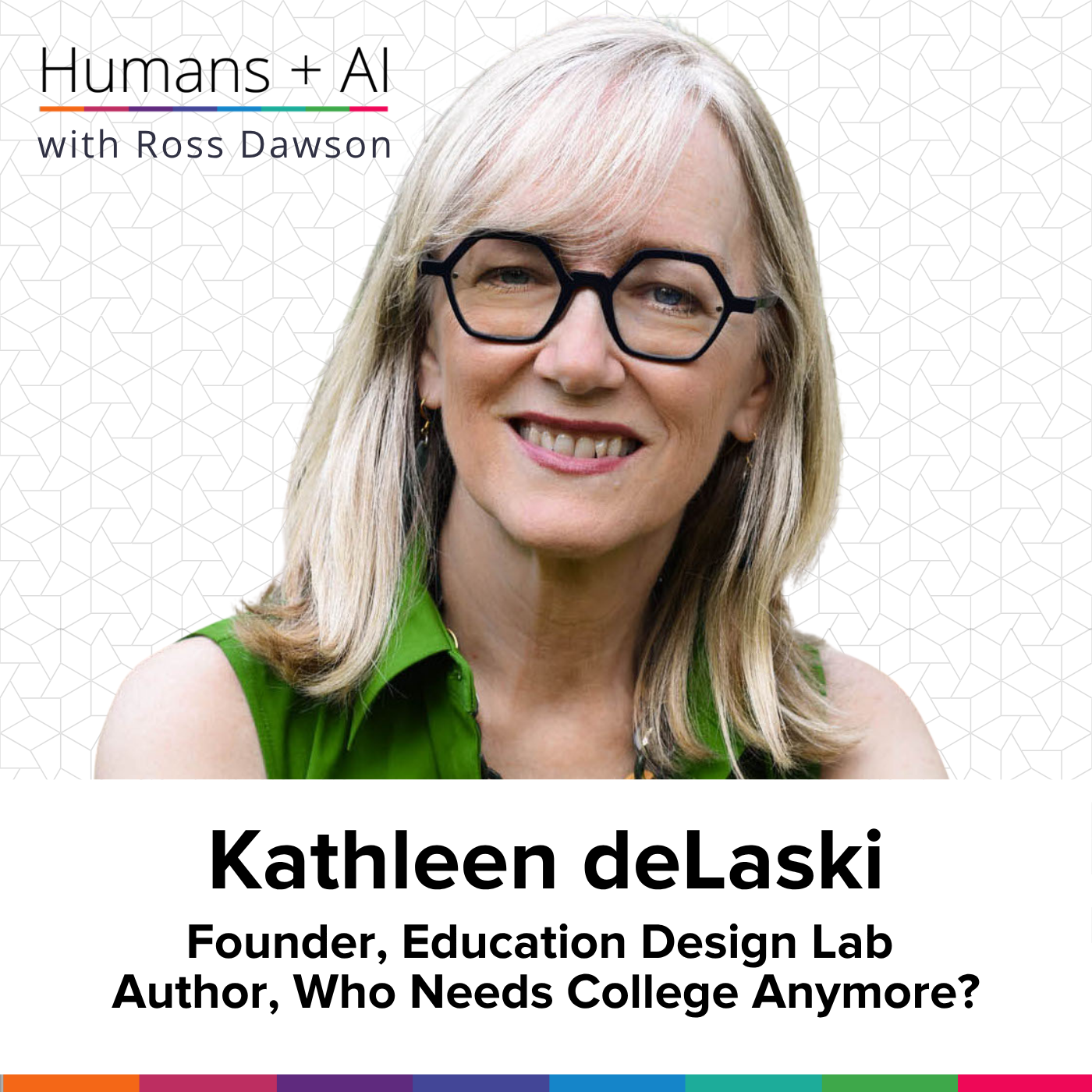


"There’s a real 'skillification' movement where you just want to get the training you need when you need it."
–Kathleen deLaski

About Kathleen deLaski
Kathleen deLaski is the founder and board chair of Education Design Lab, which helps reimagine higher education. She is a senior advisor to Harvard's Project on the Workforce and on the advisory board of the Taubman Center at the Harvard Kennedy School of Government. Kathleen is author of Who Needs College Anymore? Imagining a Future Where Degrees Won’t Matter.
What you will learn
- The evolving value of college degrees in a rapidly changing economy
- Who benefits most from higher education, including four key learner profiles
- The rise of 'skillification' and alternative pathways to career readiness
- How employers assess degrees and non-degree credentials in today's job market
- The impact of AI on both education and workplace expectations
- Why AI literacy—and understanding its limits—matters for career success
- The growing divide between technical and non-technical learners regarding AI adoption
- Practical strategies for maximizing uniquely human skills—like originality and judgment—in an AI-powered world
Episode Resources
Transcript
Ross Dawson: Kathleen, it's a delight to have you on the show.
Kathleen deLaski: Thanks for having me, Ross.
Ross: So, amongst many other things to your name, you have a fairly recent book out called "Who Needs College Anymore?" So, does anyone need college anymore?
Kathleen: Yes, the answer is yes. There are people who are looking to bash the notion of a three- or four-year university degree, but they need to look somewhere else. What I try to do in the book is serve two audiences. One is universities—what we call colleges in the US—who are actually in a state of panic right now about surveys showing that people are not valuing degrees anymore. It's a perfect moment to reassess: what does a degree need to deliver as we approach the mid-21st century? That's the hot topic, the debate that's raging.
To frame the question, "Who needs college anymore?" is to say, "Wow, you need to step up your value proposition in this age," especially when, at least here, the number of 18-year-olds is dwindling and we have AI and technological solutions that allow people to get skills as needed. There's a real 'skillification' movement where you just want to get the training you need when you need it. There's also a questioning of hanging around to learn about the liberal arts, to do your philosophy, English, or history required classes—can't we get right to the skills? That's the debate that's raging. So, colleges need to hear this message; that was one audience.
Secondly, I know so many students—even in my own family—who are trying to parse the different messages they're hearing. One message is, "You absolutely need a four-year degree if you want to get a 'good job.'" The other message is, "College isn't worth it anymore; you can just get the skills you need and get the job." Meanwhile, families think the price tag is going up and up. Here, it's staggering—although, in reality, universities in the US have actually begun to hold prices and even give a lot of discounts because they're short on the number of folks coming through the door. So, all these confusing messages—I think families also need to understand who exactly, among different types of learners, does need a degree and who doesn't. Which jobs, which age groups, which learning types? I actually walk through all those using a human-centered design approach.
Ross: Human-centered is a good way to go. So I and others have talked about the unbundling of higher education, and there are a number of elements to that, including the educational processes, the social connections, sometimes the physical place, the links with employers and credentials. Of all the facets bundled together in a degree, the real focus, of course, is on the certification—you've got a degree—and the point to which that signals to employers. I suppose that's usually the name of the game. It's the differentiator. In the past, we've seen that in some fields—most notably software—where you can get some indicators of competence outside a degree, and employers have been more than happy to accept that. So, just focusing on the credential, what is the role of the credential today?
Kathleen: Yeah, that's an excellent question, because it's particularly coming into question now. We have, like, 1.7 or 1.8 million different distinct credentials in the US alone. If you added the worldwide number, it would be bigger. So, what are learners to make of those? What are employers to make of those, when only a smaller percent are part of a degree? I say that we are absolutely at a time when the degree matters most, but there are many careers and moments in time when you can hack needing the whole degree.
Those moments are in a very tight job market, where employers can't find enough people, and in sectors that are either new—because people don't know about them yet, they're emerging—or they're very old school, like insurance adjusters, where the workforce is retiring and nobody wants to do those jobs anymore. So, new and old sectors, as well as highly technical sectors that require constant upskilling to stay in the game—things like AI, quantum, and parts of cybersecurity fit into that category. The signal power of a non-degree credential rises in careers certain and certain moments of time, but the degree is always a nice booster. The point is, you can get away with not having the degree in the situations I just described.
Ross: Yes, well, I was just about to leap to our current moment because it has a few specific characteristics. But let's dig a little more into some of the book's ideas. You describe four types of people for whom degrees are relevant, which suggests that people who don't fit in those categories may have alternative paths. So, as you say, it's related to the economy, the specific type of job or industry, but also to the individual and where they are in their life. Who are the people that do get the most value from a higher degree?
Kathleen: This may be different in different parts of the world, but I think the basic principles probably carry over. The first category, and this is where the research is the best, is what I call a "class transporter." That's someone trying to move from a lower or off-the-grid economic class here in the US to the middle class. This is often an immigrant family, where the parents came to this country specifically so their kids could get ahead, knowing they would never be able to get a degree themselves. They're working three minimum-wage jobs so their kids can live in a neighborhood with decent schools and then get into university. The entire family is lifted up into the next economic rung.
Part of what the university degree does for that student is help with networking, code-switching, and, of course, the technical skills needed to land a role. That's the number one category, because the research shows that in one generation, you can lift your family up. I actually start the book with the story of how my family did that in the 17th century. My relative came over, we think, in the belly of a ship as an indentured servant from England and was able to be one of the first students at this new college called Harvard, which was the first college in America. He got his son in—who's my great-grandfather times seven—and then the family was off and running. He became a well-known minister, and his ten brothers and sisters didn't get to go to college. That's a very typical story even today. It's that rags-to-riches story where college is so much a part of the American dream. It's the launch pad, and that's ingrained in all of us. So that's the number one category. The others are probably more strange.
Ross: On that, one of the things I'm very interested in globally is relative generational mobility. The countries with the greatest generational mobility are Scandinavia; Latin America has some of the least. Generational mobility—the ability for children to do better than their parents—America is actually not that high. For all the talk of the American dream, I'm not sure of any studies that show the role of education in generational mobility across countries. I'm not sure whether you do.
Kathleen: That would be very interesting.
Ross: Yeah, I guess a fair hypothesis would be that in America, that is particularly high.
Kathleen: Well, surprisingly to many of us—myself included when I started researching the book—only 38% of Americans get a four-year university degree, which always strikes people as really low. They think everybody has access, but the numbers are probably even lower in other places. It's not like everybody gets to go to college here, either. So, The second category is what I call a "legitimacy labeler." That's someone who may not need to move an economic class, but they feel they need that piece of paper for their own self-confidence and self-realization. What's interesting is this category is particularly populated by women and minorities. When you look at who goes into debt to get a university degree, it's very weighted among women and particularly Black Americans, especially for graduate school. They feel they need every possible imprimatur to prove themselves in the workplace. I interview different folks who go through that, and I even talk about my own journey to decide to go to grad school and pay for it myself because I felt I needed that. I was in journalism at the time, a young white blonde woman in the South, and I was not taken seriously. I thought, "I need a graduate degree." That's what I need.
It worked. I ended up getting hired at ABC News. I was their youngest correspondent in the '80s. So, it definitely works, and I think it still works. Part of why it works is the network you make and the confidence you build.
Ross: Yeah, the networks are a big part of the value higher education brings—the people you hang out with. People I know who do MBAs all say it was useful.
Kathleen: Right, right. They don't even go to class sometimes; they just do the networking. The third category is very basic and straightforward: any career where the piece of paper is actually required by licensure and you can't get around it. We're now figuring out how to game it, but we can't get around it. The best examples are doctor, lawyer, some forms of engineering where there's a lot of risk management involved, nurses, teachers—those are the best categories. You'll see in teaching and nursing lately, where we have big shortages, we're seeing ways you can be in your job and have part of your work experience count towards a degree, so you could maybe do it in two years instead of four. We're creating these workarounds because we have worker shortages, and that's interesting. I think you'll see that across the board. So that's the third category.
The fourth category is broader and has to do with how badly you feel you need community and structure to make yourself learn and to push yourself. We all know someone—maybe even ourselves—who, in the other category of not needing a degree, is the extreme DIYer who can pick up any skills from YouTube. A lot of people are finding their main learning venue now is YouTube. You can learn almost anything there. But if you're someone for whom that's not going to get you there, and you crave the society of others, particularly if you're 18 to 24, I would say go and get in community at a college, for sure—at a university if you can afford it. If you don't have other reasons why you can't do it.
So, those are the four categories. My basic catch-all advice to any 18-year-old is: if you can come up with the money—because here in the US that's a huge issue—you should go for it. You can always leave, which many people do. Almost half of people who start university in the US don't finish. You can get in the door, you'll learn something, but you might be in debt. That's the problem—a lot of people don't finish and then they have the debt. I recommend to anyone who doesn't know what they want to do: take a very economically frugal path, like choosing what we have here called community colleges, which are very inexpensive. It's not quite as much—you don't get the football team and all the wonderful seminars with small classes—but you can at least do career exposure and learn what college or university is like. So, those are my categories for who still needs college.
Ross: So, I don't think we've mentioned the word AI yet, so let me say it. This changes quite a few things, and we'll get to some of the more pointed or current ones right now. But let's just take this humans-plus-AI perspective, where hopefully almost all employers will, in some form, be using AI and expecting the people who work there to use AI. I guess there are two parts: AI obviously has a role in education, and AI will almost necessarily have a role in the workplace. So, perhaps going beyond specifically the college or university framing, how should we be thinking about both education—essentially, the gaining of AI literacy—to be able to learn, to function well in society, to do well at jobs and meet the expectations of employers, to be AI-competent?
Kathleen: I've actually turned my attention since finishing the book to this question, because the conversation about whether you need the degree and how the degree needs to be changed to be purpose-fit for the mid-21st century—a lot of that questioning is revolving around what we do about AI. I taught a class this semester here in the DC area, which is just finishing up, called "How to Get Hired in the Age of AI." It's been set up as a design sprint, where the students are researching what students are feeling about AI, what employers are feeling about AI, and then looking towards ideating and prototyping solutions. Along the way, they're using AI skills and human skills, and we're measuring which ones come in where—what's important to use in what part of the process. It's been fascinating.
The thing that's been most surprising is how reticent students are to even use AI at the tertiary learning level. I know a lot of people are saying we shouldn't even let—we're taking the phones out of the classrooms in secondary and primary school, and there's a lot of conversation about not letting AI in at all at that age. At the college or university age, the conversation has been around cheating, frankly. So, a lot of universities in the US—I can't speak to other countries—have banned the use of AI in their classrooms. As of about January of this year, many universities are waking up and saying, "Oh, maybe that was a bad idea," because of what you just explained: employers are going to want them to use AI when they get to the workplace. In fact, they're going to hire against those skills, and we're not setting our students up for success if we're treating AI as the forbidden fruit.
Our course looks at this, and the students are making recommendations to the administration in papers they're writing right now: how do we live with this dissonance? But I would say that the students and their fellow students they're interviewing are not very interested in leaning into AI. For a couple of reasons: number one, they're mad at it because they think it's ruining the society they're launching into; they're afraid to use it for fear of being accused of cheating; and thirdly, they think it's turning their brains into mush, and they're afraid of that—as they should be. So, it's been interesting. We're trying to parse out: what AI skills are employers going to expect? What do they expect right now? How do you build those skills but also maintain your skepticism?
Ross: All right, well, totally, because it's "How to Get Hired in the Age of AI." So, give me a snappy answer.
Kathleen: What I say is you have to lean in, even if you want to lean out. The leaning in part is being able to play the game with what employers want you to do with AI, but knowing its limits—knowing how you can be the boss of the bots and how you can add value to your employer by using AI and by showing where you're better than AI. But that requires you to have an understanding of how it works.
Ross: Yeah, and my focus is on judgment and accelerated judgment development. That's what distinguishes the human skill—judgment you don't necessarily have early on. So, how do we accelerate that judgment? And also, using the tools to be cognitively better. By default, you can basically think worse—as you said, cognitive erosion. But if we have this attitude of using it to improve our thinking, knowledge, and capabilities, then we can work out how to do that well. And, Ross, you're pointing—employers get it?
Kathleen: Yeah, you're pointing to an important realization that I think students came to over the course of the semester, which is that if the first rung of the career ladder is being eroded because we won't be hiring as many people to do those baseline professional jobs, we need to teach judgment and provide the experience for students to jump up to the next rank. What does that look like?
Ross: Yeah, well, which speaks to this integration where the work experience and a whole lot of things—it's not like, "Okay, today your degree is finished, and tomorrow you get a job." This is 2026, and people are saying, "In three or four years, I've got no idea what anything is going to be like anymore, so why would I start a degree when I don't even know if there'll be any jobs at the end of it?" It's an interesting question. What do you say to that? What do you think?
Kathleen: Yeah, I mean, I tend to come at this as an optimist, sort of glass half full. Maybe partly because I'm old enough to have been working in the early consumer internet business in the 1990s. There was this little startup—not sure everyone around the world remembers it—called America Online. Our job was to basically train the public; we were called the training wheels of the internet in the '90s. There were many of these same arguments about how all these jobs were going to go away. Looking back 30 years later, yes, a lot of those jobs have gone away. I haven't seen a study that actually looks at the net gain or net loss of new types of job roles, but a lot of jobs were created—in fact, like UX designer, web designer, a lot of software roles, analyst, digital analyst. You can name so many in most fields.
I think one of the reasons we're panicked right now is because we can see which jobs are going away, but we can't see which ones will get created. I feel like a lot of new and more interesting jobs are going to get created. That's where I think the debate is: are the jobs that get created going to offer the same professional advancement that a college degree would require, as the jobs that get lost? In other words, the ones that are left—are they really going to be those jobs where you actually need a human in the loop, or are those jobs going to be minimum wage, low-paid jobs like being a waitress taking orders or an orderly in a hospital pushing beds around? Those are the jobs we know aren't going away. What are the jobs further up the scale that will still need the judgment we described and the creativity and oversight.
Ross: Yeah, well, I also am—certainly relative to many others—very optimistic about the future of work. But I guess two points—well, many points—there is still deep uncertainty. We just don't know. The second related point is we don't know what the skills are that people will hire for. So, whatever jobs are created, does it mean you want a degree in AI and computer science and workflow, or is it history and philosophy and literature, which gives you the human context that machines don't have? Or is it both? What are the skills today that are going to lead to employability in the future?
Kathleen: Well, I still tell people to lean in. In the US this year, we've had an 8% decrease in computer science majors, and everyone's attributing that to AI. I still tell people to lean into computer science and related majors, because those folks are going to be the most comfortable with the technical cutting edge. They know what they need to know. If you've begun to vibe code—which I've taught the class to do, and it's so easy, even though I'm not technical and you're making apps—you realize you're one button away from having the thing crash. You still need the technical people behind the screen, and I think you always will, not just to be your help desk, but to take us to the next level.
I'm still bullish on technical jobs in computer science, and they can leverage themselves into the next new thing, whether it's AI or quantum or whatever comes after that. I worry if we tell everyone to major in philosophy—I love philosophy; my husband got his PhD in philosophy—but if those people try to be, let's say, AI Luddites and don't want to use AI, I think they will become more and more distant from the hum of society, and that's not going to serve them well.
I see a lot of liberal arts majors—we even did a survey at our university to ask, "Are you willing to build AI skills?" Interestingly, the humanities and arts, creative majors, were not interested in building their AI skills. The finance majors, business majors, IT majors—they were. So, we could have even more of a divide here than we already have between like this digital divide. If we have an AI divide, I do worry about that. So, I would say yes, if you want to major in philosophy, fine, but also lean into the technical side of your life.
Ross: Yeah, yeah. I think we must be multifaceted—today more than ever. As you say, that points to education not being too tightly tracked, which is probably useful. So, we are the Humans Plus AI podcast. Let's pull back to the big picture. Listeners are humans, mainly. What's your advice to humans in a human-plus-AI world?
Kathleen: I think to have some mental models. The future is human, right? We want to keep it that way. Consider the mental models of where AI can assist your life versus where it can take over the parts of your life that you like and want, or affect or hurt societal norms of community, the environment, and mind mush and everything else. I would say to think about where human skills are still both necessary and rule the day.
I've been listening for what are the words people say in terms of what we still need to be able to do to "beat the bots," if you will. One of them is originality. I find that an interesting construct, because in an age of AI slop, where all content looks the same, what will stand out are people and ideas that are new and different, not broadly derivative. I've talked to my students about that—traits like originality and, on the human interaction side, charisma and the ability to interact will stand out. You already see that happening on Instagram or social media—authenticity and originality are ruling the day right now.
Those are traits on the human experience side that I would mention. In terms of business or getting things done, I'm really leaning into this idea that I will use AI to try most anything, but I'm going to manage the transitions of those activities. In our design sprint, AI is doing some of our research—that's okay—but we're also interviewing humans, synthesizing the ideas, prioritizing them, and deciding what to do with them. We are the decision makers, but AI is even good at ideation, and that's fine. You can have your large language model spark ideas for you, but you have to figure out what to do with them, and that's where originality comes in. I try to look at those transitions for workflow or creative flow and figure out where AI is useful and what part of my brain I need to bring to bear to rule the day.
Ross: Fantastic. So, where can people find out more about your work, Kathleen?
Kathleen: Probably most currently, particularly related to the AI stuff, I would say my Substack, which is also called "Who Needs College Anymore?" That's an easy place to find me. I'm on LinkedIn, and the book has a website where I post a lot of stuff, and that is also whoneedscollegeanymore.org.
Ross: Fantastic. Love your work. Great to speak with you. Thanks, Kathleen.
Kathleen: Well, thank you, Ross. It was engaging. Thanks.
Podcast: Play in new window | Download