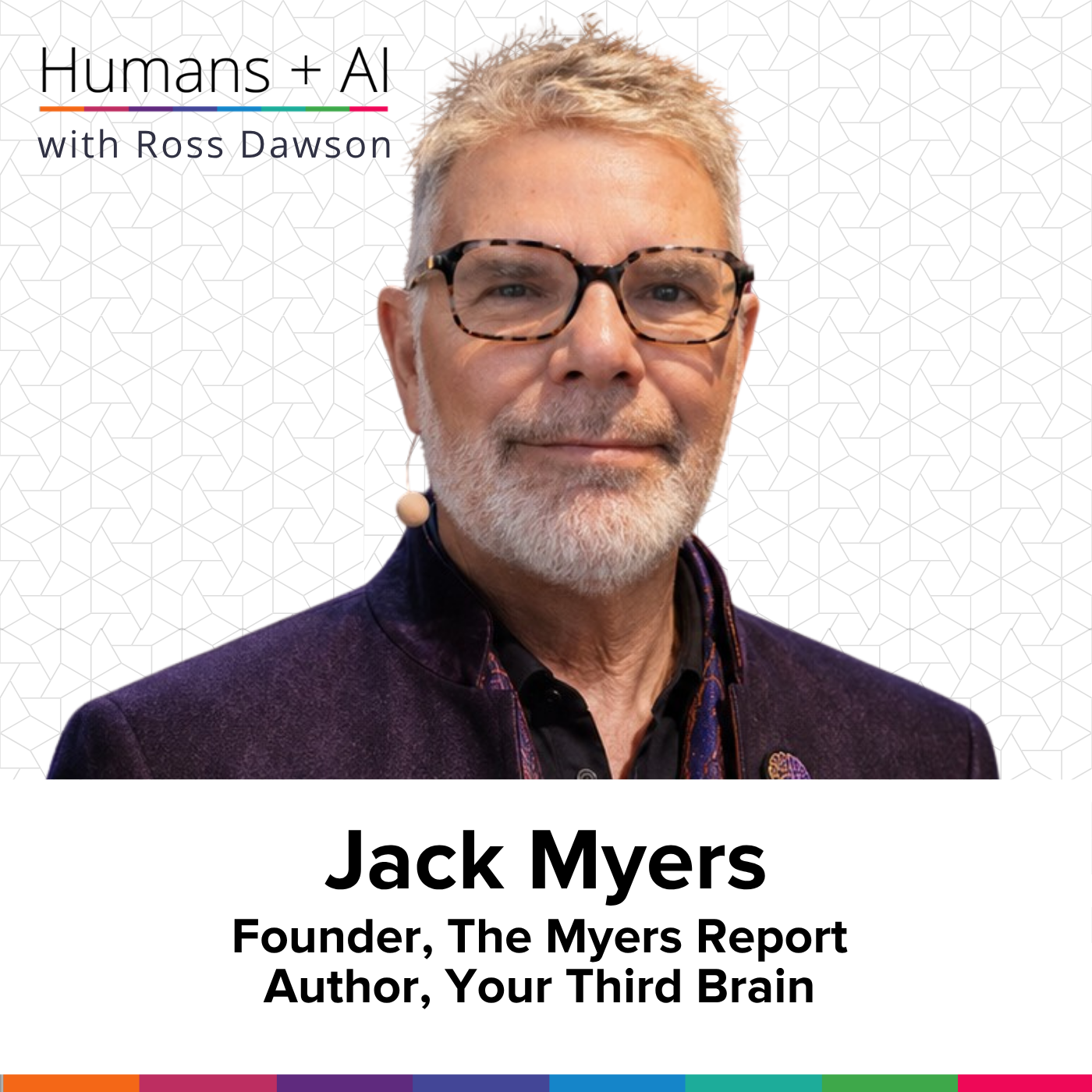


"AI can help us see patterns we couldn't see, ask questions we wouldn't have asked, imagine possibilities we might never have imagined alone."
–Jack Myers
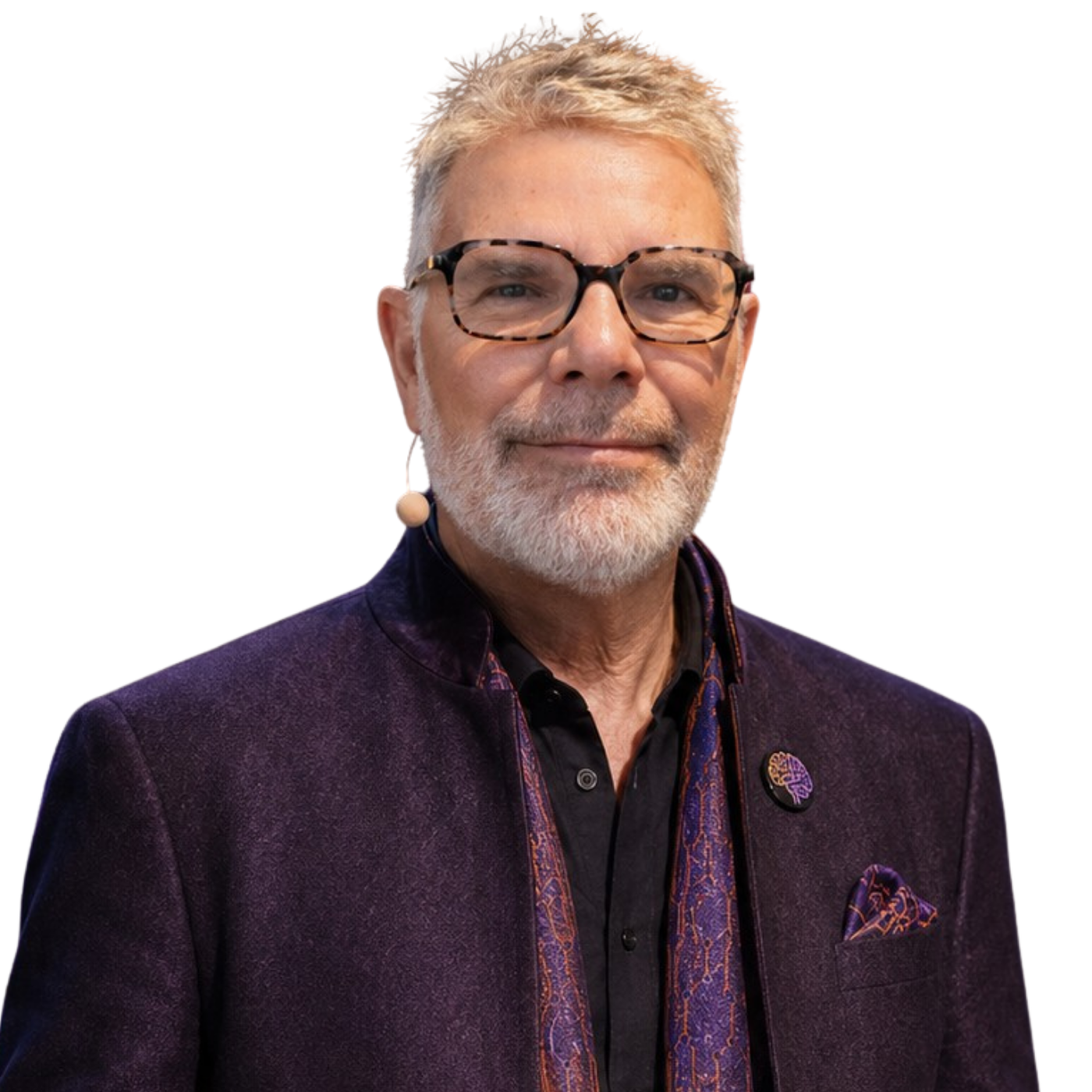
About Jack Myers
Jack Myers is a prominent media ecologist and founder and chairman of The Myers Report, a media industry intelligence report and strategic guide. He is an Academy and Emmy Award nominee for Best Documentary Feature, among many other awards for his work, and author of four books, most recently Your Third Brain.
What you will learn
- How human judgment and values remain essential alongside AI's rapid advancements
- The concept of the 'third brain'—a collaborative partnership between human and machine intelligence
- Techniques to develop 'techno intuition' when working with AI tools, ensuring AI augments rather than replaces your thinking
- Why intentional pauses and 'useful friction' between humans and AI can lead to better decisions
- How AI can transform organizations by breaking down silos and supporting collective intelligence
- Strategies for leaders to preserve trust, empathy, and meaning in the age of automation
- The risk of eroding customer relationships by over-relying on technology and ways to deepen human connection
- Practical ways to apply AI in personal and professional growth without losing accountability or humanity
Episode Resources
Transcript
Ross Dawson: Jack, it is a delight to have you on the show.
Jack Myers: It's my honor to join you, Ross. Thanks for inviting me.
Ross: So, one of the fascinating things about you and your history—you're kind of a media wizard, and you studied under Neil Postman at New York University, NYU, back in the day. Not everyone knows Neil Postman, but I remember reading the introduction to "Amusing Ourselves to Death," a book written in the '80s, where he said everyone's been afraid of 1984, but in fact it's turning out like Brave New World.
And how prescient was he?
Jack: Exactly. Brave New World led to Marshall McLuhan and "the medium is the message," and to Neil Postman. Then, as a media ecologist for the 50 years of my career, I consider myself as having a responsibility to continue the work that they began.
Ross: Fantastic. So, how did it form you, that working with and studying with Neil Postman?
Jack: Well, Neil wrote so many books, and I remember walking into my very first class. I had been working at ABC Radio and had an opportunity for them to pay for a master's degree. I saw something called media ecology at NYU, and it had the word "media" in it. I was interested. I walked into my first class.
Neil was teaching the opening class, and I would say in the first 20 minutes of that class, I learned more than I had learned in four years with my bachelor's degree at the Newhouse School at Syracuse University, which is not chopped liver for sure. It was extraordinary. Neil's "Amusing Ourselves to Death" is in the books behind me, and the notebook from that class sits back there too. I can even pull it out.
I think on the cover, if it were still there—it's been ripped and torn—it says, "Read this regularly," because it was an education on the impact, role, and influence of media on culture, society, business, politics, and vice versa, and how media and our world, our lives, are so integrated since the printing press and through all forms of media. What Neil taught me that I think was most important and most influential right now is: don't ask only what a technology can do for us, ask what it is doing to us. That question has really guided my career in media and why I don't see AI as just a tool. AI is really changing or augmenting what it means to be human.
Ross: Yeah, which very much echoes, of course, Marshall McLuhan's phrase—actually, I think it was slightly misattributed—but, "We shape our tools, and thereby our tools shape..."
Jack: ...us. Yep, exactly. And Neil said the media is the metaphor for a greater challenge to society.
Ross: So, I used to be very focused on the future of media—it used to be the center of what I worked on. One of the things I said at the time is, "Media is everything." If you think about media, it is communication, and an organization is lots of communications internally, lots of communications externally. There are some physical manifestations of it.
So, if we think about media as a metaphor for everything—literally humanity—where does that take us?
Jack: Well, the opportunity is not that AI will make us faster. Faster is nice. Look, at my age, I like anything that gives me back time, but speed isn't the only breakthrough. AI can help us see patterns we couldn't see, ask questions we wouldn't have asked, imagine possibilities we might never have imagined alone. That's what I mean by your third brain—it's not AI replacing the human mind.
It's the experience, judgment, memory, values, and imagination really entering into a collaborative relationship with machine intelligence. I like to say that the pause is the most valuable human quality we have. It's really quite simple: don't let AI answer things too quickly. Don't just assume that what AI is giving us is correct. It's not that it makes mistakes or is wrong, but we can't allow it to be the optimum cognition or assume that it's got greater capabilities and potential than we have as humans.
Ross: I just had this very interesting conversation last night with Michael Bernstein of Stanford. We were talking about this idea of useful friction. So essentially, if you've got humans and AI and you have no friction at all, then basically AI takes over because the human is a barrier. So you start to introduce useful friction.
There is an optimal cognitive load for humans—as in, if things are too easy, then humans check out; if things are too hard, we also check out—so you need to engage us in the right amount. There's this—I've got to look it up—there's Yerkes-Dodson, I think it's called, which basically says, yeah, this is the middle, this is the place where you lead to. So this is this friction. How do we design that friction, or the pause? I think it's very much in the same intent—how do we design this, not as fast as possible, but to build the right pauses or reflection time or friction between the humans and AI?
Jack: Exactly.
Ross: So, while we're on that, how would you think about how we put that in place? How do we make that happen?
Jack: First of all, I tell people: use AI the way you would use a very bright colleague who has read everything, remembers everything, and has absolutely no life experience of their own. That person's useful—extremely useful, potentially—but a final authority? Not a chance. We have to realize, when we're thinking about AI or that colleague in that context, it's only five years old, and really about as mature as a five-year-old.
Sometimes it walks across the street without looking, and we have to be careful that we're pulling it back where we need to, and watching over it. So the practice I recommend is what I call techno intuition. It's the ability to sense when AI is expanding your thinking versus when it's substituting for your own thinking. Ask it for an answer. Ask it what it may be missing. Ask what a person with lived experience might say. Ask what would make the answer that it's giving wrong, and ask it to challenge itself, and to tell us what it would do if it were us. It's amazing the kind of answers you get when you really challenge it. The third brain is strongest when AI improves your thinking without AI taking ownership of your thinking.
Ross: I agree with that. I don't want my thinking outsourced. But let's come back to that techno intuition. The thing about intuition is it can be right, and I guess it more often is, but sometimes it's wrong. So, how do we nurture this techno intuition? How do we get ourselves to where intuition is more accurate or not?
Jack: That's a big question. I think AI can be a remarkable strategic partner if we stop treating it as the oracle. An oracle gives us answers, and a good strategic partner creates better questions. So when I'm thinking about a major decision, I don't want AI to tell me what I already believe in more polished language. I think that's dangerous—to ask it to just enhance what we're doing without being critical of it. To ask it to do what we can do ourselves is—well, it's just giving us bullet points for what we already know. I want AI to stress test my assumptions: what am I not seeing? What would a competitor notice? What would a 25-year-old customer reject, given the generational differences that we have? What happens if the timing is wrong, if the data is biased, if the business model collapses?
That's where I think AI can help us, can help leaders. It can create scenarios, reveal weak signals, surface contradictions, and I think it can challenge the confidence that a lot of us bring to our decision making with experience. Experience—like the case studies at Harvard or Wharton Business School—are becoming quickly outdated and irrelevant in AI-led businesses. So I think the answer to your question is: the human role is to decide what matters. AI can model risk, but it can't carry responsibility. It can recommend an investment, a strategy, or restructuring a market entry, but only we as humans can say, "This is the future we're willing to stand behind and be accountable for."
Ross: So, let's just come back to—you've referenced your new book, Your Third Brain. So, what's the first brain? What's the second brain? And what's the third brain?
Jack: Well, the first brain is the biological brain we were born with. The second brain is our communications—our social, our cultural brain. The third brain is quite simply the collaborative process between human and machine intelligence. It's the first time in history—human history, any history—that we've had a partner, a collaborative partner, who is smarter than us, who has the history beyond what any of us can process in our own mind.
So I believe that the third brain is basically—not artificial intelligence replacing human intelligence—but a new relationship in which human experience, emotion, intuition, and purpose work alongside machine intelligence. What interests me, Ross, in that context is not simply where AI is going, but what it's doing to us, who we're becoming in relationship with it, and how we can remain the authors of our own decisions and our own accountability.
Ross: Excellent. So there's a bunch I want to dig into there. First, the second brain is essentially the social brain—how we are thinking together with others. We are social animals. We learn from others. We think with others. We learn in conversations. The thing is, when most people talk about adding AI—our relationship with AI cognitively—it is an individual relationship. Now, there is this potential for AI to help collective intelligence, to support all these social interactions of the second brain, to make those come to life, so we can actually be more intelligently thinking together.
But it's almost like so much of how AI is built and how it is used comes down to individual use—this chat interface at the moment or other interfaces where we just interact with it. So how do we take AI to make it a social tool? How do we design that? How do we think about that?
Jack: A significant part of your third brain is collective intelligence, because every entry we make in AI, everything we do, every search we do, is data. It's a form of knowledge that's going into the collective reality of AI.
Collective intelligence is different today than we've thought about it in the past. It's not a committee coming together. It's not the same as putting more people in a room. We've all been in those rooms—management by committee—and sometimes the room gets smarter, and sometimes it just gets louder. The promise of AI is that it can help organizations hear what they usually miss. It can connect ideas and people across silos. Organizations and corporations have been built on silos, on P&Ls, and AI is the beginning of a massive breakdown of silos in organizations.
In that context, it can summarize, disperse knowledge, and bring it together. It can identify patterns in employee and customer experience, and it can surface the uncomfortable signal that's often buried under the organizational noise, especially during disruptive times and when people are being displaced and replaced. But wisdom—the key word. When we think about intelligence, we also need to think about wisdom, and wisdom requires the willingness to be changed by what we learn, and the willingness to unknow the knowledge that no longer serves us. Part of collective intelligence is unknowing what no longer serves us, and that's a real human test.
AI can bring a frontline employee's concern, a customer frustration, a cultural shift, a weak signal into the conversation. But the bigger question today is: Will leaders listen? Will governments listen? Will they understand? Will they capture the opportunity? Will they allow it to change their decisions, or will they use AI simply to produce more elegant justification for what they already planned to do? That's one of the dangers in the current discussion about the role of AI in the swarms and the activity of AI independence, as I call it. Again, I come back to the child learning to be independent, and you have to impose some rules.
Ross: So, part of it is—throughout our conversation, you've given all these examples of how you would interact with AI, which demonstrate you are clearly a power user. You're interrogating it, making it a good thinking partner. But not everyone has that skill or inclination. They're just being given this thing, and they just go down rabbit holes.
So I think there are a few things here. One is obviously skills or education or awareness—getting people to think better about how they use these tools. Another is the design of the interfaces. I think there's plenty we can do to design interfaces to do that. And part of it is also just the systems in which we sit, and part of that goes to where AI is not just this individual interactive tool; it is set within teamwork, within organizations as a substrate for how we interact with each other, and so on. So, along these or any other dimensions, what are the things which you think can help more people be better at interacting usefully with AI?
Jack: I want to come back to Neil Postman and media, because I look at these questions and the work that I do today with large organizations and with individuals through the prism of media. I look at media as being the warning label on the AI bottle. It's the canary in the coal mine that stopped singing years ago. I hope your audience knows the canary in the coal mine.
Ross: Explain it quickly.
Jack: I think of it as coming out of the Pennsylvania coal mines, but I think it came from England and the coal mines there, where they'd leave the canary when they left at night, and if the canary wasn't singing in the morning, then they knew there was gas and they shouldn't go in. I look at the media industry as having that—the canary stopped singing a number of years ago and no one paid attention, and it's been on a downward track. Across the world, legacy media has declined as technology has really taken over the media. I think that answers your question, because the media industry had extraordinary creativity, extraordinary brands, extraordinary relationships with their audiences, and then little by little, it surrendered the relationships. Discovery of content moved to search, conversation moved to social platforms, advertising value moved to data, and data moved somewhere else. One day, the media industry looked up, and the advertising business looked up and realized it still had content, but much of the relationship had been captured by the tech companies.
That's the danger for every business now, and for every leader and executive and professional now—from health and wellness, to financial services, to the legal profession. It's already impacting education. AI will change organizations not just by automating tasks, but by shifting where value is created and who owns the relationship. If an AI assistant becomes the primary interpreter between your company and your customer, and the supply chain is run by AI, you become invisible. So the question for leaders, for everyone, is not: do we use AI just to become more efficient? It's: how do we use AI to deepen the relationships, deepen the judgment, the discernment, and the trust that really matters in relationships and really differentiates us from the machines.
Ross: Well, it's a great framing, but I want you to—you said, okay, we've got to ask how we can use AI to deepen relationships and judgment and how those are manifest in relationships. All right, so if you're a leader of a—let's call it media organization for now—how do you do that?
Jack: Ah, I love the question. First of all, the best organizations will redesign work around the human strengths: curiosity, empathy, synthesis, accountability, and meaning. Sure, AI will handle more of the pattern recognition, the coordination, the simulation, and production. But humans have to remain responsible for the purpose and the consequence, the accountability. It's not about humans versus AI—it's meaning amplified by machine capability. What I would do—I have a little cheat sheet here. First of all, I think breaking down silos. I said before, Peter Drucker wrote a book, The Concept of the Corporation—I think it was 1952—and he said the two primary purposes of a corporation are marketing and innovation, and he also said that corporations should organize around capabilities, around silos, and every team should have its own P&L. Well, that organizational model in an AI world, in any world today, is not working. So I change it to marketing and integration—breaking down silos, integrating across capabilities and organizations.
Yes, that means scaling back on people, but it doesn't mean people are being replaced by machines necessarily. It means that replication of capabilities that's being duplicated across multiple organizations needs to be brought together, with AI being the resource, the partner, the collaborator to help break through those human barriers that often prevent the breakdown of silos and integration. Marketing—the statistics on the percentage of chief marketing officers who report directly to chief executive officers has declined from 63% of CMOs reporting to CEOs in 2024 to just 48% in 2026. So we're seeing a decline in the role of marketing, and AI is at the core of marketing's capabilities to integrate across media, creative, public relations, and customer experience. So marketers have been disintermediated at the very time they should be mediated. Especially in the United States, human resources—due to our political environment—have been dismissed, disintegrated. DEI, diversity, equity, inclusion, has been treated as illegal. Accenture just settled a DEI case with $25 million paid because it had DEI regulations internally. These are the people who are the most important in an organization today, and the ones who should be in charge, with marketers, of how to use AI. So I would say we need to reinstate and reinstill the importance of trust, credibility, relationships, accountability, judgment, ethics, presence—human presence. I get passionate about this because I see that, especially again in the United States, we've lost the importance of the human relationship, and the danger is that we allow technology to move in as it has in the media industry. I hope I didn't talk too long on that.
Ross: No, that's good. So, something just came up there, but we're talking mainly around within organizations. One of the points, particularly for media organizations or anything which has a relationship with customers, is how do you instill that trust, that feeling of relationship with your customers? Back in, I think it was '98, a couple of BCG consultants wrote a book called Blown to Bits, where the thesis was there is now no longer a trade-off between richness and reach, and so with the internet you can have rich relationships with as many people as you want. They always say, well, it's half right. It does extend that ability to reach more people with richer relationships, but the trade-off still remains.
I think there's a very similar thing with AI now, where AI—you can arguably have a richer relationship with more people, but there is still this trade-off. There is still something which erodes from that truly true relationship and feeling of connection and brand and so on. So, how do you manifest this with your customers? I say, particularly, I think a media organization is a great example of that because it is a communicator by its nature.
Jack: Customer relationships are probably the single most important concern that a company should have. The point you're making is an interesting one—that you can have deeper relationships with more customers or individuals. I don't necessarily agree with that. When you're dealing with customer relationships, I think every company, every leader should ask: what happens if you were to ask your best customers—your two, three, or four best customers—what makes you unique? What keeps them with you as opposed to moving to your competitor? If their answer is the technology or the data, then you're going to lose those clients because someone else will come in with better technology or more data.
If it's people—if you lose one of your best people who has the best relationships—are your customers going to suffer? Are they going to be concerned? If not, then your people are not doing the job they need to do. The best teams, I think, will use AI not just to accelerate consensus but to protect dissent. They will ask, "What are we overlooking? What's not represented in the decisions, or the answers, or the strategies that we're putting in place? What are we hearing from our customers that we're not? When we're listening to our customers, what are we hearing, and what are we not hearing? What's the inconvenient truth that keeps appearing?" I think that matters beyond business. Societies don't become wiser just because they have more information. We already have more information than we know what to do with.
I think societies become wiser when they develop better ways to pay attention, to make meaning, to act with responsibility and accountability, and that's really what I call the third brain challenge at the organizational, but also at the civic level. Where are the ethics? Who's making the ethical decisions? AI can describe a feeling, but it can't feel. It can't, in a conversation with a customer, discern what's not being said, what's being felt, and only humans can feel other people's feelings. You can describe your feelings to AI, but it can't feel with you, and that's where I think we need a positive evolution between how we relate to and understand the opportunities that AI creates and the dangers that it imposes—not just the technological concerns that are right now and today, but the concerns about the lack of ethics being built into the systems, the lack of accountability in some form being built into the systems.
Ross: So to round out, what are your few recommendations? The idea is everyone is a leader, but what's your recommendation to leaders in this world, with this emerging third brain, on how they can bring more prosperity to themselves, their communities, their organizations, the world? What do we need to be doing?
Jack: Well, I'd of course like to answer, "Order and read Your Third Brain." But if I could ask—
Ross: What does your brain tell you?
Jack: If I could ask listeners to take one action, I guess it would be to choose one area of your life or your work where you've quietly lowered your expectations for yourself or for others—colleagues, a family member, a friend. Enter into a conversation with AI and bring your best self—your honesty, your goals, your highest human aspiration—to challenge what you can do to again raise those expectations, whether it's for yourself or for others.
I'm not recommending a to-do list. I'm not recommending a 12-step program. I'm saying: ask, what do I want to understand more deeply? What problem or reality have I accepted in my life? What pains me? What relationship, organization, community, or future do I care enough to want to improve? What health concerns do I have? What relationship concerns do I have? What do I wish I had a lawyer to help me with? What would I like to learn? What have I always wanted to learn my whole life, but haven't had the opportunity?
I think that's why I wrote The Third Brain and where the third brain begins. I think a lot about my grandchildren when I'm asked this question, and what do I want for them? They're going to grow up—they'll never experience AI as something new. I have six grandchildren. My youngest are three and five months, and I like to tell the story of my friend whose child's first word was "Alexa," because it was the word that his child heard the most in the house. My hope is not that they become efficient users of machines or turn to machines, but that they become fuller human beings because they learn how to think with machines without surrendering judgment. Because they don't have to unlearn; they only have the opportunity to learn.
I think our responsibility as parents, educators, coaches, leaders is to make sure that we build into our teaching, into our leadership, empathy, imagination, creativity, courage, willingness to take risks, and I think mostly—I keep coming back to the word—accountability, to be accountable for decisions. AI is not accountable. I was in a meeting with one of my clients, and I asked, "Why did you make that decision?" The answer was, "Well, the AI told us to do it." The AI is not accountable, and that was actually one of the triggers to why I wrote The Third Brain—not a book about becoming more technological, but a book about becoming more fully human in a technological age.
Ross: Fabulous, great answer. So, where can people go to find out more about your work?
Jack: Thank you for asking. JackMyers.com—J-A-C-K-M-Y-E-R-S. JackMyers.com, jackmyersbooks.com, and my Substack is themyersreport.substack.com.
Ross: Fantastic, loved the conversation. Thanks so much for your time and your insights and your work, Jack.
Jack: Truly honored to join you, Ross. Thanks for including me.
Podcast: Play in new window | Download