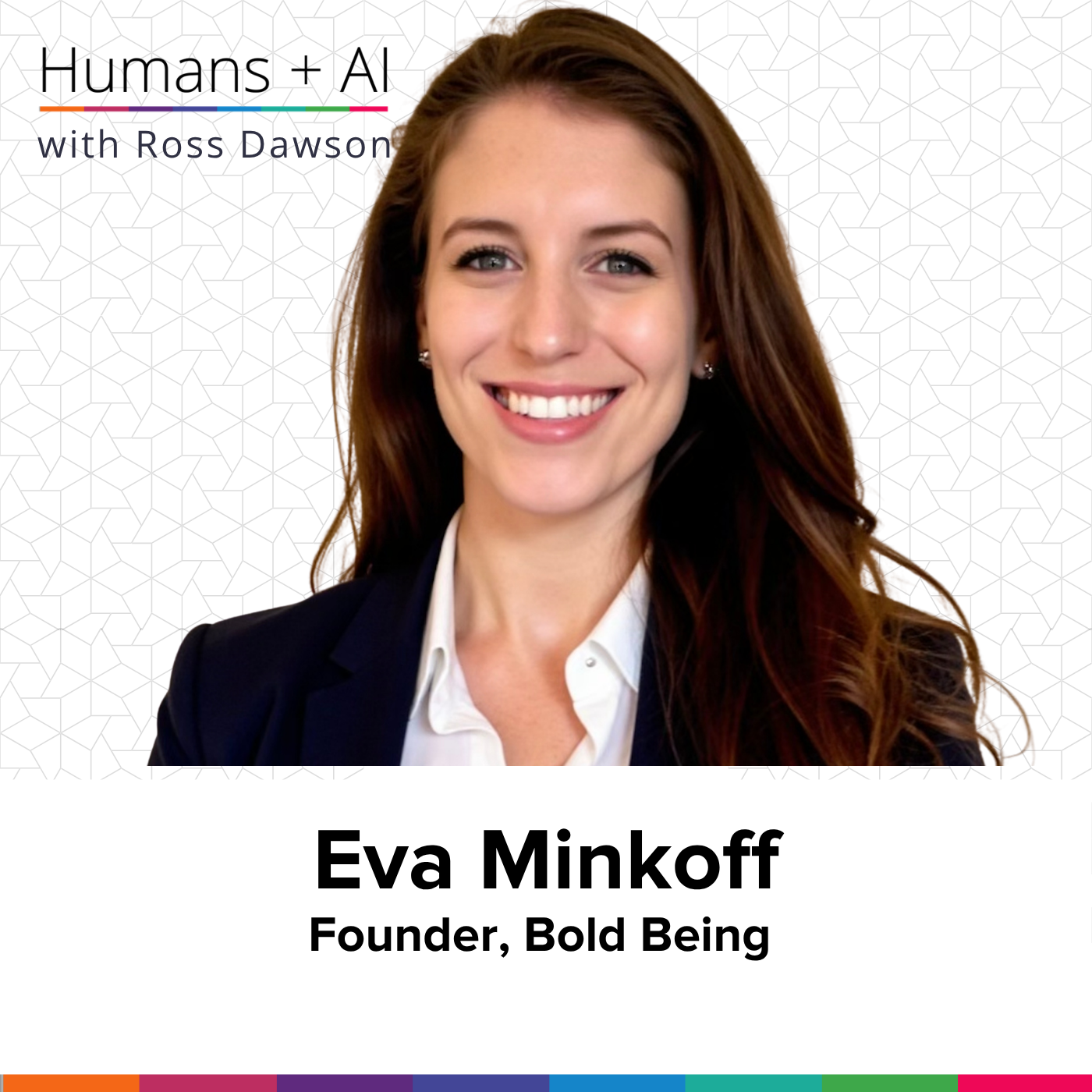


"If we are in touch with what is driving us in all that we do and say and be on this planet, that will allow us to have that stable foundation from which to move forward."
–Eva Minkoff

About Eva Minkoff
Eva Minkoff is Founder of Bold Being and Chief Transformation Officer of Transformental. She works with senior healthcare leaders to help them lead transformation in their organizations and across the industry.
What you will learn
- How AI creates both threats and possibilities for human identity and value
- Why the rapid pace of AI brings deep uncertainty and shifting norms for everyone, regardless of their stance on technology
- The importance of understanding and connecting to oneself—including self-compassion and self-awareness—as a foundation for wellbeing in the AI era
- How AI can augment creativity and human potential, rather than merely replace existing strengths or talents
- Why mental health and authentic human connection have never been more critical in navigating transformational change
- How embracing vulnerability and admitting uncertainty are essential leadership skills when confronting unknowns in AI-driven organizations
- A practical three-step approach (Admit, Identify, Meet) leaders can use to foster connection and resilience among teams
- Insights from interviews with healthcare executives on overcoming fear, embracing adaptability, and leading transformation amid AI disruption
Episode Resources
Transcript
Ross Dawson: Eva, it is wonderful to have you on the show.
Eva Minkoff: Oh, so wonderful to be here. Thank you.
Ross Dawson: So we have wonderful, wonderful things that are humans, and we also have AI. And sort of in your words, you say, well, there are some threats, and there are also some possibilities. So perhaps to start off—and we'll dig into this more—what are the core of the threat and the core of the possibility?
Eva Minkoff: Yes, I'm not one for extremes. I do like to live in the messy middle, in the gray, and so it is important to look at both extremes so that we can find the threat—and yes, I use that word, even though it is not commonly used, in my opinion, when talking about AI, with the exception of job loss.
For me, I think that's really at the core of what humans are experiencing in the age of AI, and something that I came across in research that I've been doing with executive leaders navigating AI is that it doesn't matter if you are the most gung-ho person, avid user of AI, lover of AI, or deathly scared and avoiding it at all costs. Everyone is experiencing at some point some version of identity threat because our experience as humans is fundamentally shifting. Our norms are shifting. How we operate is shifting.
And most importantly, therefore, how we see ourselves, our lives, our value is shifting, and that's why I use such a heavy phrase as identity threat.
Ross Dawson: So there's also possibility.
Eva Minkoff: Yes, possibility. So humans, you know, we've been around for quite a while now, and we've gone through eras of really transformational changes, really transformational experiences in how humans function. The difference is that this one's happening at a greater speed, greater pressure, greater scale than ever before. But because we've lived in a place of possibility in the past, we have risen to the occasion. We have been able to adapt. That possibility is absolutely there now.
Admittedly, I think to many people, even those who are avid users of AI, at some point will think to themselves, "Yeah, but it looks a lot more difficult, and there's a lot more uncertainty, and I really don't know what the future holds." And I don't say that to be a negative Nancy. I say that to validate what we're up against when we're in the place of possibility. Humans have boundless opportunities to grow. Truly, I mean, I believe that we at some point will probably be able to access parts of our brains, and there'll be telepathy and whatnot. I don't know, but we truly don't know what we're capable of.
And what I love about AI more than anything is, as many say, the ability for it to augment what we already have. There's someone I interviewed who actually talked about John Lennon, you know, from the Beatles, and how he was known as one of the most prolific and genius songwriters of all time. And now I heard that more than half the music on Spotify is AI-generated—some crazy fact like that—and you know, good catchy songs. What if John Lennon was alive today? Think about his innate brilliance and talent, and how he saw music in a way that was so unique. And if you added AI to that, it's not that AI would create a John Lennon song. It's that it would elevate what he has. Like, I would love to experience that. I wish he was around to work with AI, or maybe we'll do that with his music. But the possibilities are endless, and I am very optimistic in that we don't know what's to come. But if we look toward that, it will help keep us afloat amongst many other things that I would love to talk about.
Ross Dawson: Yeah, yeah. Just on the creativity point, I mean, I think that there's many creators who say they do not want to be augmented by AI and they will choose not to. And I suspect John Lennon wouldn't have. But I have also seen many creators—filmmakers, sculptors, artists, and musicians—who have chosen to use AI to augment themselves with quite extraordinary outcomes, which has taken us to new spaces. I think that's really important.
So one of the things—a lot of your work is around mental health, and I think that's absolutely fundamental. One of the things around, if we can say there was one silver lining to COVID, it was that people have now recognized more broadly the importance of mental health. We can talk about it more. It is more acknowledged, and it always has been, you know. Humans are frail. We are strong, we are frail, and we do need all the help we can get in navigating what it is. It is difficult to be alive, as well as a glory and a blessing.
So mental health and AI does impact that. It changes who we are when we interact with AI. It changes who we are. So, one part of your work is around connection, and I think that's the heart of mental health. You know that we are social humans, social animals. We are connected to other people. So, love to hear how you think about connection at the heart of what it is to be, and perhaps then from there we can look at how AI impacts that.
Eva Minkoff: Absolutely, it's not just that we are social beings. It's not just that we need to connect with others, though that is fundamental, and we are wired for connection, but I also like to take it a level deeper and consider connection to self first. A lot of people will call this self-love, even just self-like, self-compassion, and I see that first and foremost as understanding oneself, because how can you have compassion really for anyone or anything if you don't understand them?
And now, when I say understand them, you can have compassion for a person across the street who's crying, and you know literally nothing about them, but you know about the human experience. You can recognize that emotion in someone, and you can connect through that. And so, first, look at yourself and think, okay, well, how do I know myself as a human on this planet, including what maybe I don't love, maybe what I do want to change, maybe what is a reality for me, like actually having mental illness. So one, understanding that, and then two, not making yourself wrong for who you are, and that is something that has fundamentally changed my life and the life of my clients, my colleagues, friends, and family—taking off that pressure of needing to be in the right or wrong or the good or bad.
A true part of connection to self is seeing yourself, loving yourself, despite who you are and how you show up, hopefully wanting to grow, right, and do right. But you know, we're human; we make mistakes, and everybody's got their stuff, as I say.
Ross Dawson: So, what happens when we put AI into that?
Eva Minkoff: So, as humans, it can be difficult to connect at baseline when we are confronted in any way, shape, or form. That could be from stubbing our toe to having a cancer diagnosis to having an argument with a partner to having a kid who's throwing a tantrum—whatever confrontation to the human experience is. And to put it very simply, like I have a whole philosophy around this and a way to expand on it, but let's just go with survival patterns like fight, flight, freeze, and fawn. I think most people are familiar with at least the first two.
Now, this is how humans operate, right? Like I said, when we're confronted, when we're stressed—insert negative emotion here. AI exacerbates that, and for some, so much
Ross Dawson: so. So why or how does it—why or how does it exacerbate it?
Eva Minkoff: So let me see if I get this right because someone quoted it yesterday, or someone said this yesterday, which was: all technology advancements in the past filled in our gaps, and AI is taking over our strengths. And it's still something I'm pondering about because I think there might be some elements of gaps as well. But it has this air of replacing us, even if it's not replacing our jobs or even something super specific that we do. It has almost infinite intelligence, and even for those who wouldn't bank their value in intelligence, it's still a part of being human. It's why humans are the top of the food chain, right? We are the most intelligent beings on this planet, as far as we're aware.
Now, if you take into consideration the survival patterns that we mentioned, which we're already reliably going to be in, and you take that existential threat of this other entity that, you know, quote unquote, could be better than us—I'm aware that it's not. A lot of people would argue that, but just this, like I said, the air of it being something that's kind of crowding our space, if you will—that is pretty much constant threat. And so you can imagine that if we're in fight or flight and whatnot all the time, the impact that's going to have—it's a biological response to have those, right? We all refer to when you're being chased by a lion that you can run at a certain speed, or kids trapped under a car and you can lift it, sort of thing. But that's a very temporary moment that humans are supposed to be in, and right now we are feeling it every day.
And I actually want to make this very clear: it's not necessarily because of AI directly. I say it's because of the AI era. It actually doesn't even matter if you're using AI or not. We are living in an era of constant change, fueled by AI, constant uncertainty. Honestly, I feel like uncertainty is the closest to an objective feeling that one can have right now. Like it's almost guaranteed that people are feeling uncertain in some way, shape, or form, in the micro and macro ways.
Ross Dawson: Pretty, pretty fair assessment, I would say.
Eva Minkoff: Yeah, like I know we can't really say that feelings are a fact. I mean, one can say, "I am feeling this way," and I guess that's fact for them. But feelings themselves—uncertainty is pretty close to it right now.
Ross Dawson: So switching, so we talk about threat and possibility. So, yes, I think, you know, there's many people I know who are close to the frontier of AI, and every time you see a model do something else, you sort of get shaken a bit, and it's quite an experience. I mean, you know, exhilarating, but yes, it does—I think you're right—it does challenge your identity. I think that's a really interesting insight.
But let's switch to the possibility side. I think that there's always two sides, so where do the possibilities lie here? And maybe there's something in between, so tell me if so, but what's the most positive frame we can take around this very real challenge, and how we can deal with it, transcend it, whatever.
Eva Minkoff: So, essentially, my whole career, the common denominator was around relationships and connection—literally in media, tech, community, clinical, all of it. And so I've been the biggest cheerleader of human connection, as you can imagine.
Yeah, and I say this because this is my weird optimistic view, and maybe actually a lot of people that come on this podcast, including yourself, feel this way. But a part of me is like, yay! Finally, now we're going to actually focus on it because it's a necessity, and I've always thought human connection is a necessity, of course, and empathy and compassion and vulnerability. And I work in the world of healthcare, so particularly in medicine, particularly between doctors and patients. But it's always been pushed to the back because it's—I don't know, for some reason, regardless of the amount of research that's proven the financial outcomes, it's considered fluffy and not necessary in order to move forward.
I'm getting to the positive part, I promise. Now, because of the breakdown we're experiencing in connection, it has truly never been more important to have that connection to others, to self, and I haven't even really talked about connection to purpose. And my purpose is to bring that to the forefront sooner rather than later.
I do believe that we will adapt once again. We will find our sense of normalcy again, but I do think it's going to take a while. I think this is going to be an ugly few years. That's one of my only real pessimistic views—is three to ten years? I'm really not sure, but not a futurist. I think it's going to be rough because it's going to take a lot of rock bottom moments for people to realize that I need to know myself better in order to—not just thrive, but even just survive in this era.
And so the possibility that I see is, we're going to get to know ourselves better. We're not going to be able to hide anymore because it's going to be necessary. We're going to need to be with each other, be human with each other, be real with each other. Because—I don't know how to put this exactly—but it's not going to work. We're not going to work as a human race in this era if we don't prioritize that. So the giddiness I have around it is we're going to go back to the fundamentals, the fundamentals that we should have been in touch with all along, and now we're finally going to elevate those in a way that will allow us to really—this is funny, I've never said this before—but to augment AI. I think if we're augmenting ourselves, we can augment the use of AI.
Ross Dawson: Yes,
Eva Minkoff: I like that. I haven't said that before.
Ross Dawson: Yeah, no, I absolutely, I see one of those opportunities as us understanding ourselves better, and you know, obviously many people use the mirror metaphor for AI. It's so like us, and we can see ourselves in it. They can see us in it. And if we use the mirror as well, it can help us to see ourselves better, or that's just one way of framing it.
But just a little bit more on the purpose, as I understand that that really is a critical part here, and where in times of uncertainty, purpose is perhaps nothing better to take us through. But we need to—that clarity is something which can pull through. We need to find a purpose which does evolve in a changing world. So, what is our connection to purpose, and how can we build that?
Eva Minkoff: So, a word I haven't used yet, surprisingly, is the word stability, because it's another way to put what's going on right now with uncertainty—is instability. And these three connections in particular—purpose—allow us to find stability, because it's something that is, I believe, innate within us. I actually don't think we find our purpose. I think we find the application of our purpose, which may or may not be through our careers. I think it's great if it is your career, but I have it that we were born with some drive to see something for humanity happen, or maybe not humanity—even this world. It could be animals, for instance, or the environment, and we can't help but live our lives through that lens.
I do think most of us are not aware of it, to be honest. Which, like I said, with all the connections, needs to change, and I think will. But if we are in touch with what is driving us in all that we do and say and be on this planet, that will allow us to have that stable foundation from which to move forward.
So, I like using extreme examples sometimes, really to hit a point home. So this might be a little bit sensitive, but I'm Jewish, and sometimes when I think about the worst of the worst, I think about my family that was in the Holocaust, and I read Man's Search for Meaning, and I think that's—if anyone knows what that book is, honestly, I think by the title you can kind of understand what it's about. And so I think about my purpose, which is possibility, and what I would do in that situation, how I would find possibility, how I would help others find possibility, and that being my purpose, even in the worst of the worst situations. And that's how I would find grounding and stability in myself, regardless of the starvation, the cold, the torture, whatever, you know, God forbid, may be.
And so, hopefully, no one's experiencing—or as few people as possible in this world are experiencing—something like that. But it gives us a sense of agency. Right now, the world is—because we're in this fight and flight, and what—it's a reactive state, and you can't be in agency when you're in a reactive state. They're really an antithesis of each other. If we are in touch with our purpose, it allows us to choose it actively. Even though, like I said, I think we automatically kind of are living our purpose, this is a place where you can always go back to choice and think to yourself, okay, with that in mind, how do I want to be? What do I want to do? And sometimes, how you want to be, how you want to respond, is all you need
Ross Dawson: to do. Yeah, yeah, absolutely. So in my most recent book, "Thriving on Overload," the first of the five powers is purpose. Ta-da! That has to be the starting point because without the purpose, you kind of get a bit aimless. And yes, I think there is the potential for AI to both provoke us to define our purpose and to take us to greater stability.
So you've been doing this extensive study, which I understand is lots of interviews with healthcare executives on how they're dealing with AI. Is that in fact—just for you to describe what the study is and what you've learned, so that others can learn from all of your hard work.
Eva Minkoff: Oh man, what I've learned. Okay, yes. So I did—as I said before, I work in healthcare. However, I'm a coach, a researcher, many things of humans. I just chose healthcare because it's my background, and I think it's one of the most high-stakes, high-impact industries. But these interviews were with humans. Sure, we talked about patient care and clinician well-being and whatnot, but we're just talking about humans here.
So I have now, as of today, 57 interviews with healthcare leaders in the last five months—it's been busy—and I took it on because I thought to myself, "How could this not be valuable? These are the people I work with and help as well, but I'm working with small groups or a leader one at a time. I want to hear from people from all corners of the industry, which really means all corners of perspectives, right? So it doesn't actually matter that it's in healthcare or not.
So I left it very vague. I said healthcare leaders. You consider yourself a leader. You lead in a group. I don't care if you're the CEO of a hospital or you have a two-person team. I will actually share that one of the most interesting findings was the gap I saw in trends in who showed up for the interviews. So I have a number of what I would call in-seat leaders, especially people in the C-suite who I really wanted to interview because they're usually at the forefront of decision making in AI rollouts. However, most of them were people I already knew.
When it came to the outreach, which was mostly people I did not know, there were almost no—was it like two C-suite leaders, and there were a couple reasons for that. One is they're in such survival pattern mode that they couldn't even think about it. They're really in like a freeze or flight or whatever it is, and they admitted to that. And then there's also a fear of exposure.
Now, I mark these interviews as initially confidential, and then if they want to be credited, they can. And I go over the very specific takeaways in quotes if they want to be credited. But it didn't matter. The depth of threat that they have been experiencing was something that most of them, especially because they didn't know me, just couldn't bring to the forefront. And I know this because I've been directly told, as well as sort of to the side told by people who work with those types of people, and also just fear of it coming back to them from a legal standpoint. Even though I don't care about names or anything like that, I care about thoughts, feelings, and behaviors. So,
Ross Dawson: what are the natures? So, what if you could distill it? I mean, or part of it's through intuition around direct—you know, what do you hear directly, and what do you see? What is the nature of this threat that these executives are feeling in the AI context,
Eva Minkoff: Sure. And the reason I went with the gaps first, to be clear, is it was really proving my thesis, my thesis of which we've spoken about with the breakdown in connection and identity threat. So I just found that interesting. I wasn't expecting that, and I think I have a few other gaps, but I won't go into that.
So, one in three—I've been putting together a bunch of findings now, and it will be ongoing—one in three said that they have some version of "they have no playbook, they have no precedent, they've never had anyone ahead of them," and I think I could say literally every single person said some version of "I don't slash we don't know what's going on," and I very much appreciated that candor.
It's very interesting that only three people out of the 57 actually said the word "threat," though, when kind of inherently, when you feel like you don't know, there is a sense of threat. People don't—we might not talk
Ross Dawson: about that as an executive in an interview. Use those words. So, you also found you're beginning to uncover that there were some effective responses to this challenge. It's true. Nobody knows. There is no playbook. Well, there's beginning to be a little bit, but basically, the playbooks are being written, and we don't know what AI is going to be tomorrow. So it's pretty hard to build some strong plans. So it is, yes, it is highly uncertain. It is very challenging to bring in and transform organizations with AI. So I think you did find that there were some useful responses in the people you spoke with.
Eva Minkoff: Oh, for sure. And I want to be clear. The findings I have are extensive. I'm going very, very high level right now. But
it would take a very long time to go through all the very specific ones, and I do plan on putting this out as a book at some point, and hopefully many other avenues. But yeah, I wish I could go through all of it right now.
Okay, so again, because there is so much I could say on what we have found, I'd say there's really three steps I was able to break it down into—what is advised and what leaders are doing that are actually thriving, not just individually, but in the outcomes that they're seeing. There's a lot of different studies coming out right now. I mean, even Bill Gates spoke about this like a week ago. I think that AI ROI is not doing so hot, to put it lightly. It could be anywhere from like 70 to 90% of companies are just not seeing ROI whatsoever.
And so, I've been looking at those that are, and not just ROI in terms of literal financial outcomes, but also, well, I guess in healthcare, like patient outcomes, clinician well-being, and all the things that lead to positive progression. And those three steps, if you will, really do tie in perfectly to the connection. So I was happy to see that it worked with essentially my thesis.
I call this the AIM method so far. Like I said, all this is a work in progress, but the A stands for Admit, which is the connection to self piece, and this is what we spoke about earlier. It's getting to know yourself, including what you may not like or what's going on with yourself. So admitting means saying to yourself, or even out loud, "Maybe I'm excited about AI, but I don't really know what I'm doing, and this is changing faster than I can keep up with and even absorb. I don't really understand my value now. Like, I'm recalibrating who I am as a person, as a leader." Being honest with yourself is key. It is number one. It is connection to self, and as we've spoken about, that's not something that can be skipped.
I would say there is a hierarchy to these connections, and connection to self is first. And some of the data that I collected was one in four leaders describe performing certainty that they don't have, and the ones who were very honest about that were the ones who actually were able to come forward and—I'll just say—be successful, with air quotes, in some way. That looked different for many different people. Like, they were comfortable with their own incompetence. Some of them said, "What is that phrase? I surround myself with people smarter than myself." Like making sure that they did that. Role modeling not knowing. And again, even though the word "threat" didn't come up very often, there was a recognition of "this feels unstable, and I have the ability to stable myself, stabilize myself." So I would say for the overall sentiments, that first level of connection—so admitting.
Second was identifying what hasn't changed, and that's when we come into that sense of purpose. Like, what's been true always about you? What's been true maybe about the organization? Like, what's the organization's purpose? It's important to keep in mind as well. What's our mission? What's our aim? What is true about me in terms of my core strengths? Who am I, even without the job title and role? Like, what do I know about myself and the situation or the environment that has not changed? So, I is for Identify—identifying that, and that is going to be the foundation for the steadiness that one has to hold on to in order to move through this era.
I would say that there's actually—I'll leave it at that. I think that's fine. Oh, and then the third is M, which stands for Meet your people, and so this is connection to others, of course. And one of my favorite phrases is "meet people where they are," meaning understanding.
So that whole connection to self element is—if you can connect to self, you know that other people have that version of that, and giving them the space and opportunity to do that, and to understand where they're coming from, I cannot tell you how key this is as a leader in the age of AI. We're talking about education. We're talking about addressing fears. Also, I mean, all sorts of resistance. There's like nine different types of resistance people have shown in the age of AI. If you don't know what your people are experiencing, if you don't even know what your family and friends are experiencing, you're not going to be able to connect with them.
And so, part of that, part of meeting people where they're at, if not really the first step, is modeling it. So that means going first—not just admitting to yourself that there's uncertainty and you don't know what you're doing, but admitting that to others. And that is something I heard in, oh my god, dozens of interviews—that the leaders that actually came forward and validated what their staff were feeling because they explained that they felt it too—it was like a 180 in the environment.
Ross Dawson: Yeah,
Eva Minkoff: You can't teach people change. You have to lead through change.
Ross Dawson: Yeah, no, that makes a lot of sense. I think that's really, really valuable. You do have to acknowledge—you do, you know, admit, as you say, that you know, don't try to pretend it's all normal and good and easy. You know, I was used to, you know, through my life—actually, a lot of my mission in my life is saying, well, recognize what's the same and what's changing, and what's the same, what's different, and that's a really important skill. And I think, as you say, there are some things that are the same, and that's something to give you that stability and understand, you know, you can corral the change. And of course, that meeting of people, the connection, is fundamental to it all.
So, wonderful, thank you for its insights. I think that all really nicely led up to these insights and your lessons there. So, where can people go to find out more about your work?
Eva Minkoff: I have a Substack called Human Leadership Now. I also actually publish it on LinkedIn, where I'm very active, and it's where I've been publishing and writing a lot of the findings as we go along. And I really appreciate people commenting because I'm getting more feedback, more insights on the insights I'm already posting. I actually love contradictions, so bring on the contradictions. That doesn't mean anything's wrong or right. All these viewpoints are very important and very telling. So I'm Eva Minkoff on LinkedIn. I don't even think there's another Eva Minkoff on LinkedIn.
Ross Dawson: Nice to be unique.
Eva Minkoff: Yeah, shocking, honestly. And so, really, that's the best way to find me. And feel free to direct message me, to email me. Relationships and connection are my thing. So
Ross Dawson: that's awesome. Thanks so much for your work and for sharing today, Eva.
Eva Minkoff: Thank you.
Podcast: Play in new window | Download