

"If you consider the unbelievably complex interrelationships among what can be millions of particulars, you can come up with more accurate and useful answers than if you try to go about using laws to predict them."
–David Weinberger

About David Weinberger
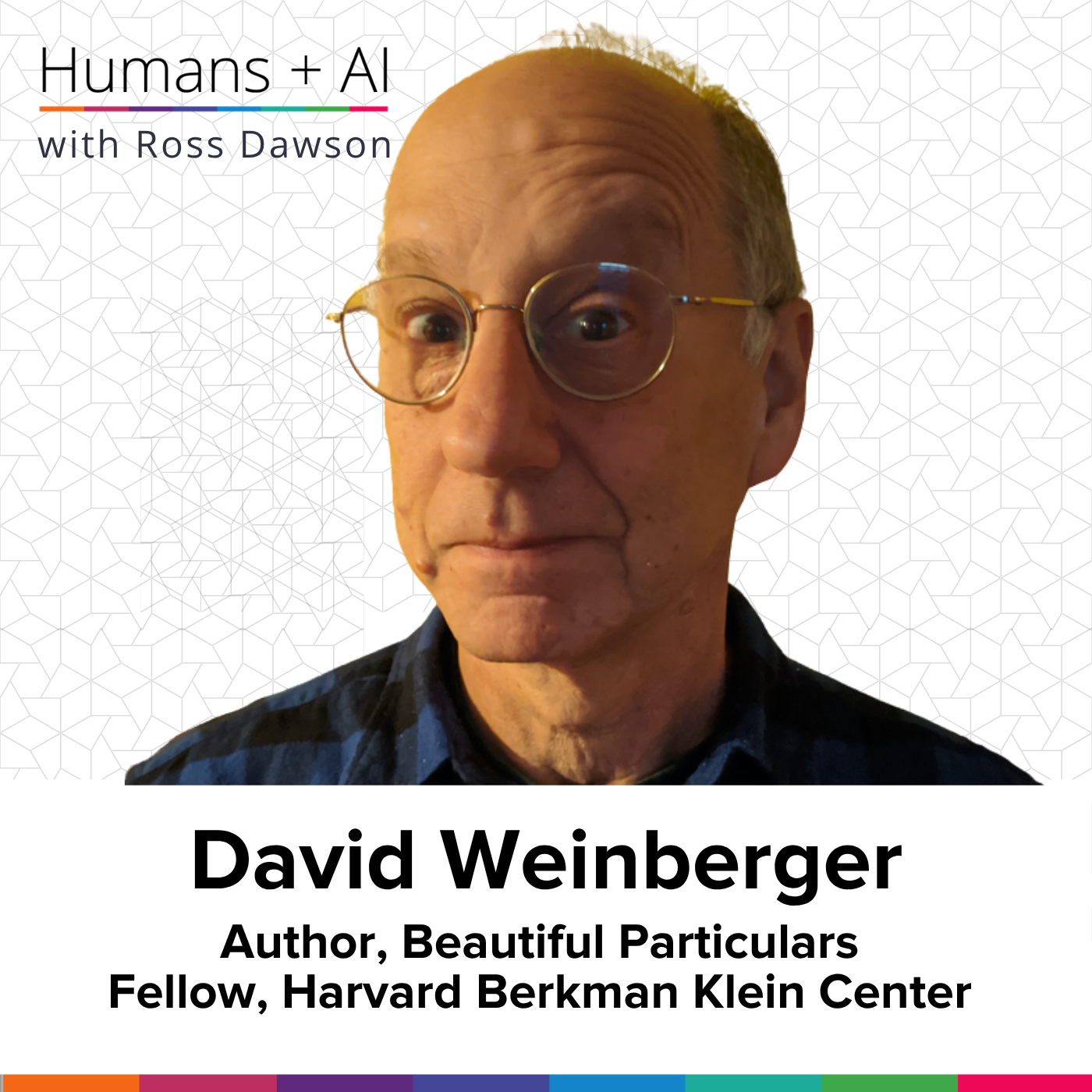
David Weinberger is author of five books, including next Beautiful Particulars, out from MIT Press in November 2026, and co-author of the bestseller The Cluetrain Manifesto. He is a Researcher at Harvard MetaLab and Fellow at Harvard Berkman Klein Center. David has delivered hundreds of keynote speeches, and published in New York Times, The Atlantic, Harvard Business Review, and many others.
Website:
LinkedIn Profile:
University Profile:
What you will learn
- How AI shifts Western thinking from valuing universal laws to appreciating particulars and complexity
- The philosophical impact of new technologies on our understanding of knowledge and self
- Why human cognition relies on generalizations, while AI excels at processing immense particulars
- How integrating human general thinking with AI’s particular focus can create powerful complementary intelligence
- The central role of embodiment—why caring, meaning, and moral life arise from our lived, bodily experiences
- How genuine moral decisions are grounded in the specifics of real-life situations rather than universal rules
- The importance of valuing art, relationships, and lived experience as expressions of unique, irreplaceable particulars
- An optimistic vision for using conversational AI to deepen learning, encourage curiosity, and foster better human interactions
Episode Resources
Transcript
Ross Dawson: David, it is a delight to have you on the show.
David Weinberger: It's a delight to be here.
Ross Dawson: You have a wonderful trajectory of thinking and books over an extended period, and coming out—well, perhaps not the culmination, but certainly on that trajectory—is a new book called Beautiful Particulars. So, what do you mean by beautiful particulars?
David Weinberger: So, the book has a premise. The premise is that historically in the West, at least for many centuries, we've understood ourselves in terms of our dominant technology. You can take this way back. You certainly can easily take it back to the printing press and the like, and so in the most recent age of computers, we started to think about ourselves in terms of information and controlled processes and inputs and outputs and bugs and the rest, and we actually have sort of an inner mental picture of how our mind works on that basis.
There was another major technology right after computers—the age of the internet—where everything started to look like a network, which is interesting and there's some truth to it, just as there is in the computer vision. But now it seems pretty clear we are at the dawn of the age of AI, and so the question is whether it's too early to start thinking about how that might affect how we think about ourselves and our world. And the answer is absolutely too early. But, you know, let's go ahead and give it a try anyway, and that's what the book does.
The thing that sort of corresponds to the way information and bits and processes and programs started taking over our minds in the age of the computer—what I'm speculating, and it is speculation, I wouldn't even know how to provide evidence for it and may well be wrong—the speculation is that in the age of AI, a few things are going to hit us really hard in the head, and some of them are important and obvious, such as the world is way more complex than we thought.
We know this because super complex machines can be more accurate in their predictions and do things we humans can't do when aided. But what the book focuses on is that the West forever has—well, let's just say since the Greeks, no need to exaggerate—has taken universals to be the most important sorts of truths. They're really useful because universals—Newton's laws are one type of example—they're real, they work, they're true, and they help us out a lot.
It's sort of amazing how well they work. But AI is showing us, I think, that in at least some important senses, universals are shortcuts, not the truth. They're really important shortcuts for managing very complicated and complex things—that is, things in the world—because the world is extraordinarily, beyond imagination, complex, of course.
So, the book suggests that the architecture of machine learning—the type of AI that it's talking about, which includes the large language models that everybody's talking about and talking with—that these things are made possible because they ignore, they reject the role of universals, of that sort of law, and instead just look at the particulars of cases. We call that data, but I'm calling them particulars because that's what they're standing for.
It turns out, just empirically, that in many situations, for many problems, if you consider the unbelievably complex interrelationships among what can be millions of particulars, you can come up with more accurate and useful answers than if you try to go about using laws to predict them, and that tells us something about the world. It tells us something I think really interesting about the world. It makes particulars, in some sense, come first. They're the reality.
It's not that the laws aren't true, and I'm not going to argue with Newton or with science by any means. I like those things, but we can make more advances through particulars in many areas now, and this tells us that the world—actually, particulars count for a great deal. In some sense, they're at least an underappreciated part of the universe in our culture.
Ross Dawson: So this is, in a way, a thesis about the nature of knowledge, and also the difference potentially between the nature of human knowledge and artificial knowledge, if we can call it that.
David Weinberger: That is a primary change, I think, in how we think—if, in fact, we are entering an age of particulars. There's no question about that, and AI by itself has pushed this crisis of knowledge, or at least a deep change in what we think knowledge is, for sure. The book talks about that, because how could you not? It's really, really central, but it also talks about how a view of the universe that privileges particulars might change other sorts of Western—I'll call them philosophical ideas, although that sort of alienates people from them when you put it that way.
But, you know, classics like free will and creativity and the nature of reality and little things like that. But knowledge is—it's really important. It's right on the firing line, so to speak, of this change.
Ross Dawson: So the thesis of my most recent book, Thrive on Overload, was basically finite minds and infinite information, and I think that there's actually a correlation there. Our minds are finite; we have to work through heuristics, as you say, reduce to go to generality. That's the only way we can function because of the limited frame, and that has been extraordinarily valuable to humans. We've been so good at being able to make those generalizations or those universals, but now that we have the complement of the AI, which can go into the particulars—that infinite, not just infinite information, but infinite ability to process—that we have complements, which I think goes to the point of the interface. How do we then interface effectively that human knowledge and thinking based on generalization and heuristics and structures and frameworks, with the particulars as you describe, which the AI can deal with? How can we interface the best?
David Weinberger: So first of all, I completely agree with everything you just laid out before you got to the question. So yeah, completely agree. And I actually like generalizations better than universals. Universals is a philosophical term that has a lot of baggage. Generalizations is, I think, a better term for it because generalizations find what's in common, and thus ignore on purpose—and for good reason, in a pragmatic sense—they ignore what the differences are among the things that are being captured in the generalization.
So, for me, I want to say easy part, but I'm not sure it's easy. It's just one that's dearest to me. We already, despite everything I just said, have a good sense of particulars as humans, and we use that in many of the things that are most important to us.
It used to be not in weather forecasting, where we since the early 1900s started applying Newton's laws to the handful of factors that we knew about with weather, but there are so many other areas that we tend to not elevate as much as I think we should. We don't regard them highly enough. So, in some sense, I think it's a change of emphasis. For example, art almost always works because of the very particular choices that the artist makes—whether it's a brushstroke on a canvas, or it's the jazz artist improvising, or the right choice of a word in writing. What hits us—and I have no right to talk for everybody, but I'm about to—what hits us when we really have to do a double take or get drawn into a picture or the writing is the particularity of the expression.
That's why art and science have an uneasy interface. It can be very useful at times, but I think many of us have the sense that the human experience of art often, and I would say essentially, is this getting blasted by the utter rightness of a particular choice, whether it's a note or a drop of paint or the curve of a marble sculpture or whatever. Likewise, in the photos that we love of our family, it's the look in the granddaughter's eye right then, or whatever it is. It's almost always, I think, the particulars that get us. You can look at examples outside of art as well, of course.
For example, in history, we've gone way past the belief that we can apply laws to history. There's still some value in looking at broad, sweeping changes, but I think we are already very attuned to the capriciousness of events, which turn on particular combinations of chaotic—who would have known? You know, the bullet missed. The bullet grazed his ear, and except for basically every small thing in that environment, it might have ended very differently, and it did for somebody sitting behind them. Of course, sorry, I'm referring to a Trump assassination attempt in the news as well.
And in conversation, and humor. Humor is all about it. It is 100% about getting the right words in the right order, and everything has to be right about it, or the humor doesn't work, and you don't actually see that in a lot of media. You can have a great movie in which not everything works, but for humor, for a joke, it is so particular and precise. It's also particular to a time, usually, and to an audience and all the rest of it.
If we start valuing that more than we do, and recognizing it as something that's so essential to us, and losing some of the worldview that emphasizes the—and now I will use universals because I'm thinking about laws of physics and laws of science in general—if we can, I think it changes a real commitment to particulars, which I think AI may be bringing us to—a real deep recognition that these are not little accidents that you can just say, "Oh, it's all just a bunch of accidents." Well, it is, you know, but it's not just a bunch of accidents. It's life, and it's many—explicitly many—of the things that we most treasure in life, including human relationships. You know, I did not marry a general person. I married a very specific individual.
Ross Dawson: I want to loop back to some of the ideas you were just expressing there, but I want to go to your intellectual history as well, as certainly is laid out in your book. So, you know, the first one, The Cluetrain Manifesto, was simply just pushing, taking us beyond the one-to-many model of communication, but if you just even go through the titles of your books, they are all in a way different facets of the same things.
All Small Pieces Loosely Joined, Everything Is Miscellaneous, Too Big to Know, Everyday Chaos, now Beautiful Particulars. Arguably, they are saying the same idea in a different way. Now there has been, of course, an evolution, a very strong evolution through those ideas. But just interested initially, just to reflect the essence—is there an essence of an idea which has been common throughout, and if so, how has that been evolving?
David Weinberger: Well, it's actually—I know this seems unbelievable, but that's absolutely correct. But I did not realize that my entire intellectual life has been about the same thing, and it goes way past Cluetrain, which was, as you say, about the power of nodes that are loosely—well, loosely connected. I guess that's the next book title. It's sort of ridiculous. I'd never actually grasped the whole thing, but my doctoral dissertation, which was in 1979—so it's a long time until 1999, we actually could do the math, I guess, between that and a tech book, in some sense, a book about technology—my doctoral dissertation was on Martin Heidegger's idea of things, you know, just stuff, things.
Heidegger, who over the past 10 years, or a little bit more than that, has been disclosed extremely convincingly as a—we always knew that he was just a bad human being, but not only a very committed anti-Semite, but his anti-Semitism seems to be buried, seems to have twisted his philosophy in a way that turns it into gibberish. Now, everybody who has studied Heidegger at least acknowledges it looks like there might be a problem there, but I think most of us at this point say, "Oh my God, it's essential to him. It's not a little side angle."
So it has, in my view and some others', made it impossible to—it explains why his ideas about being, which he, you know, big the being, which he elevates as the most important topic and the only really essential topic, and why it devolves into complete and utter, from my point of view, blather and sort of self-involved nonsense, which is such a shame, has something to do with his Jewish concerns. That's not the point. I'm a Jew, by the way. That's not the point.
The point is that even my dissertation, which was not on his idea of being, but of things that are things, the people who were evaluating it—which are, you know, external Heidegger scholars and the like—and they liked it, it was fine, I got my Ph.D., but both of them said the same thing: "But there's one thing that bothers me about it. You never talk about being." And it didn't occur to me that I didn't, because I thought, you're talking about things, you're talking about being. I don't have a separate idea of being as, and that's, I think, a different way of saying the same thing of the through line.
It turns out I've always been interested in the things as unique entities that are in relationship and only can be what they are because of their relationship to other things. That part of it is good Heidegger, and that's what I—and it wasn't until I was writing this book that I had a forehead-slapping "D'oh!" moment—as in, this is a Simpsons reference, which may be lost on some listeners—that said, "Oh, okay, yeah, everything I've written has been an extension of what I was interested in when I was a philosophy student," and I can't tell you why. I absolutely can't tell you why.
Ross Dawson: Well, we've all benefited from this. Yeah, this—well, I think in a way, certainly, it's been my experience. Is the world coming to you, as in everything we've been working for, from way, way, way beyond, is now more and more relevant?
David Weinberger: If that's the case, it's certainly an accident, right? I mean, I've just lucked out.
Ross Dawson: Well, so this goes to the point of, as I say, you know, it's human cognition and AI cognition, if we call it that. And this idea of the miscellaneous and the chaos and the small pieces and the particulars is what AI does. And we're now in this age today, we have that complementarity between the two—humans and AI, the human general thinking and the AI specific thinking. So you, in a way, you've nailed it, and that trajectory has come all this way.
David Weinberger: So I should just accept that because that's very, very nice. But one of the basic ideas of the book that follows from its premise—that we interpret ourselves through our tech, through our tools and things—is that in fact we may be thinking about ourselves in those very same terms, terms of particulars, not so much as a species that generalizes, which we do spectacularly well, which accounts for much of our success, right? I mean, that's why we're better at surviving in many ways than most creatures. Well, you know what I mean.
But I think, and in part because I hope that some of the holes that philosophy traditionally has dug itself into get new light thrown on them—at least some new light thrown on them—if we start really crediting particulars, things and their differences, and that's really the heart of the matter, we start taking them seriously as the stuff of life, as opposed to it only being what it is insofar as we can grasp it through generalizations.
Ross Dawson: So, throughout all of your books, you have been positive around the potential—dare we say optimistic around framing—that we can create a positive future. One of the lovely quotes from your book is, "Heal the split of mind and body, the philosophical wound the West inflicted on itself." And so, you know, that is, as I say, very Western, specifically that split of mind and body. And so now you're suggesting that we have a frame where we can heal that split.
David Weinberger: Yes, like many others, it seems to me to—the book, I think, several times reminds readers that it's only about the West, and that's the only—which is a terrible limitation. But it's my limitation. I do talk about this in the book, and it requires some fancy footwork, which is not good, right? Because AI is bodiless, and this problem is the genesis of many of the problems that philosophy has made for itself and made for all of us. So obviously, I think, AI has no body, has no mind from my point of view either. I don't think it can have, although many people disagree with me, and I'm not sure I'm right about that.
So maybe as we run in—this is going to be really optimistic, okay, Ross—as we run into the limitations of AI, that conversational AI, large language models, for example, if you spend a lot of time with them, or even a little time, they are remarkable. They are so convincingly conscious that you have to keep reminding yourself they are not at all. They're not even close to. I mean, it's a large, huge model with words and parts of words that are distances from all—are in a space that's highly dimensional, which means they are positioned in every dimension in terms of their distance from other words. You can't even imagine the thing, much less understand it.
Usually, when you're looking at results, it's so far removed from how we think, how we experience—I'm sorry, how we experience and experience thinking—that the limitations that AI faces in that regard, the fact that it doesn't have a body, can perhaps show us that the split between the two doesn't help us. It doesn't explain things. It relies upon an idea of mind that's a fiction made up to account for the presumption that the mind and body can't really go together. It's an unbridgeable gap. It's only an unbridgeable gap because we defined mind in a particular way, apart from body—very particular, very emphatically, we defined it apart from the body because the body was seen only as a source of distraction and sickness and death and all the rest of it.
But the thing that bodies actually give us—the really, really important question that they are at the root of—is human thought and experience exhibits at every step the fact that we care about things, and that caring is, you know, too happy a word, I think. It's not really, but it's taken that way. So things matter to us. Why do things matter to us? It's because we're in a body that we have to maintain and are going to die, and we feel pain, and bodies are the center of caring, the mystery of caring. This is not original thinking, right?
So that's not a distraction for traditional Western philosophies. That's a distraction because you want to go pee or have sex, or you have to stop thinking about being because you have to, you know, have dinner. But without caring, there is no thought. There's nothing. There's no world. There's just stuff. This is Heidegger, by the way. I'm sorry to keep going back to him, but since I went on about his awfulness, he's deeply right about some things, and this is one of them. Care is at the heart of human being and thought and experience.
AI gives us a really—every time we have to distinguish ourselves from AI, we may be reminded that, oh, it's because we have bodies and it doesn't. Nothing matters to it, and everything, all of our experience is about what matters to us—that makes body somewhat integral. It's a convincing experience of why embodiment is not a hurdle you have to get over—how can we manage to get our mind and body together? No, it's the basis of everything—of thought, experience, life.
Ross Dawson: So this takes us—I mean, there's one of the key points in the optimistic frames—essentially that all of this can help us be better people. Another quote from your book says, "The lived moral life is far more particular, relational, and embodied." So you talked about the embodied, you mentioned before, and the love of specific, particular people. And so again, your thesis here seems to be that in this world of the complement of AI in the particulars, it is enabling us to be more moral, to be more inclined to shape a better world.
David Weinberger: I think it makes morality—it explains some things about morality and directs us in a particular way. The way that we generally—I have this horrible generalization, right? But we tend to think generally about morality as a set of rules that we either live with or we don't, and it's a philosophical and religious history, that's for sure. But it's extremely common, and it's often helpful. But those things tend to be shortcuts, you know, where things are easy.
It gets—the moral problems that are really hard and wrenching are moral and wrenching because they're hard and wrenching because the particulars don't fit into the moral laws, they're just too hard. But it turns out that even simple problems for us generally, where we're not really thinking about applying moral principles, but we want to get it right and we realize we can hurt somebody, etc.—the way that we deal with them, I think almost always, is by being careful about the particulars.
So I'll give you a quick example. Let's say that you have two friends, and one of them comes to you and says, "Oh, I'm so angry at our other friend—call that person B. We just had a big fight. B is driving me crazy. Lifelong friend, driving me crazy. Don't tell anybody, and don't tell her, but I'm just so angry at her." And you do what you can, which is nothing.
And then another friend, call her friend C, you run into her—it doesn't matter—and she's very excited because she's just completed the placement of people at tables at her wedding, which is a thing for American weddings. You get assigned to a table. A lot of care is taken in that. I know. Just go with me. It's American. And she proudly says to you, "Well, I finally figured—it took me forever, but I finally worked it out so that A and B, such good friends, that they can be together."
And so now you have a moral problem. Do you tell? You promised A you wouldn't tell anyone, but you really should tell C, or else suppose they get into a big fight. But the two friends who are angry—all of this will depend upon the particulars of, in this case, the people involved. You know, in particular, that A tends to get overexcited, and next day she's fine, and you know that C is or is not argumentative. If A started to fight, B would just handle it, it wouldn't escalate, and whatever you know about them.
So you make a judgment based upon those particulars. And if you had exactly the same situation a week later, but with different people who have different personalities and different relationships, you might come to a very different conclusion. There are too many moral laws you could apply here—don't tell a lie, don't— that's not how we approach these things. It's different when you're legislating, but in life, no. Moral issues are almost always tied—the problems, in particular, are tied to the particulars of the case.
It's good to know that. It also makes how you teach philosophy of morality very, very different, because in general you're either teaching a form that looks to the rules, wherever they come from—maybe from God, maybe from reason—or you're looking at how you evaluate the consequences of an action, see how it benefits, hurts, or harms people, and both of those are useful tools. Both of them run into terrible problems when the going gets particular.
Ross Dawson: So, rounding out, what would you say is the case for optimism today, given humans in relationship to technology, which has of course been the lot of your trajectory, and so now we have a very particular instance of rapidly progressing technology. So, what is your case for optimism?
David Weinberger: Well, you get better results socially, generally, if you are more optimistic than pessimistic. You've got to be pessimistic too, because horrible things can happen if you're not. When I was doing this book, I had a choice whether I could go positive or negative because it's explicitly speculative, which gives me a lot of room. But I didn't even consider going negative for more than an instant because I didn't want to spend five years thinking through how AI is going to ruin us. That's just too depressing.
And because I think there's some value in presenting what I hope is a reasonable, optimistic interpretation—that it will help people not become so depressed by what's around them that they can actually start to institute some good, some benefit. But I'll tell you one thing. I don't know. I genuinely cannot predict, even on a large scale, how we're going to take it. The most obvious one is that we'll become convinced that our minds work like computers, like AI-driven computers, and everything is algorithmic, and we'll just feel worse and worse.
But if I have another minute, I'll tell you about something I find really optimistic that is very particular and not at all philosophical—well, a little. Over the past, I don't know, five or six months, I keep having conversations with people who I run into, who tend to be people in my orbit, and, you know, sort of among other things, privileged and often academic or whatever, and we all discover that we've been doing the same thing, and we're really excited about it, which is using these LLMs—you know, Gemini and ChatGPT and Claude, and Claude is a favorite of many of us—to have long conversations about topics we otherwise could never have a conversation about.
It would require getting together several experts, having them talk, be infinitely patient, not make judgments about the dumbness of our questions—and I ask them very dumb questions—and have them there as long as we want, and then be able to come back to them and pick up where we left off about questions of all sorts. Some of them are just dumb questions, and some of them are not. Some of them are interesting about how the world works. The only example I can think—I'm terrible at recalling examples. The only one I can think of was from a few days ago, and it's a little too smart a question, okay, but I never thought about it. I know that there are three spatial dimensions and time is a fourth, and I know that string theory has some notion of like 11 dimensions. I once asked a string theorist friend of mine about that, and I said, "Why 11 instead of 12?" He said—he's a very nice guy—but he looked at me like I was insanely stupid and said, "You do the math, duh." So I asked it, "Why are there only three spatial dimensions?" And it explained it to me, and the parts I didn't understand the first time through, it explained more.
You can have long conversations about many, many things—anything—and those conversations are so invigorating that I hope that they will help to teach us how to have good conversations with people as well. I hope this becomes an educational tool, and will make us all smarter and better and less ashamed of our ignorance.
Ross Dawson: Well, that's, I think, one of many, many positive things that come out through your book, but I think it's a wonderful, very valuable framing you've created through not just Beautiful Particulars, but the whole trajectory of books. So thank you so much for your work, your time, and your insights today.
David Weinberger: I don't think anybody's ever referred to my books as my work, but I appreciate that. That's a nice thought. Wonderful questions, and thanks very much.
Podcast: Play in new window | Download