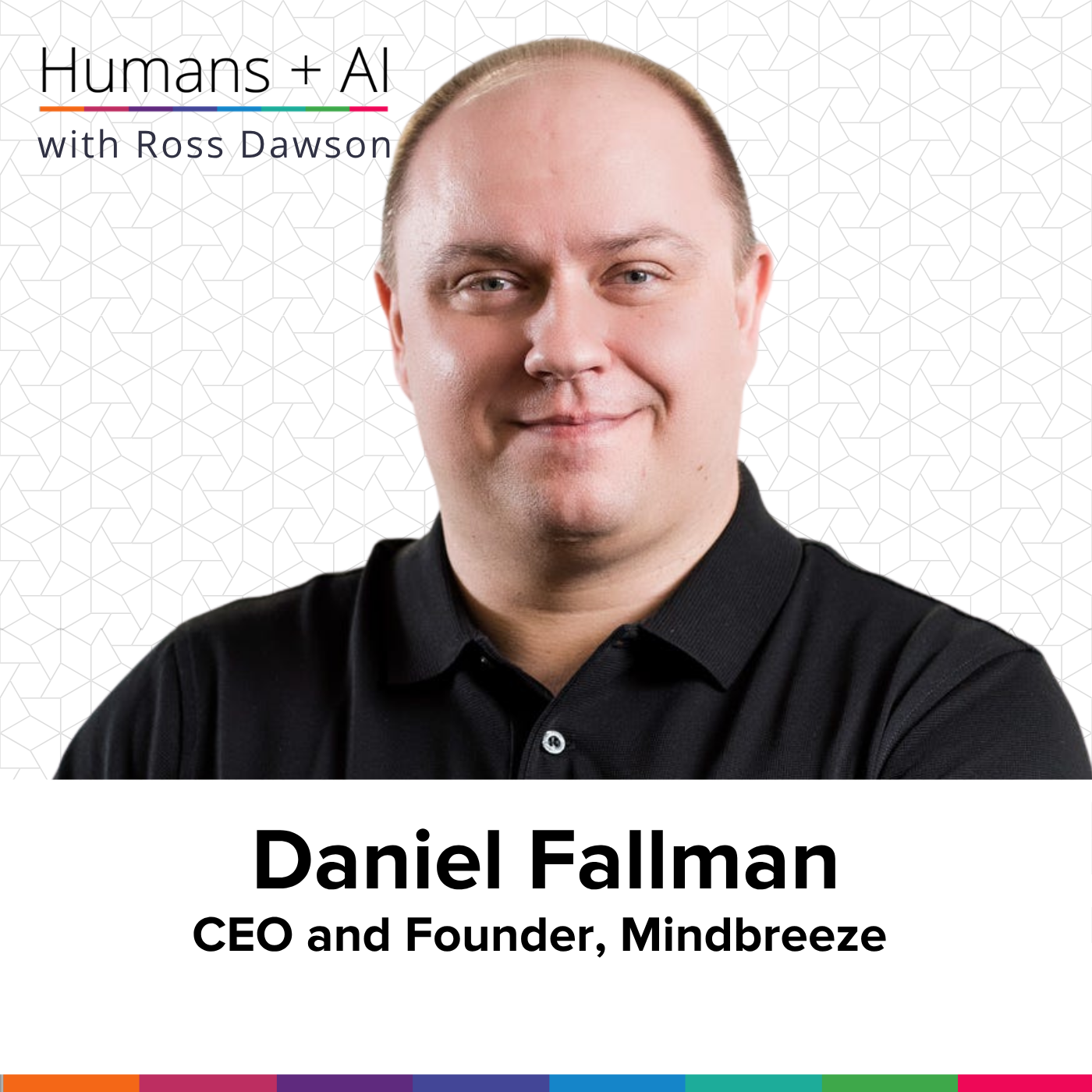


"Throughout history, I think human potential has often been constrained by access to knowledge. It was constrained to expertise, to experience, it was even geo-bound to a certain geography."
–Daniel Fallmann

About Daniel Fallmann
Daniel Fallmann is founder and CEO of Mindbreeze, a leader in enterprise search, applied artificial intelligence and knowledge management he established in 2005. He is a member of the Forbes Technology Council.
What you will learn
- How AI is shifting from pure automation to the augmentation of human expertise in organizations
- The value of connecting and making accessible distributed knowledge across organizational silos
- How agentic workflows and dynamic user interfaces enable context-aware decision support
- Strategies for defining and balancing the respective roles of humans and AI in complex organizational decisions
- The importance of explainability and traceable audit trails for AI-supported decision making
- Why judgment amplification is key and how AI filters and organizes information to empower better human decisions
- How capturing and surfacing collective intelligence transforms individual expertise into organizational capability
- Predictions about the rise of end-to-end agentic AI use cases and enterprise simulations for more informed decision making
Episode Resources
Transcript
Ross Dawson: Daniel. It is fantastic to have you on the show.
Daniel Fallmann: Thanks for having me.
Ross Dawson: So, very interested in what you're doing. There's a lot there around how decisions are made inside organizations, how we can support that, the roles of the humans, and maybe you can just outline the philosophy. What are your big picture thoughts about this? What are you thinking about what we need to do, and how we're changing how organizations work and how decisions are made?
Daniel Fallmann: Yeah, tremendous shift in the last few years, right? I mean, we come as Mindbreeze from an area where it was always important—even 20 years ago—to connect information that's across silos in organizations, and nowadays it's even more important because all of that AI around needs context, needs information to do the job, so to say. I think the biggest misconception, if you ask me about AI, is that it is primarily about automation. I don't think that's the key. Automation is certainly part of the story, but I really believe that the much larger opportunity is augmentation.
It augments every employee with the potential of your superstars, your subject matter experts, making that expertise scalable for the organization. I think that is by far the biggest achievement we can expect in the next few years from AI, because that really changes a lot.
Throughout history, I think human potential has often been constrained by access to knowledge. It was constrained to expertise, to experience, it was even geo-bound to a certain geography. Back then, we simply could not access the right expertise at the right moment, and what AI changes is that expertise can become available now on demand. At Mindbreeze, we see this every day. Organizations already possess tremendous expertise, and the challenge is that access is distributed—people, systems, documents, and processes. You have the knowledge, but the challenge is making it accessible, right? And that's exactly where we think this were Mindbreeze is so important for enterprise AI.
Ross Dawson: Yeah, well, let's dig into that, because I want to get more into this issue of the relative roles of humans and AI, and judgment, and so on. But let's start with, as you say, there's a lot of data, a lot of information being captured—or not being captured. If humans are involved in that, there's this very old knowledge management term: right data at the right time, to the right person. Exactly. And I guess now that's more amplified. So, how is it—and I think there's also the presentation, how it's presented, it's not just the data. Given that we now have the capability to access this enterprise knowledge, how is it structured? What are the architectures, and how can we bring that to the right person in the right way at the right time?
Daniel Fallmann: Yeah, I think historically, if you wanted to solve a complex problem, you needed years of experience or direct access to specialists to get things done. Nowadays, AI can make this expert-level knowledge available exactly when we need it. What do I mean by that? Look, for example, at the topic of legal advisory. You get tons of NDAs as a corporation. Typically, this NDA in the workflow goes directly to your legal service department, and they come back with feedback—if the NDA is fine, or you need changes, or what the next steps are.
If you now put AI into this sweet spot, what does it do? It uses the subject matter expert knowledge of your legal advisory team and transforms that into agentic workflows. At the end of the day, the NDA runs through this agentic workflow and automatically, critical things are annotated without human interaction needed. Why? Because typically, it's basic things that are critical—things like unlimited caps, things like oral information being disclosed, which is always very difficult to prove. So you typically try to do this in written form, and those basic things—what I mean is, this scales for every subject matter expert. Every subject matter expert has very specific tasks they do very well.
Now the question is, how can we scale not only having the right data but also having a perfect UI and the perfect presentation for the whole organization, to institutionalize the subject matter expertise via AI for the whole organization? At the end of the day, this is a big step forward when it comes to resilience, because AI is 24/7 on, and it can take care of those basic things immediately without human capacity involved, which means your experts have more time for other tasks. They can really focus on the niche things, or on decisions they have to take. Because honestly, I also think that you don't want AI to take a decision. I don't think we need AI to take decisions; I think we need AI to inform us with all the key facts so we can make wise decisions.
Ross Dawson: Yeah, well, as you point out, there are a lot of low-level decisions which can be delegated with oversight, and what is more interesting now are the more complex, challenging, less tractable decisions. So, that point of—what are the human roles, what are the AI roles? Looking to the more complex problems, the ones where you have these deep human experts, and where you want to use the full depth of their knowledge and the breadth of their expertise. You just mentioned this idea of how you present that information—bring the right information, then present it to them. So, what does that look like in practice? How are we defining the human relative the AI roles, and how is that information presented to the subject matter expert in ways that really do support their application of their experience and expertise?
Daniel Fallmann: In our case, we call this agentic workflows and agents—we call them inside touchpoints. What this inside touchpoint does is provide a 360-degree view on a business object. A business object could be a company you work with, an employee, a partner. The first thing we do is have this 360-degree view on an object that matters for the enterprise, for your business case, and based on that, we derive more or less on the fly the user interface for whatever task you try to achieve.
This could be, for example, you want to generate something—a ticket, a template for a contract. Those things rely on the 360-degree view's data for your role in the organization, and with your context derived from the data, we can execute very different user experiences for the end user, depending on their role and context. Why? Because, of course, we are using AI even there. There are standards for that, more and more. We will also see standards for that—one is agent-to-agent interfaces, very low level, it's MCP. Then there's also this agent-to-UI protocol—I think Google is a driver for that as well—where you generate the user experience for the task on the fly.
We will also see more dynamic structures—we call them touchpoints—because the touchpoint has this context of the user, the role, and the tasks. There will be more dynamic interfaces in the future that are just relying on the context.
Ross Dawson: Yeah, yeah. I'm very interested, very excited about the potential of dynamic interfaces customized to the situation and the individual. One of the things you work on and talk about is defensible, explainable decisions. I think that's a really critical part of the picture—of course, we do need decisions to be explainable, we do need them to be defensible. So, how do we actually make that happen? How do we design the systems so that we can do that?
Daniel Fallmann: I think, as I briefly mentioned before, the value of AI in decision making is not that it makes decisions for us. The value is that it expands the context available to the decision makers. Better decisions typically come from better context. I can connect to information that would otherwise be fragmented across systems, experts, domains. It can surface those relationships in the UI we just discussed. It can also come up with alternatives, assumptions, it can make risks transparent. All of that, the humans can then oversee, but I think human judgment remains essential. We typically call this the human-in-the-loop factor, and I think that is crucial.
Those judgments become significantly more powerful when they are supported by this contextual intelligence. Knowledge was typically difficult to access. That is something that we now have solved. If you use tools like ours, knowledge is accessible, the context is accessible, and I think the goal then is not to automate the strategy around it. The goal is really to augment decision makers with the best expertise available. That would be my main task here, honestly.
Ross Dawson: So, to come back then, the term you've used is judgment amplification. I'm very happy to hear that phrase—it's very aligned with all of my work, this idea that human judgment is critical, and let's not let it erode, but instead refine, improve, and amplify our judgment. What does that look like in practice? How do we amplify the judgment of humans who are so central in these decision roles?
Daniel Fallmann: I think the judgment piece is really about facts—underlying facts around data, expertise, but also strategic alignment with business goals. I think today's topic typically and today's task need a tremendous amount of information to get done, and AI is like a filter. It can filter in multiple dimensions, depending on which subtask we are working on, and can help us pinpoint the information for that subtask with accuracy.
You can think a bit bigger. One opportunity we have around AI is the creation of collective intelligence. The world's expertise today—also the expertise in organizations—often remains isolated with individuals, departments, organizations worldwide. AI allows us not only to pinpoint information for such tasks, but also to capture, contextualize, and share knowledge at an unprecedented scale. In many ways, we are moving from individual intelligence towards real organizational intelligence—not just one individual, but what the organization can do.
You know, there was a famous statement from Siemens: Siemens would be outstanding if Siemens knew what Siemens knows. That is true for today's organizations, and it's true for collective intelligence. A field engineer, a compliance officer, a CEO—all require different contexts and different guidance. The future is not one AI experience for everyone. The future is trusted intelligence adapted to each person's role and responsibility, and expert knowledge and world knowledge are increasingly merging into contextualized, operationally usable intelligence. I think that's the big key element there.
Ross Dawson: So, I guess one of the key points, as well as linking that idea of judgment amplification and explainability, is surfacing reasoning. For decisions to be explainable, they require some kind of reasoning trace—whether that's human reasoning or AI reasoning. Being able to do that is actually one of the ways to improve human judgment, because you're, in a way, forcing the human to be explicit about their reasoning and to be able to expose that. So, how can we put something like that into practice?
Daniel Fallmann: So, you mean the reasoning piece—how can we put explainable AI and audited AI in place?
Ross Dawson: Well, one of the points you have made is judgment amplification. One of the ways for judgment amplification is to test reasoning structures, and I suppose part of the link there is that if we have some kind of overt reasoning structures, that provides a form of explainability of how a decision was made.
Daniel Fallmann: Absolutely, absolutely. I can tell you how we do that today. Already, every interaction you do, we make traceable—and traceable in an anonymized form, so it's not the end user we are tracing, it's the actions. We trace how task A was achieved to solution B, so to say, and in between there is detailed auditing, which reflects this paradigm of explainable AI.
One of the most important pieces here is all of the reasoning happening behind all of the subject matter expert knowledge that is provided contextually inside of workflows, for example, needs to be audited. You need to have audit trails for it, because at the end of the day, you want to be able to go back and say, "We came to this solution because of..." That is a clear and important piece, but honestly, there is a way to go. Why? Because, as you know, you do not have just one AI tool in enterprises—you have quite many. Those are now starting to interconnect via protocols like MCP, agent-to-agent, and many other different ways.
Importantly, it only helps you in one part if a tool like Mindbreeze does that auditing already, but there needs to be a standard for general purpose use. I would argue that if one piece audits everything and the rest of your agents and tools don't, you still have a problem in enterprise AI usage. So, I think there is a way to go there, but I can tell you that the leading organizations already take care of that and make those kinds of audit trails usable.
Ross Dawson: So, we're in the middle of 2026. To round out, perhaps, where do you see the next year or two, or more, in terms of being able to get to better decisions, where humans and AI are both used to their best capabilities to amplify what organizations can do?
Daniel Fallmann: Personally, I think we will see lots of agentic use cases in enterprises, end-to-end—not only as prototypes, but real-world use cases far beyond pure automation tasks. Today, it's a lot about automation, but I think the usage goes far beyond that.
The very big topic that organizations will adopt over the next two to three years is simulations—simulations based on enterprise understanding. If you have an AI like we at Mindbreeze do, and you understand business processes, and you then transform business processes, you can in advance simulate how those changes might affect your organization. We as humans are hands-on—the more hands-on something is, the more you can think about how it will work out. Simulations help us a lot to make decisions understandable, and we will see more in that area.
In general, when it comes to the evolution of humans, humanity, and AI, I'm personally extremely optimistic. Every major technological shift has always created concerns, but many of those concerns, at the end of the day, did not work out badly, but in a very positive way. In reality, I look at AI and see an opportunity to democratize expertise, to make knowledge more accessible, to help people solve problems faster and collaborate more effectively than ever. The pro area of using all of that technology as an enterprise is outstanding. We live in an interesting time, and I think we will see really cool use cases in the future. I personally believe in the simulation decision piece a lot. For simulations, you need the context as well, so I think that context and expertise together is a very important key aspect.
Ross Dawson: Yeah, that's fantastic. I very much agree that there is an extraordinary opportunity, no doubt about it. So, where can people go to find out more about your work?
Daniel Fallmann: Certainly AI at the Mindbreeze website. I also write articles for Forbes Tech Council, and we do a lot of blog posts, podcasts, YouTube videos—we try to be present as much as possible. But as always, most of our time goes to our customers, for sure. We are a hands-on organization, we take care of our customers, and that's where we spend our time too. But yeah, always happy to chat about new opportunities, and everybody who is interested—reach out to us, we are happy to support you.
Ross Dawson: Fantastic, thanks so much, Daniel.
Daniel Fallmann: Thank you. Thank you, Ross.
Podcast: Play in new window | Download