

"AI is thinking for you, so the risk isn’t that AI thinks for you; it’s that you stop noticing when it does."
–Arun Varadarajan
About Arun Varadarajan
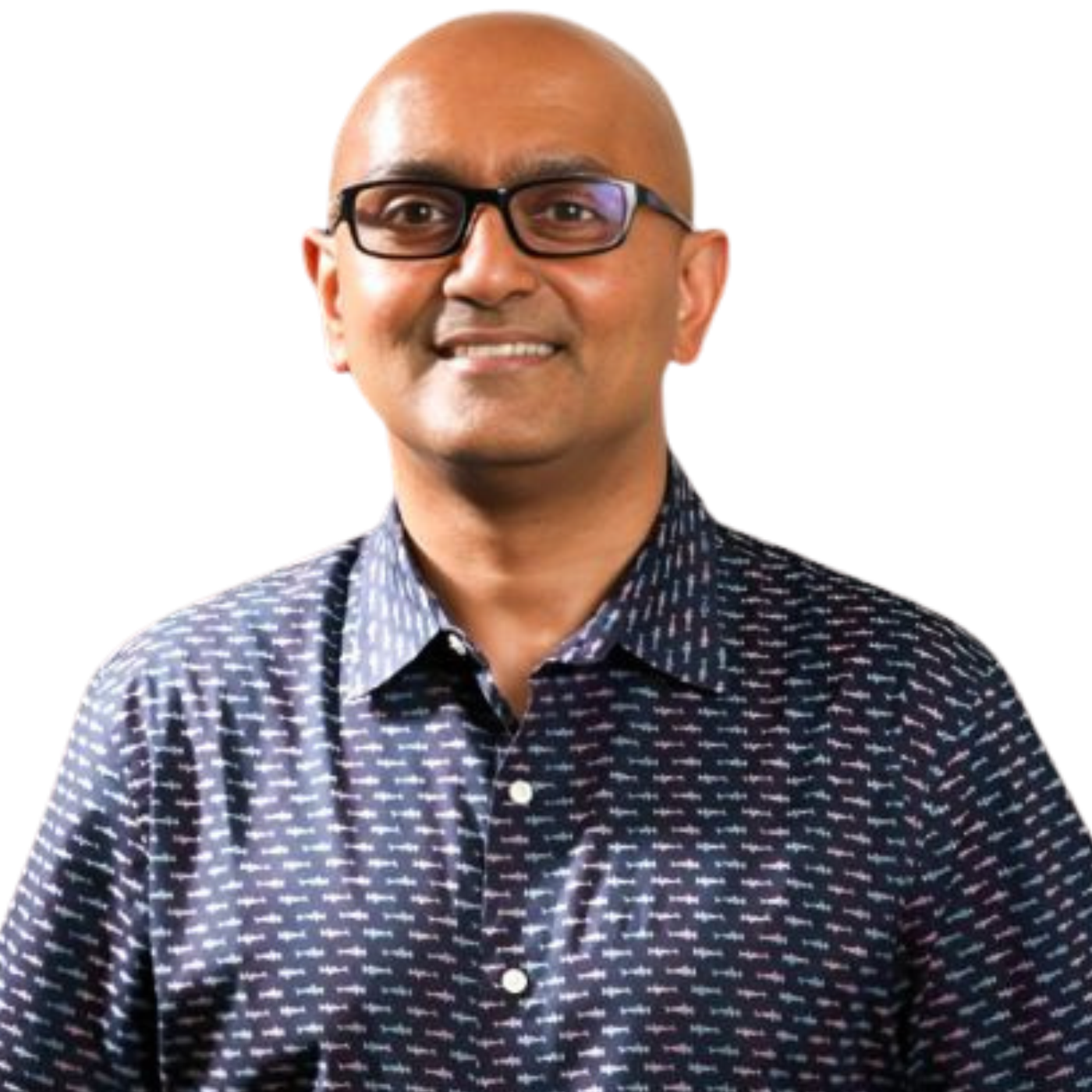
Arun Varadarajan is Co-founder and Chief Commercial Officer at Ascendion, an AI-native engineering company. He previously held a range of global senior executive roles in leading software and consulting firms.
What you will learn
- How AI can raise productivity while expanding human creativity and problem-solving
- Why organizations should focus on doing better things, not merely doing existing tasks faster
- How to combine generative AI, traditional machine learning, deterministic models, and human judgment across software development
- How to redesign approval processes so people actively challenge AI outputs and remain accountable for outcomes
- Practical habits for strengthening judgment, including thinking before prompting AI and asking it to challenge your assumptions
- How AI is reshaping organizational talent into expert-led barbells with amplified juniors and fewer orchestrators
- How to develop junior professionals through AI-assisted apprenticeship focused on questioning, checking, and disagreeing
- How to use AI for outcome-based services, strategic stress-testing, pre-mortems, and decisions guided by risk and blast radius
Episode Resources
Transcript
Ross Dawson: Arun, it’s wonderful to have you on the show.
Arun Varadarajan: Great to be here too, Ross. Thank you for having me.
Ross: AI is changing things a little bit, isn’t it? So, looking at the big picture, how is AI changing the world?
Arun: If I were to put it in one sentence, I would say that AI raises the floor for everyone.
But to me, human potential is the ceiling, and you only raise it by doing better things, staying in the friction, and owning the outcome.
What I see today is that most people are focusing on using AI just to raise the floor.
I truly believe that AI has set things up for people to be much more creative, become builders, and create abundance. What we fail to realize is that there are so many problems, Ross, that are still unsolved.
If we can purpose AI to solve those big problems—including something as fundamental as clean drinking water for everybody on the planet—I think the world will be a better place.
So, it is changing. It is changing dramatically. But I think, at some level, we are looking at the wrong end of the equation.
We seem to be asking, “How can I do things better?” as opposed to, “How can I do better things?”
Ross: Fantastic. I think we’re very much aligned on all of that, so I’d like to dig into it.
We’ve started with a very big picture, and we’ll loop back to that. Let’s come back to what you do at your organization, Ascendion.
This is building software for clients, I gather. So, let’s talk about software and the software process. A lot of work is changing.
It would be fair to say that the software development process is changing substantially, and it still involves humans—possibly fewer humans.
Though, of course, we’re also creating more, or hopefully better, software. It’s not a fixed amount of software we’re creating. There’s obviously the potential to create more.
At a high level, how do you see the new roles of humans and AI changing the software development process?
Arun: Sure. Just to provide a little background before I delve into that question, we started Ascendion six years ago, during the height of the pandemic.
The pandemic became a forcing function for us to ask whether there was a better way to deliver software to our clients.
I truly believed in the capabilities and versatility of human engineers, but I also realized there was a lot of toil involved in building software.
My thought process was: What if I eliminated that toil and created more headroom for thinking, creativity, and thinking ahead?
When you’re building software for clients, you might start with a one-line vision statement from the client or a copious, detailed document describing what they want.
But that is not a static need; it is a moving, dynamic need. Many software projects fail because we, as engineers, have not thought through what else could come our way as we engage with a client.
My hypothesis was that this happened because we were so caught up in the toil of building software, rather than the real reason we were building it. That reason got lost.
Before that, I used to run AI and data for a large firm, and I had experimented with using machine learning and AI to build large data platforms.
I said, “Why not apply the same thing to software? There must be a way.” If you really break down software, some people call it a science, and some call it an art.
I think it is a combination of art, science, and process. That’s where I realized there could be a clear opportunity for us to employ machine learning and AI.
In those days, it was machine learning and AI, well before generative AI was common parlance. I felt that if I could make it frictionless for my engineers to build software, they might build much higher-quality software.
Their focus would then be on the client rather than the process of building it. That’s how we started the firm.
Fast-forward to today: We obviously need fewer people to build the same amount of software. But I think it has made our company much more oriented toward delivering outcomes, which was never previously the case in our industry.
We spoke about outcomes, but our commercial models were never aligned with outcomes. When you go to a barbershop and ask to have your hair cut or trimmed, you don’t pay by the hour.
You pay for the outcome. In our industry, we say, “Yes, we will deliver this amazing outcome for you,” but everybody gets paid by the hour.
So, where is the incentive to orient toward outcomes? In fact, you probably want to delay the outcome so you can make more money from the client.
It has made me rethink everything from the commercial model to how we engage with clients and orient ourselves toward our trade, which is building software.
Ross: There’s a lot there, and I want to dig into it. First, though, a quick tangent.
Generative AI has proven to be exceptional at code generation, bug finding, and so on.
Are you still applying anything you learned from using machine learning in code development, or have you switched entirely to generative AI models for code?
Arun: We do not employ generative AI ubiquitously across our engineering process. It makes no sense. There’s a place for humans, and I keep saying this: Everybody needs to realize that judgment is a muscle.
We’ll get to that. There is a clear place for humans, a clear place for generative AI, and a clear place for traditional machine learning and deterministic models.
You must take a provenance-based approach to applying the right technique. We believe an ensemble of capabilities is required across the engineering lifecycle.
There are places where you want to use generative AI because it makes sense. There are also places where you don’t want to use generative AI because nothing needs to be decided.
It may be a simple, rule-based routing decision that can be handled by a basic machine learning model. So, we absolutely believe in applying model techniques based on provenance.
Ross: Let’s get into that changing human role. Of course, there is still a human role, but it has changed.
It has changed even over the last six or 12 months, let alone the last few years.
How do you define the human role today, given all these extraordinary complementary techniques and technologies?
Arun: Ross, you have argued that there is significant value in the friction between humans and AI.
Ross: Yeah.
Arun: I agree, and the trap is what worries me most. In today’s world, many of our engineers have moved from producing to approving.
I’m describing what is happening today: The machine does the work, while the human hopefully designs, judges, and signs off.
But if approving means simply clicking “Accept,” we have built a generation of rubber stamps. In my opinion, a rubber stamp is worse than having no human at all.
Ross: Yeah, I agree.
Arun: To me, approval should operate under three broad conditions. First, the approver could have done the work themselves and is therefore able to say, “Yes, this looks good.”
Second, the approver says no often enough to prove that they are actually thinking.
Ross: Yeah.
Arun: Finally, the approver owns the consequences. That’s what I’m worried about. Their name is on it because they can’t blame the agent.
As I said earlier, judgment is a muscle. If all you ever do is approve, you’re letting it waste away. The friction is how you retain that judgment.
I once told someone that a human in the loop who never says no isn’t in the loop.
Ross: Yeah. You’re saying it in almost the same words I often use. That leads to the question: If judgment is a muscle, we need to improve it.
If simply having a human in the loop is not the way to do that, what is? How can we design work so that judgment improves?
Arun: I personally follow three habits, and I encourage my fellow practitioners to think about them. The first is that I think before I ask AI.
Ross: Yes, okay.
Arun: I write my own framework or answer, even if it’s only a rough draft, before I put a question to AI. Then I compare, because if I ask AI first, I anchor on its answer.
But if I think first, the machine definitely helps me sharpen my thoughts. I’m happy with that, but I’m still in control. So, the first habit is: Think before you ask AI.
The second habit I’ve started developing is making it argue and parley with me. I have a viewpoint, and I ask it to challenge that viewpoint and make the strongest case against it.
That is the friction you talk about, which I really enjoyed hearing you discuss. That idea is built into my second habit.
Third, I am very clear about which calls are mine. Some decisions are rules, and the machine can handle them. I don’t need to get involved.
But some are judgment calls that carry real consequences and have significant ramifications. I make those decisions, and I decide that upfront.
Even though the machine is helping me, I maniacally focus my attention on that final category. Today, I find that attention is what is actually scarce—not information or intelligence.
Attention is scarce because this thing is doing everything for you. AI is thinking for you, so the risk isn’t that AI thinks for you; it’s that you stop noticing when it does. Right?
Ross: This is all extremely similar to many of my frameworks. But how do you cascade this through the organization?
You believe in these habits, and you adopt them as an executive. How do you then imbue this way of thinking and acting throughout the organization and influence how people work?
Arun: You have to lead by example, Ross.
One thing we were very clear about from the outset is that, while we call ourselves executives—and I’m also the company’s co-founder, so my role is different—we are all fairly hands-on practitioners.
We get involved in the details, and there are several client programs and projects in which I’m personally involved. I’m not going out there and saying, “Do as I tell you, not as I do.”
I’m actually modeling what good work means. I’ve been intricately and intimately involved in defining our method.
While we built a platform, one thing we decided during the process was to create a platform that would enable this entire way of operating. I felt that was the best way to systematize an approach.
Once we built the platform, we also realized we needed to define a method around it. We needed to explain how to use the platform and employ it in different engineering contexts.
That’s where we were able to bring in many of these habits and good practices. That’s something I strongly believe in.
As we move forward, we really need to start thinking about the entire notion of expertise. We have to find a way to codify expertise and make it available.
With AI coming into play, expertise could become a scarce commodity, and we can talk more about that. I have some views on it.
But that’s how we’ve been doing it: systematizing it through a method and leading from the front.
We design systems that help everyone follow a similar approach, share best practices, and feed them back into the system.
We believe this willy-nilly approach of throwing AI tools at people and hoping for the best is not even as good as a prayer.
Ross: Yeah. Let’s go to the expertise piece. In fact, I’ve been doing quite a bit of work with clients on how AI changes expertise.
Whether you’re inside an organization or working as a professional, your role involves having distinctive expertise. You’re an expert in a particular domain.
Of course, AI changes that in a variety of ways. For particular questions, you can usually get a fairly good answer if you ask an expert a specific question.
So, what is the changing role of expertise? Most people seem to be saying, “We’ve got expertise. Let’s codify it, put it into AI, and potentially make the expert redundant.”
Of course, I think we both agree that at least some value remains in the original expertise.
So, let’s go there. How does AI change expertise, and what is the enduring value of the expert?
Arun: That’s why I wrote a series about the new talent model I see emerging. It’s not there yet, but I’d like to see it move in that direction.
For decades, organizations had pyramid structures. You had many people at the bottom doing most of the work, a few people at the top directing things, and some subject-matter experts around them.
In the tech world, that pyramid structure was already challenged when agile came along. The pyramid began shifting into what people called a diamond shape, where most judgment and expert work was done in the middle.
Now that agents have entered the world of work, I believe the shape is slowly moving toward what I call a barbell.
At the top, you have deep experts—the people who know the domain cold. They are the people who can design the systems within which the agents will work.
They are the irreducible human capital in the organization, in my view, which is why I put them at the top of the barbell.
Ross: What is it about their expertise or capabilities that enables them to remain at the top? Why are they so valuable? What is at the core of their value?
Arun: Think about these veritable AI agents that show up at the door. They are trained on general capabilities, but they completely lack an understanding of your domain and operating context.
They don’t know where the bodies are buried or where the issues are.
They don’t know what happened the last time a regulator reviewed your processes or when you failed to deliver the last customer project.
Who knows that? The experts running your businesses know it. Bringing AI into your workforce is no different from bringing new hires and recruits into it.
Who onboards them? Who makes them successful? Who continues to mentor them and ensures they are performing and learning on the job?
Nothing has changed. To me, people have not realized that this irreducible human capital within the organization is even more valuable in the AI world.
It needs even more protection and investment.
Ross: Absolutely. I agree.
Arun: I think another change will happen, and we’ll talk about the apprenticeship issue. I have my views there.
As you may have gathered, the bottom of my model consists of junior people working inside the system. Their work is amplified by the agents supporting them. That’s the bottom.
The interesting part is the middle, where I have the thinning handle. It is a small, critical layer of orchestrators who are effectively experts in the loop.
They coordinate and sequence the work, handle exceptions, and make calls the agents can’t make. But it is deliberately much smaller.
I truly believe organizations must begin thinning their middle, investing in their subject-matter experts, and amplifying their commitment to them.
I’m also starting to see many organizations stop hiring fresh graduates. Don’t do that.
You need the bottom of the barbell to be sufficiently stocked because that is your next generation of subject-matter experts and orchestrators.
But there is a particular way to onboard them. That wasn’t your question, so I’ll wait until you ask it.
Ross: Well, that is my next question. If you have the barbell, we can readily understand the experts, but you’re going somewhat against the grain.
Youth employment is going down, and in software, the older you are, the stronger your employment prospects currently seem to be.
Many organizations are specifically reducing entry-level roles, which I agree is completely flawed. You’ve identified the need for a pipeline, but there is also a changing role.
Juniors used to do what AI now does, so they have to do different things.
What do they do to create immediate value, rather than simply learning to become more valuable later?
How do you accelerate their ability to develop judgment so they can reach the top of the barbell more quickly?
Arun: Amazing question, Ross. I understand the concern because conventional wisdom says that judgment comes from doing the grunt work.
If AI does the grunt work, how does a 20-year-old ever build judgment? I think that’s the question being asked.
My answer is that apprenticeship will move from doing to challenging. I’ll explain what I mean.
Juniors can learn by checking whether the machine is operating according to a standard, identifying where it is wrong, and explaining why.
Think of a medical resident doing their residency in a hospital. They don’t learn by performing every surgery. They learn by watching, checking, and being checked.
But that only works if you understand that this is the new operating model. Juniors must be allowed to disagree with the machine.
They should also be allowed to oppose the current methods through which the agents have been configured—and be rewarded when they are right.
Ross: Does this mean you’re hiring people who are prepared to challenge? Traditionally, society has said, “You’re young. Know your place and don’t interrupt.”
Is one of your hiring criteria now a willingness to disagree with older or more senior people?
Arun: I think so. I actually believe thinking skills are not being taught in schools.
Ross: No.
Arun: I believe there is an opportunity to rethink curricula. People need to be taught much more critical thinking, lateral thinking, and curiosity.
In fact, I was having a big debate with my wife, who is an educationist, and her colleagues. They were all very upset about AI coming into play.
They said, “Kids are using AI. We should not allow them to use it.” I said, “Listen, there’s actually a great opportunity with AI.”
If you teach children to be curious with AI, ask it questions, and challenge it, that could be very interesting.
My view is that a generation that can generate anything but judge nothing is not a generation of builders.
What we need is a generation of builders.
Ross: You are in the professional services business, and it’s fair to say that professional services are changing.
Among other things, clients say, “You’ve got AI now. It should be cheaper, faster, and quicker.” Clients have different—and sometimes inappropriate—expectations.
We now have a different balance in how we apply expertise to create client value, which is how I define professional services.
What is changing in professional services, and what are the opportunities?
Arun: You’re right. Clients’ expectations are changing, but the way they express that change could be better.
On one hand, the first qualification gate might be, “Are all your engineers trained in AI?”
They ask, “Do they know Claude? Do they know this tool or that tool?” There are many questions of that kind, which many people can probably answer.
Then, when it comes to commercial negotiations, nobody asks for outcomes. Everybody still says, “Reduce your unit rate.”
What needs to happen, Ross, is that clients must stop merely asking whether people are AI-conversant.
They should also change how they buy services from their service providers. Hold them to outcomes.
I’ll tell you where I believe the opportunity lies for services organizations. There is a major malaise affecting many engineering services organizations.
When they walk into a client’s office, they essentially say, “We can do anything for you. What can we do for you?”
They don’t say, “These are the three things we can do for you that will create asymmetric value in your business.” They never say that because they don’t know.
If you ask any of the services companies in the broader fraternity of which I’m a part, “What are you most famous for?”
Or if you ask, “What are you exceptionally good at?” they won’t be able to tell you.
That’s because they aren’t exceptionally good at any one thing, and you cannot be exceptionally good at 100 things.
But their view is that they need to be good at 100 things. The opportunity ahead is for firms that specialize heavily in a few areas.
They can show up at a client’s location and clearly say, “Here is the outcome I can deliver for you.”
It could be client onboarding at a bank. It could be prior authorization for a healthcare company’s system, or launching a new product for a technology firm.
But they must clearly state, “I can do this for you within this timeframe and with this much capital.” They must guarantee and underwrite the outcome.
In my opinion, those firms will be the winners. That’s the opportunity, but two things have to change.
Clients must start buying differently. Services companies must also realize that if they don’t specialize and hang their hats on a few areas of expertise, not much will change.
Ross: Looping back to the beginning, we were talking about not merely doing things better, but doing better things.
Part of the frame, as we’ve discussed, is creating better organizations. One of the levers we have for affecting the world is building better organizations that bring in people and give them skills.
Those organizations can generate value for themselves, their people, and society.
What is your vision for creating a humans-plus-AI world in which AI amplifies human capabilities?
How can it create the capacity to do better things so that we are, in fact, doing better things?
Arun: I believe AI can play a significant role in strategic decision-making, complex thinking, and complex scenarios.
It can be a superb sparring partner for strategy, investment decisions, and other matters for which we traditionally rely only on humans.
I believe it can widen your options. It can identify scenarios you didn’t want to consider because of your biases, and it never gets tired when you ask it questions.
If I ask my finance guy to create two more scenarios, he says, “Really, Arun? Another two scenarios?”
The good thing is that AI can create another 100 scenarios for you, but it will never own the bet.
It’s important to understand that before deciding what to hand off to the machine. I use some simple tests to decide what to hand off.
I have my own definition of what I call a “blast radius,” and I’ve created my own computation around it. Broadly, the heuristic considers how uncertain the situation is.
Is it a rule or a judgment call? What will it cost if it goes wrong?
What are the risk and regulatory exposures? Is there a reputational risk?
I compute the blast radius. If it is small, let the machine handle it. But if there is a large blast radius, let the human lead and the machine spar.
Consider something like an investment decision, which is not something you would hand off to AI. Hopefully, please don’t. I’m not recommending that anyone do so.
But the first thing AI could do is stress-test the business case before you fund it. Every investment memo I’ve seen is biased toward a yes.
So, maybe ask AI to write a contrarian one.
Ross: Yes.
Arun: One that might push for a no. That could be valuable because we don’t generally conduct pre-mortems; we mostly conduct post-mortems.
This may be an opportunity to conduct a pre-mortem and ask, “What if we do this and it fails? Why would it fail?”
Because we are oriented toward positivity and wanting to do good things—which is positive—we tend not to conduct enough stress testing.
That’s an area where I think AI can do an amazing job.
The second important point is that very few companies examine whether an approved business case has actually delivered its intended outcome.
If we can use AI to track the promise against the result, period by period, we could learn how to make better bets.
It might also help you kill a bad bet early enough that you don’t lose the farm or the bank. While AI is not making the call, it can still help.
In my computation, capital allocation probably has a huge blast radius.
But the machine can help you build the business case and argue against it when necessary before a person signs and owns it.
I think these are things that can really change the game.
But this is where I believe the current level of understanding about using AI to do better things is still low.
I’ve seen many board decks with AI included as a slide, and that worries me. Many C-level people I meet and speak to don’t really understand what AI is. They are not practitioners.
I live AI every day. I use AI in everything I do every day.
Therefore, I’m in a much better position to speak to everyone in my organization, from a newly hired engineer to senior executives.
If you are not an AI practitioner, you can never be a decision-maker or strategic thinker about employing AI. That, at least, is my submission.
Ross: There’s a lot there that I agree with. It is strongly aligned with my work on AI, strategic decision-making, and strategy.
I love seeing this humans-plus-AI thinking applied to what you are doing: building a dynamic organization and creating value for clients.
I love your work. Thank you so much for your time and for sharing your insights.
Arun: It’s been awesome talking to you, Ross.
I’ve really enjoyed listening to you and the other people who have joined your podcast.
It has been a privilege to have this conversation with you.
Podcast: Play in new window | Download