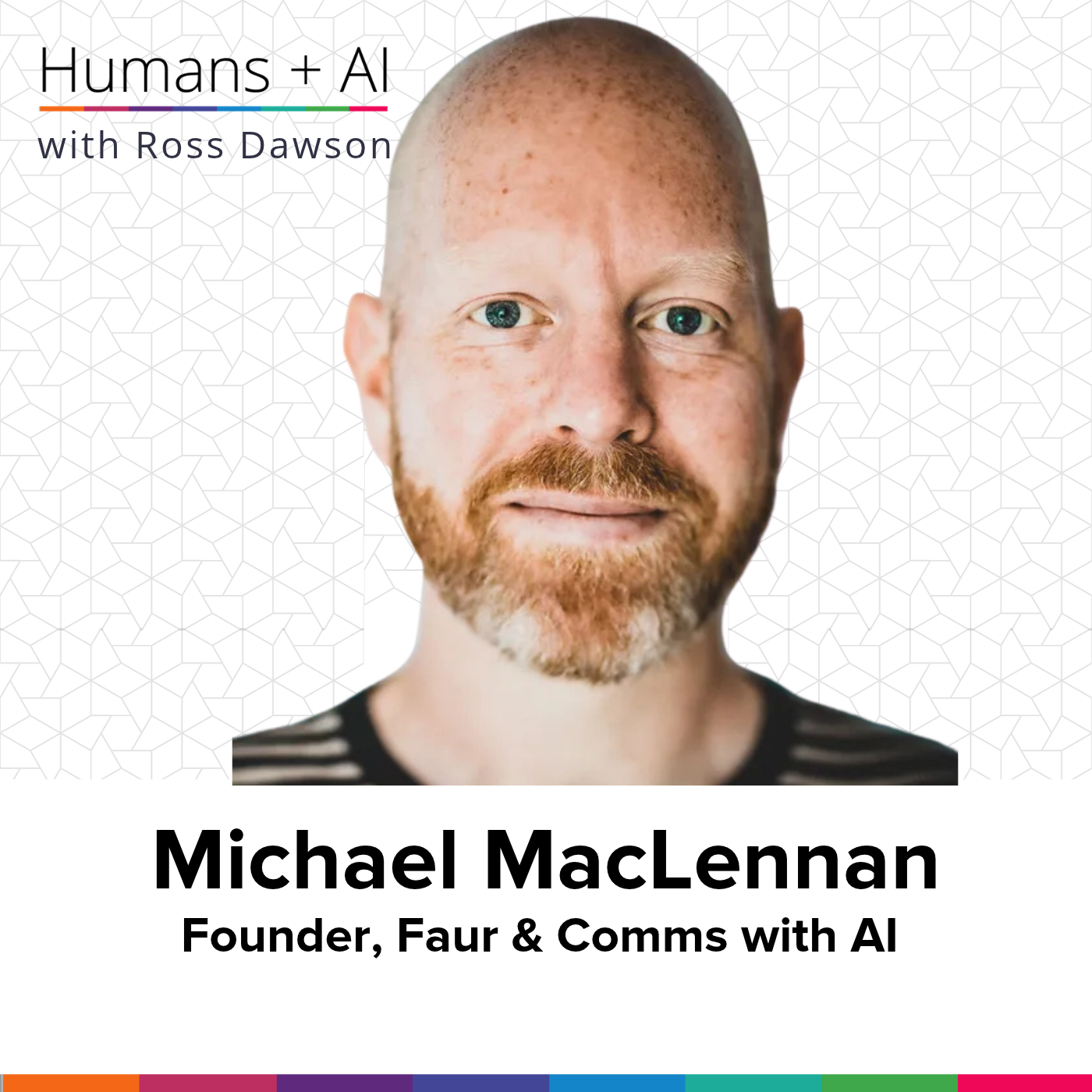


"In reality, organizations still need support to become the best possible communicators, explain what they do, and reach their audiences."
–Michael MacLennan

About Michael MacLennan
Michael MacLennan is Founder of communications consultancy Faur and Comms with AI, which won Gold for Best Innovation in AI Tools for Communications at the 2026 AI Comms Awards, where he was also named AI Communications Leader of the Year. He earlier led digital work at Red Bull and Barclaycard, and founded Covid Aid, which supported more than 385,000 people.
What you will learn
- How AI is transforming organizational communications for both internal and external audiences
- How to define and maintain an organization’s mission, positioning, audience, and brand voice
- Using AI to refine messaging, explore language options, and test communications against audience personas
- Keeping foundational communications documents current through iterative AI-assisted updates
- Auditing websites, social channels, and internal knowledge bases to improve the accuracy of AI-generated representations
- Applying AI to stakeholder analysis, research, risk identification, and communications planning
- Building human approval points, escalation processes, checklists, and assurance gates into AI-supported workflows
- Communicating effectively with AI agents by emphasizing clarity, credibility, transparency, trust, and evidence
Episode Resources
Transcript
Ross Dawson: Michael, it’s great to have you on the show.
Michael MacLennan: Yeah, I’m very pleased to be speaking to you, Ross.
Ross: Communications is a fundamental part of what it is to be human. We’re born, we communicate, and we die.
You’re delving into communications with AI, so let’s put a frame around this. This is really about how companies largely communicate with the world. Is that right?
Michael: Yeah, it certainly is, and it’s something I’ve thought about a lot since becoming part of the profession. I started in media, then moved into marketing and communications.
I don’t know if it’s because I started by studying philosophy, which feels many, many years ago. Since then, I’ve thought about the philosophy of language and how we communicate.
I’ve always been slightly fascinated by communications as a profession. Communications, as a word, is such a fundamental part of what we do.
Everyone listening to this podcast will be communicating daily, not just with other human beings but also with AI. It has certainly been prominent in my mind over the past few years, as it has for other people.
This is fundamentally changing both the nature of the word “communications” itself and, more significantly, the industry. Previously, communications would be used to help organizations, executives, and individuals articulate what they were selling.
Whether it was a service or product, communications could help people articulate it better. It could also help articulate what the audience or customer expected from them, so it wasn’t just a one-way dynamic.
Now, you have this layer that you could call intermediary, but it definitely exists alongside everything else. The relationship between a client and an agency, for example, is now being shaped on both sides through communication with AI.
The role it plays means conversations take place on both sides, strengthening the work being done. It also provides new possibilities and ways to accomplish much more with people’s time. That’s something I’m really interested in.
Ross: Thinking back, we have a communications function inside large organizations, with a head of communications and a team. Their role, going back to what you were saying, is articulation.
You can’t just ask AI, “Who are we?” That requires input and analysis of the organization. Let’s think about that as a macro frame.
The mission, vision, and values are obviously relevant to both external and internal communication. It’s important to recognize that you have external communication, which is how many people think about it, but internal communications are also critical.
As you said, this is about articulation: What are the words? What is the language? Sometimes, what are the images, frameworks, or whatever else is required?
Let’s say we have an executive team, board, or senior leaders who are saying, “All right, we don’t think we’ve articulated as well as possible who we are, why we exist, and what we do.”
What is the process, and what are the human and AI roles in articulating what the organization is? Why does it exist, and what does it stand for?
Michael: There are three elements around this. The first is the foundation, or what I call the foundational structure. This can cover who we are, why we exist, and what we are.
It’s especially important now when somebody can go into ChatGPT and ask, “Who is this organization or person?” You have to think about where it will go for information.
It will go to your website, certain social media presences, and YouTube transcripts. More than ever, something is scouring everything you’ve said about yourself and then looking to present it.
From an internal perspective, you want to be clear and consistent. You also want to ensure that what is found represents you as well as possible.
The foundational layer can include your positioning: What is your organization? What are its mission and purpose? What are you looking to achieve? Who is your audience?
It covers all those fundamentals. It also includes your tone of voice and how you want to articulate who you are.
Ross: What are the human and AI roles in that? Classically, when you do these things, you have a workshop with a group of people and a facilitator.
The facilitator says, “All right, what words come to mind? Let’s craft a phrase and look at alternatives. Which phrase is the best one?”
Of course, people will still be coming up with these ideas. What, then, is the role of AI? For example, it could generate a range of options.
It could suggest different words or phrases. It could help us consider our personas, whom we’re trying to address, and what each persona might think.
How specifically would you use AI to refine and craft what is hopefully a better message?
Michael: I think “refinement” is a really good word on which to base this discussion. I remember working on these projects in the past, and they would produce these totemic documents.
You would spend months producing them and, as you said, have many conversations with various internal and external stakeholders. You would arrive at a document that could be dozens or hundreds of pages long.
It could be referenced, but it would often just sit in a folder somewhere and not be used enough. You would then find that how people talked about and articulated what you did started to shift, creating inconsistency.
Nowadays, particularly with folders and AI tools that can work directly on your computer, the nature of keeping these things updated changes. You have the ability to be much more iterative and maintain an ongoing relationship with them.
These are no longer documents that merely sit in a folder and are glanced at occasionally. Using agents or scheduled tasks, it’s very easy to maintain that two-way process.
On one hand, the documents can be updated with the latest news, developments, personnel changes, and organizational goals. They can also review what you’ve been doing and highlight when things are changing.
Is that something you need to change, or should the documents be updated to reflect it? This allows foundational structures to remain much more current and inform everything you do.
Ross: Let’s take a step back. This is also about context systems. Anything a company communicates externally or internally needs to be consistent with what we might call its brand voice.
That brand voice is really its identity: Who are we? Part of what I was trying to get to earlier is how AI tools can help crystallize your identity.
I guess part of what you’re suggesting is that you can instruct LLMs to reference that identity for every document you create. They can ensure each document is aligned with your particular voice.
That’s the first step toward consistency and clarity. If you’ve articulated your identity, you can communicate it well. Then, to your point, it can evolve as your strategy or positioning changes and remain current.
What precedes that, in a way, is applying a well-articulated frame to any and all communication.
Michael: Right now, there is significant work involved, and it depends on the size of the organization. The larger the organization, the greater the uplift.
A lot of work I still do includes website audits and examining how people present themselves online. Now, outdated news articles, information, and web pages that you haven’t paid attention to are suddenly being examined and referenced.
Externally, there is definitely work required if you want to be presented as clearly and accurately as possible. Internally, you may have a SharePoint bursting with thousands or millions of documents.
Many of those documents are irrelevant or outdated. You have to consider how AI tools look through them and decide what to source and reference. Are they looking in the wrong places?
It’s interesting when you think about the nature of communications. There is a widespread belief that AI tools could remove the need for people to help, assist, and work alongside them.
In reality, organizations still need support to become the best possible communicators, explain what they do, and reach their audiences. Right now, there is an opportunity to do that as well as possible.
To do it, however, you need the right support to shape those documents and perform that work. You need communicators who can examine the material, determine what is relevant, and organize it effectively.
Ross: Yes. Moving into the humans-plus-AI frame, communication clearly isn’t something you completely delegate, for many reasons. Let’s look at the ways AI can be useful.
We’ve considered the big framing question of how we clarify our identity. Now, let’s think about the communications team. They perform a great deal of work involving many workflows.
Let’s unpack a specific instance. What is an example of a project or task within a communications team? How is it done well now?
What are the human and AI roles, and what are the handoffs? How do we ensure the best quality and use of resources when humans and AI communicate as a team?
Michael: I’ll use an example I’ve worked on extensively over the past year: a digital and social media launch for a major infrastructure project. Because infrastructure is highly regulated and involves construction, you need to be very careful about how you discuss it.
Otherwise, planning permission could be jeopardized. This is on the more risk-averse side of communications, where what you don’t say can be as important as what you do say.
You must ensure that you don’t cross any boundaries. For something like that, you work alongside AI at every step. From the beginning, you use deep research and additional tools.
These can provide a much more nuanced and broader understanding of the landscape, including which other projects succeeded or failed. We were working with a relatively small but still substantial team. It wasn’t just one person.
There were a few dozen people involved, but AI tools enabled us to examine far more projects in a short time. That research gave us a sense of what was possible and impossible, and what others had done well or poorly.
It also revealed positive and negative feedback, which could then shape the plan going forward. It was really interesting.
Ross: I’d like to return to that, but a couple of things immediately come to mind. Infrastructure is a great example of a field with many stakeholders, each with quite distinct interests.
You have an objective, but there are often many competing interests that can be aligned in various ways. You’re looking for resolutions. LLMs are fantastic at that kind of stakeholder analysis because they synthesize information well.
Another area involves risk scenarios, where LLMs are also very effective. You can ask, for example, about obvious or non-obvious risks arising from a particular communications stance.
You can also ask how those risks might be mitigated. Are those kinds of approaches useful?
Michael: Yes. I spoke about foundations and having that structure. Once you have those, you can use skills, project instructions, or whatever is appropriate to work alongside you.
The work you do is then informed and assisted by the AI tools. That leads into what could be described as a final stage, although in essence it isn’t: assurance.
For that project, I produced specific folders and checklists around messaging and certain production tasks. These written checklists ensured that I could explain the process to key stakeholders if needed.
I could say, “This is what we’re doing and why. This passes green, this is amber, and this is red. This is what we’re changing to mitigate the risk.”
That made our work much more appropriate for a highly regulated process. I say it isn’t necessarily a final stage because it is iterative. As you go through any process, things won’t stand still.
The way you can discuss and reference a project, including how you talk about it with certain stakeholders, also changes. You want those assurance gates to be updated to ensure they remain accurate.
Part of the work AI can do well is ensuring that things are updated so nothing slips through. For these types of projects, it could catch details such as the number of jobs created or specific project spending.
Those details could become talking points for a spokesperson. They could then be picked up by somebody who may be critical to a decision-making process.
AI is extremely helpful for keeping you on track and ensuring consistency.
Ross: Before we move on, I want to dig into that work a little more. You have a communications team with a group of people. Do they each have their work and use LLMs individually?
Do you have approval processes or common AI systems across the team? Do you articulate roles for agents within these communications teams to complement humans?
What are the specifics of the workflow between humans and AI in a communications team?
Michael: As you went through those options, I was thinking that there are definitely elements of each in what I use. One issue everyone encounters is that, over the course of a year-long project, the models and capabilities change significantly.
There are always new ways to do these things, so nothing stands still. From the first stages of that project, part of the foundation was establishing an approval process.
Part of communications is crisis communications. We had a separate crisis document that explained whom to escalate particular issues to.
As projects progress, things change, but you find that some aspects can be handled better by the tools you’re using. When it comes to message responses, I’m now much more confident in the first draft produced by the tools.
I would never say it should go straight out, because you always want to review something like that yourself. However, it is now much closer to a final product.
When you’re building documents and these tools, it’s important to have stop points where you definitely require human input.
Ross: That’s a great point. What are some examples of those stop points for human input?
Michael: I’m a big fan of voice-dictation tools such as Wispr Flow and Granola. I’m now often out and about, talking into my phone and getting my thoughts down at that stage.
I think these processes should start with us. Particularly for something this important, there should be a proposal that you can review and iterate on before creating a first draft.
You also need stop points as you approach the final stages. Some moments are forks in the road, where you don’t want to choose the wrong path.
Otherwise, you may reach a finished product and discover that it has gone in an entirely wrong direction. You can build that into your instructions and processes.
When something could fundamentally go in several different directions, the tools should seek your feedback. What I find interesting is ensuring that the tools push back on you about that.
Sometimes, there will be time pressure, and you’ll want to say, “Just get it over with.” In those moments, it can hold you accountable.
When you have many priorities, you may be inclined to let something go away and handle the work independently. It’s much like telling a human assistant or somebody else to go away and deal with it.
If it’s something really important, the tool should be able to speak up and say, “No, we need your direction here.” Otherwise, it may produce something that requires much more time to correct later.
That’s definitely something to build into the instructions and the way the tools work with you.
Ross: One of the things we discussed before pressing record was communication with agents. Until recently, communication was directed toward humans in one way or another. Now, of course, there are entire layers of agents.
Individuals increasingly have agents, organizations have agents, and layers of agents help people find and interpret things. How does communications change when it is directed toward both humans and, sometimes, AI?
Michael: It’s a really good question. I have a very recent example. Last week, I wrote an article for Comms with AI about citations now being visible in Bing Webmaster Tools.
Those citations will primarily come through Copilot. I’m very grateful that Comms with AI, which is a free resource, received over 700 citations in one day.
That’s fantastic and really good. Then you look at how that translated into website visits, and the number was zero through Copilot. As a free resource, that doesn’t bother me.
However, it’s useful to know, write about, and consider because people are clearly having conversations with ChatGPT, Claude, Gemini, and other tools. Comms with AI will then be referenced or name-checked.
I appreciate that Microsoft and Bing now allow you to see that because it isn’t as readily visible with other tools. If there are that many citations through Copilot, there are probably more through ChatGPT, Claude, and others.
It fundamentally changes your relationship with your audience. When agents are looking at who you are and what you do, some aspects of SEO visibility also change.
SEO was about attracting a human reader, and there were tricks and tips you could use to rank highly in Google search results. I wouldn’t necessarily call them sleights of hand, but there were definitely ways to improve your position.
Those methods will remain important. SEO isn’t dead, despite what some people say. However, there is now much more emphasis on what appeals to the tools.
The models will also change, so this will continue to shift. Their assessments may be based more on tangible evidence and the ability to see through promotional fluff.
You need to think practically about the more methodical way these tools may operate. How you present yourself, particularly through elements such as SEO titles, may need to be geared more toward tools and agents.
That can differ from what sounds attractive to a human being at first glance.
Ross: It’s already fairly clear that generative AI favors particular formats, including the listicles many people are publishing. In the big picture, however, I think that’s very tactical. It’s about how we get more eyeballs.
The point of communications is really the quality of your communication. It’s about being understood and not merely having people say, “Here’s a website” or “Here’s a product.”
Increasingly, what is distinctive is still the idea of brand and connection. In some domains, the decision is about the best product, the cheapest product, the lowest price, or whatever else.
In many domains, however, it’s about which organization someone wants to deal with. That’s where so much value is created.
It comes back to communication as identity and framing, and being able to get that across. It isn’t simply about being found by an agent when somebody is looking for something.
Michael: Certainly. For me, communications, when done well, is very much about building trust and relationships with your audience or customers. It’s about whomever you want to speak to.
As with SEO, there are tricks you could and still can use to rank higher. When Google updated its systems, however, it might penalize people who exploited them to fake their way up the rankings.
I feel that the same applies to AI and SEO visibility right now. There may be things you can do to appear higher, although it’s harder to understand the rationale behind those results.
Google, Bing, and other search products were never easy to understand, but it’s particularly difficult at the moment. If you try to pull the wool over agents’ eyes, I think you will eventually be penalized in a similar way.
They will be looking for credible sources to reference. They will want to point people toward sources where there is greater honesty and transparency about what something is.
It’s about being more functional in how you explain what you do and what you achieve. You should also be more honest because that will build authority and credibility with agents.
Ross: Can AI help people be more honest, transparent, and clear in their communication?
Michael: Yeah, that’s something I ruminate on personally every day. Having studied philosophy many moons ago, I think about how I spoke and how I speak, even to you now.
I think AI tools can help people communicate more clearly and better articulate what they do. I also think about this from my media background.
When I interviewed people, some were very verbose and spoke about themselves very eloquently, while others didn’t. That didn’t necessarily correlate with their intelligence or the quality of their thinking.
What I really enjoy about the tools now is that they can also help agency-client relationships. Previously, people could struggle to articulate what they wanted to say or communicate.
Now, to an extent, they have a trusted product with which they can discuss these things confidentially, or more confidentially. They can game things out and reach an understanding before speaking to somebody else.
It’s similar to having a dictaphone, recording some silly ideas, and then listening back to them. Now you can do that and immediately receive feedback.
The tool might say, “Actually, maybe that is a bit silly, but there’s something there,” and then provide feedback. That is really helpful.
When I talk about AI and Comms with AI, I don’t want to be too much of a cheerleader. I want to bring a critical lens.
However, when I’m most optimistic, I think AI can enable people to communicate better. They can say things aloud that they previously couldn’t because of fear, ridicule, shame, or whatever it might be.
Now they can express those things. I’d like to think that, in some cases, clients can then come to an agency, me, or someone else better prepared.
Rather than struggling to express something and having it miscommunicated, they can present something more aligned with who they are. That gives you something stronger to work with.
What you produce is then more closely aligned with what they think, which benefits everyone involved.
Ross: That speaks to the broader point. There are obviously negative and positive aspects to how AI can be used. One of its greatest present potentials is the ability to clarify how you communicate.
It can also support your internal communication with yourself and your understanding of who you are. You can clarify how you want to express who you are to others.
It takes some skill to use AI tools that way, whether personal skills or potentially skills.md files that guide the machines. The ability to draw out our truer voice is at the heart of what Comms with AI could do.
Michael: Yes, and that also requires balance. You can certainly use the tools to maintain that balance as much as possible. Using myself as an example, I ensure that they keep me on track.
When I’m putting ideas into a dictaphone, Wispr Flow, or Granola, it’s very easy to get carried away. I’ve seen many people run away with projects and put so much time into them.
You can do so much around a project that it distracts from the work you actually want to be doing. I try to build in checks and balances, including typical project-management tools and behaviors.
That ensures things keep moving forward in the right direction. As with the project I mentioned earlier and its checklists, it’s also about having goals and KPIs in place.
You regularly use analytics and reporting, as people did before, to examine your results. You can then ensure that what you’re achieving remains on track.
Ross: That’s great. It’s wonderful to see what you’re doing to support organizations with that. You have a website with many resources. Where can people find it?
Michael: It’s Comms with AI, at commswith.ai. It has free resources and prompts as a first step. It also has a newsletter and all sorts of information and advice.
I encourage people to go and have a look.
Ross: Excellent. Thanks for your work and your insights, Michael.
Michael: Thanks, Ross. It’s been a pleasure.
Podcast: Play in new window | Download