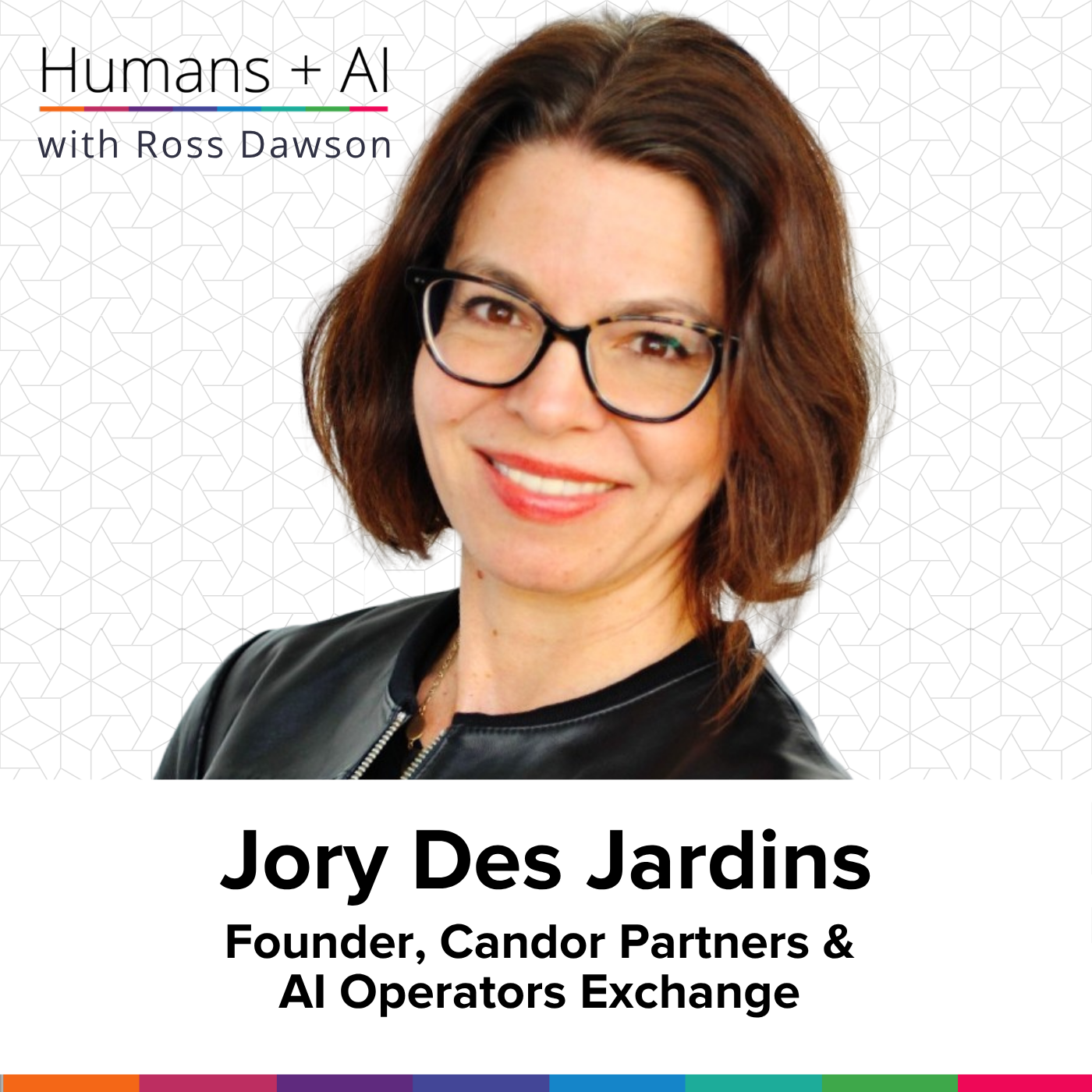


"If we can justify how AI can enable human flourishing, and the way I bridge that is through human agency, then we can make the case that you can, in fact, adopt AI in an organization and still build flourishing and human agency."
–Jory Des Jardins

About Jory Des Jardins
Jory Des Jardins is Founder & Principal of strategic advisory firm Candor Partners and Founder of AI Operators Exchange. She is author of Human Agency Architecture and an instructor on LinkedIn Learning and Maven. Jory’s previous roles include Founder of BlogHer, Head of Global Startup Marketing at AWS, Global Head of Community at ConsenSys.
What you will learn
- How human agency architecture provides a framework for empowering individuals within organizations during AI adoption
- Why preserving human judgment is critical for productivity, skill retention, and organizational succession planning
- How to balance productivity gains from AI with maintaining and fostering human flourishing at work
- The risks organizations face if they over-delegate cognitive and judgment-based tasks to AI, including cognitive foreclosure and succession hollowing
- Practical frameworks for deciding which tasks to delegate to AI versus retain as human-driven, including five key delegation categories
- The importance of transparency and disclosure in maintaining trust when integrating AI-generated outputs
- How measuring human flourishing—beyond productivity—can guide organizations toward sustainable and meaningful work environments
- Strategies for helping individuals and organizations navigate the cultural and structural challenges of integrating AI, ensuring both adaptation and the retention of unique human strengths
Episode Resources
Transcript
Ross Dawson: Jory, it's wonderful to have you on the show.
Jory Des Jardins: Great to be here. Thanks for having me, Ross.
Ross Dawson: So, amongst other wonderful things, you've created this human agency architecture, and I want to dig into that. What is it, and how can we architect human agency? But perhaps, you know, start with where does all this come from?
How did you—why are you focusing on human agency?
Jory Des Jardins: Well, it seems like everyone's thinking about it now, but in different formats. I'll tell you how I came to human agency architecture. It goes back to when I was a founder, developing a company around what was then frontier technology—social media, which I know you appreciate.
What we found was that there were all kinds of abuses of best practices and standards, and we wanted something more fluid that worked with the individual—not just how the business can leverage it, but how humans can leverage it. We found that was great business. It developed trust, and we developed frameworks for advertisers to better understand how social media worked, how influence worked, and how trust formed between influencer and brand, or an organization wanting to leverage that brand. Ever since then—and that was, gosh, 20 years ago—I've been thinking about, and kept moving into new forms of frontier technology, how to make it more trustworthy.
Here we are now at AI, and everyone's thinking about it. I came at it from an organization I was working with at the time, sometime last year. I was starting to use AI a lot, still developing frameworks and working specifically around this idea of human capital and intellectual capital, and how you maintain flourishing in an organization, and why it even matters. The movement was around why, and making the case for why flourishing was so important.
I was working on the narrative for that, and the challenge, of course, was taking that into organizations and having them believe it, because they were more focused on AI productivity—how do we stay valid, how do we stay in front of this technology? I had this aha moment: if we can justify how AI can enable human flourishing, and the way I bridge that is through human agency, then we can make the case that you can, in fact, adopt AI in an organization and still build flourishing and human agency. But you need frameworks that help you think through that.
Because right now—and I'm in Silicon Valley, and you know this because you were just here—we're in a big AI adoption phase, and there's a lot that's not going well, especially around human agency.
Ross Dawson: Well, there's a lot of layers there. So, on one level, you've got the individual, and essentially, society has tended over centuries and decades to give us less agency, to stick us in boxes, and get us to fulfill our organizational and social functions.
But in organizations now, especially in Silicon Valley as you say, every startup is saying, "We want to hire high agency individuals." I think it's a little different for larger organizations, where arguably they kind of say, "Do we want high agency individuals?" Hopefully they do. And then, of course, there's the societal level, where again, how do we enable people to participate in creating their society?
So there's a lot there to play with.
Jory Des Jardins: Well, and we have precedent, and this goes back to social media, right? This was supposed to enable the democratization of media—we all could express ourselves and connect. That was the currency we thought we had, but at the same time, it actually started to compress our agency. We became addicted to it. It didn't necessarily fulfill the promise of connection; it isolated us.
So where could we have changed that? I think we're at a moment now with AI where we can answer that question, and we should be thinking about it. How can we make sure that we stay in front of the adoption? We don't get enmeshed, lost, overwhelmed, or drown in it.
Ross Dawson: So, let's dig into the organizational piece. You've got leaders; they're adopting AI. They say, "All right, we want to get value from it," and hopefully some of them have some degree of a human focus in all of that. So, at a high level, what is the framing? What are the ways in which leaders should be approaching AI adoption to enable human agency? And let's just say, in order to enable organizational flourishing alongside individual flourishing.
Jory Des Jardins: Well, I kind of look at it from—if I had to do an axis, if I did a quadrant (I love my quadrants, I think we all do)—the y-axis is human agency, and the x-axis is productivity. Right now, we're in this phase where everything is about productivity. But if we start to apply across categories, how much are we giving to AI?
We do it based on how much accountability is required. The more judgment you need to put into a task, the less you delegate to AI. If it doesn't matter—at Amazon, we used to have the two-way doors: if it's something that's reversible, if it's not going to have a big impact, delegate to AI. In some ways, it's common sense, but it's about applying it to a framework, and we haven't yet really looked at all the tasks we're doing and applied the framework to them.
What I was seeing—and I've been in a group I convene called the AI Operators Exchange, where we talk with operators in the middle of all this—it's an all-or-nothing proposition right now in so many organizations, especially in tech. It's like, "Well, everyone has to be using AI. We're not really going to look at what you're doing; you just need to start using it." This is where people are starting to feel a sense of lost agency—not just lost jobs, but even if they keep their jobs, they're feeling like they have no control over what they're doing. There's a loss of their sense of accomplishment, a loss in their sense of choosing the work and doing their best work. They may be more productive, but are they really doing their best work? That's how I started to think through the categories and the framework for what to delegate to AI.
Ross Dawson: So Stanford released its excellent human agency scale last year, essentially saying there are some things which don't require human agency and things which are very high agency, with five different levels. I suppose a very crude way of looking at it is that different functions in the organization can be allocated to different roles. Does that make sense to you as an approach, or what subtleties or nuances should we overlay on that human agency scale?
Jory Des Jardins: I think there's more subtlety to that. By the way, I did see how Stanford did that with mental health in AI, and they divided it by how much AI to delegate based on these very sensitive areas. I thought it was a really good framework, and very similar in some ways to the human agency architecture and the decision rights that I came up with.
But overall, I think where organizations are missing some subtlety is they're thinking about the work and the workflows and what to delegate to AI, but they're not necessarily thinking about, "Okay, once we decide what remains human, what do we do with that?" They're not redesigning the roles or how to structure the work; they're just delegating it and everything else stays the same.
So I like to decouple the time from the judgment layer, because I think that's really where we have to start redesigning roles—especially where we're keeping it human. We need to redesign those roles to be more judgment-focused and to really reward the output and the judgment, not the time put into it.
Ross Dawson: So, I think you and I and a lot of other people agree that human agency is a good thing in its own right.
Jory Des Jardins: Yeah.
Ross Dawson: But let's say you're talking to a leader who's focused on return on equity and return on capital. How do you make the argument to that person that human agency is a good thing?
Jory Des Jardins: I love this question because it's the number one question I get. I've actually been teaching the framework, and the number one thing I hear is, "Well, my boss says—what do I tell him or her?" There are three risks to using AI right now in the organization, and you may not feel it right away, but you will at some point.
The first one is cognitive foreclosure, where you stop being able to actually do a skill over time. In some cases, it doesn't matter, but in many it does—especially when those skills are judgment-based. You want to keep that; you don't want to give that up. But if you over-allocate to AI, you will start to lose that capability over time.
The second one is succession hollowing: you won't have people who have judgment left in the organization to give the judgment, or you won't be developing that judgment from within. So you're hollowing out your team; you're not going to have it in several years' time.
The third one is around quality. I was talking to an operator who said, "Hey, I've got one quarter to turn things around, and by turn things around, that might mean AI-enabled, full workloads on AI, we're shipping product, people aren't touching it." I just suggested to her, "Start to measure the output, because you will probably start to see some declines in the output over time if you don't have human involvement." That's the third risk: your productivity.
Ross Dawson: Well, that's a good answer, and I'm glad you've got a—
Jory Des Jardins: Yeah.
Ross Dawson: I'm so glad you have a readily prepared answer to that question. Well, it's a question I'm asked, and it's worth asking, worth answering.
Jory Des Jardins: Yes.
Ross Dawson: Yeah. So, one thing in there is—I absolutely agree. One of the most critical things now is that all interactions with AI should be designed to increase judgment rather than erode judgment. The default, and how AI is usually used, is that it erodes judgment. But there's also something there where you are—well, maybe not conflating, but you are talking about judgment and agency together. How do judgment and increasing or decreasing judgment and agency relate?
Jory Des Jardins: I think that the more judgment you use, the more agency you have. That is agency: the capability to use judgment and creativity. There are several things I would also add to that, but judgment is one of those things that is human. It is human-led, human-derived. AI can't touch it. AI can copy it, AI can look for patterns, but it can't ultimately judge. That is one of our key distinctions. There are several others—I have a list in my brain of what it can't touch—but judgment is probably the most important one.
Ross Dawson: So, there's a lot of parallels to your work and mine, and one of those is around the decision delegation, or what you call the decision rights framework—what are the different types of decisions, and the degrees of human involvement in them. I'd love to hear a bit more about how you think about that, from a very pragmatic frame, because the reality is that every organization has a set of decisions. All decisions will involve humans and AI in some form, and there needs to be some kind of useful, structured, pragmatic thinking around how to set up decisions so that humans and AI are optimally involved. How do you do that?
Jory Des Jardins: So, I break it up into five categories, with both ends of the spectrum being full delegation to AI and no delegation to AI—the difference being, of course, the most judgment. Where you have the most judgment, there's no AI involved. What kinds of roles or tasks would that look like? Think about where you are at the top of your game—if this were a job, you're paid for your judgment. You're a judge; you don't want to turn over the judgment to AI.
You may use AI for research, for precedent—there are all kinds of things that can help inform that—but that judgment is human and needs to stay completely human.
Other things, as I mentioned before, are reversible, not consequential, or perhaps keep you from doing your best work. For example, when I'm developing strategies for a client, I hate having to format my documents. I'm not good at it, and I don't need to do it anyway—you want the content. So I will have AI format that, and I'm okay with that. I'm not a designer; it's not affecting me. Now, these categories also change depending on where you sit. If you're a designer, that may be too much to delegate to AI.
Then there are middle categories. The areas where those pivot are around the ability to develop. You don't want to delegate something to AI at the expense of your own skill building, and that's what I call the human developing category. Yes, you can delegate it to AI, but learn it first. The opposite of that is human calibrated, which says, "Okay, you can use AI, but you probably need to run your own reps against it so you don't lose that capability." If you have an expertise and you turn that over to AI to replicate, you will start to lose that expertise.
I have an analog version of that: when you learn to fly, you have to put in manned hours. A friend who's a pilot explained to me—even though autopilot can help you go from point A to point B, you have to fly that plane by yourself a certain number of hours with no support, using the instruments. You have to be able to do that, and that's your certification. That's so you don't lose the skill. It's too important to lose that capability.
In the middle, this is where I think a lot of knowledge work is going—what I call human evaluated. That's simply: AI can do it, but a human is accountable for the results. A human reviews it, evaluates it, changes it, makes any revisions, and ultimately puts their name on it. I do that all the time now, especially around strategies. I've done strategies so much, I can have AI churn out something I've done and apply it to something else, but ultimately, I need to make that call: is this actually applicable here? I make those changes and adjust it accordingly, because it's my name on it. I'm accountable. Humans are always accountable.
Ross Dawson: So, one of the pieces there is around disclosure. What is disclosure, and where does that fit in the picture of how we allocate roles and decisions?
Jory Des Jardins: This goes back to trust. When I was very active in social, and we were developing frameworks for trust in social media, those frameworks were largely around disclosure. I'll give you a very early example: when I ran a blog network and we ran advertising on blogs, we also did deals with advertisers who were paying to be on the network, but they weren't paying for endorsement of products. We would have those disclosures in there. So if a blogger wrote about that product, they could say, "Here's my disclosure: I was sent the product for free, but it doesn't impact my review of it." That was to keep the trust.
We had different categories for those disclosures, and different guardrails and guidelines. We worked with the FTC on guidelines when they were starting to develop best practices around social media and endorsements. Similarly, to keep trust in AI, we can think everything is AI-generated and not trust it, or we can disclose what parts of it were. Ideally, that also protects our original thinking. If it's my strategy, I'm going to tell you, "This is my strategy. I did use AI to help me review it, copy edit it, fact check, etc., but the ideas are mine." That's meant to protect—not to call out or shame anybody, but to protect and to develop more trust.
Ross Dawson: So, one of the elements in your architecture is that of flourishing as a metric. I think that's a wonderful frame—this whole idea that what you measure, you can optimize, and for many reasons, it should be an intent. How can we measure and—well, maybe not optimize, I'm not sure we can quite do that—but how do we maximize human flourishing? How does that go into a management system or societal system?
Jory Des Jardins: I'll be really honest with you—I'm still working on that. When I took that on and was working with the brain capital movement, we were working on a framework for how you measure it. What we did is we tied it to productivity, but there was also a qualitative element where we interviewed people for their feelings about work—did they actually feel like they were getting their best work done? Did they feel that stress and wellness are also part of it? Because flourishing is also a human feeling—it's not just about productivity, but things like, "Is my productivity playing in?"
So it was actually this whole panoply of data that we came up with for the frameworks around what human flourishing looks like. We tied it to productivity: when the company was productive, were people also flourishing? There are different quadrants on this spectrum. There are some who are very productive, but they don't have a sense of human flourishing—they don't have agency, and they don't have human flourishing. It's just not high. They don't rate high there, and that's great, but it's not sustainable. The most sustainable productivity was where there was human flourishing. So it's not that there is one metric that matters; it's the play of a combination of metrics where there's productivity and measurable business outcomes alongside wellness outcomes.
Ross Dawson: Yeah, that's—and so in the bigger frame, now that we've got this what we could call intelligent technology that we've created, going back to our point around judgment and how we can be better, be more capable over time—what can we do in designing work, designing how organizations function, designing structures so that our cognition, our thinking, our capabilities, our judgment are always improving for everybody in the organization? What's that look like?
Jory Des Jardins: It's hard. I'm just going to say that out of the gate. I've been thinking a lot about this because someone who was looking at my framework said, "Oh, this makes perfect sense. But how are you going to get a company to agree to that?" It's pacing the frontier of our learning. Are we going to go backwards and make sure that people are doing this all by hand before—it's not productive. However, I do think there has to be, in a workflow, enabling people—and I'll give you an example from an agency, just because I'm very close to this one and understand it. You can use AI to write a press release, but I have all of my young people who I've worked with over the years—when I have teams, I have them draft press releases of their own. Why? Because they have to understand what good looks like. If they have AI continually do that, it's a reversion to the good enough, and you'll never understand what excellence looks like. We'll all be reverting to the good enough, but we will never quite achieve the good enough when we need it to be good enough, and the excellent when we can do the excellent.
So, in some ways, you have to sacrifice that productivity in order to achieve and get the reps that you need to develop the judgment to later on down the line be able to apply it, and that can be brought into a product. I mean, we can think about that. I was talking to product leaders and trying to explain how this could be baked into a product. If that person is at this level, then make them do the job first—don't do it for them, or show them how their work could be improved.
Ross Dawson: Yeah, and another piece of all of this is that humans are lazy. If things are easier with AI, people just do that. Some people are fine with that—they just say, "Okay, I'm going to take the harder path, which will make me smarter." But for many people, you have to make a system where they see it's not just impacting productivity and immediate, today productivity. It's also about how you get people out of their comfort zone, or out of being too comfortable, and that's a cultural thing as well.
Jory Des Jardins: Oh, without question. I know that universities are struggling with this right now, because they have to get the reps in—their students have to get the reps in—but there's so much pressure to get it done. I don't have an easy answer right now about how we do this so that we're all on the same page. We're not. But I do think that we're starting to see some of the fallout from it happening, whether it's degradation of product quality, succession hollowing—all of those risks I mentioned before—we're starting to see them. So that would start to be part and parcel of the whole process.
Ross Dawson: Yeah, well, I think again, it's important to acknowledge that it's not easy, because that's the differentiation. People say, "What's the differentiation between organizations?" If it is that those that have done the hard work of helping their human workforce grow and develop and improve judgment, as opposed to the easy part—you can't expect it to be easy, and there are no easy answers, pretty obviously, but that means that it has value.
Jory Des Jardins: Ross, I'm so sorry. I think we cut out, so I didn't hear everything you said. That was on me.
Ross Dawson: So, if we think about it—okay, I think most people would agree: human agency, human flourishing, these are good things. People have been worried about the future of work for a very long time, and have had predictions of devastation for a long time—this technological unemployment—and it hasn't happened yet. But moving forward, we can't see what's happening, and we could have some quite negative and very plausible futures of work, but we could also have some very positive ones where we create work where more people's potential is expressed, where they have meaning in their work, which is fundamental. People need to feel they are contributing to society, and that's fundamental. We can't just have a basic income and throw that out everywhere. So, what is that journey? How do we push things towards that future of meaningful work?
Jory Des Jardins: I sort of had this realization—and for a tiny bit of background, about three years ago, I teamed back up with one of my co-founders from my previous company, and we created a digital community for people rethinking work called Optionality. The content's still up there, but we no longer have the community that we're actively building. The reason for that is a lot of the attitudes we were trying to normalize have become normalized around work. I think COVID changed the way we view work. We now expect to get more purpose out of it, or we know there are certain rules that were once absolute that we can break, and so we're thinking in terms of my meaning portfolio, my career portfolio, other ways of approaching work, other modalities I'd never thought about before.
All of that is great, but what surprised me as AI was really starting to take hold is that this community we had developed—these were first movers in so many ways to previous eras of technology—some people just took the bull by the horns and rebuilt their careers using AI in some capacity. Others wanted nothing to do with it, and it was because they really felt this threat to who they were as people. Many of them were creators—it was a largely creator ecosystem—and they really felt threatened by AI. I thought, what is the difference here? What is the difference between the person who is totally embracing AI and the person who doesn't even want to engage with it because they feel it's so threatening?
I think part of it is about leveraging it in the right ways. Sure, AI can take over things that were once sacred for you—you don't have to let it. We started to look at the use cases that were most effective, and so many of them were just like when we developed this framework way back in the day that helped people democratize their platforms and have access to readers. You can use AI to help bring you closer to things you never had access to before. We have access to new forms of information. There are people who are recreating their careers—they couldn't have done it before without AI. So, what were they building? How did they build it? We started to ask people those questions: what were they using AI for? In many cases, they were using it to ask hard questions of themselves, basically creating mirrors for themselves—what are my strengths, where do I belong in this new world of work, what are my strengths—and starting from there, which gave them agency to adopt AI in ways that made more sense. Not, "I'm going to suddenly become a developer when I never had any technical skills," but, "Here are my strengths. I'm going to use AI to amplify those original strengths that I have, those unique skills I bring to the table."
Ross Dawson: Fantastic! So, where can people go to find out more about your work?
Jory Des Jardins: Well, I have a Substack—it's called the Architecture of Work. I post regularly on LinkedIn and on the Architecture of Work, so you can find me there as well. But the frameworks and deeper dives are on the Architecture of Work. Hope to see you there—they're available for free, and we can geek out all day long. Hope to see you there, Ross.
Ross Dawson: Fantastic, fantastic. It's lovely work—it's so important. So fantastic that you're not just laying out the architectures, but helping to put them in place. So thank you, Jory.
Jory Des Jardins: Thank you.
Podcast: Play in new window | Download