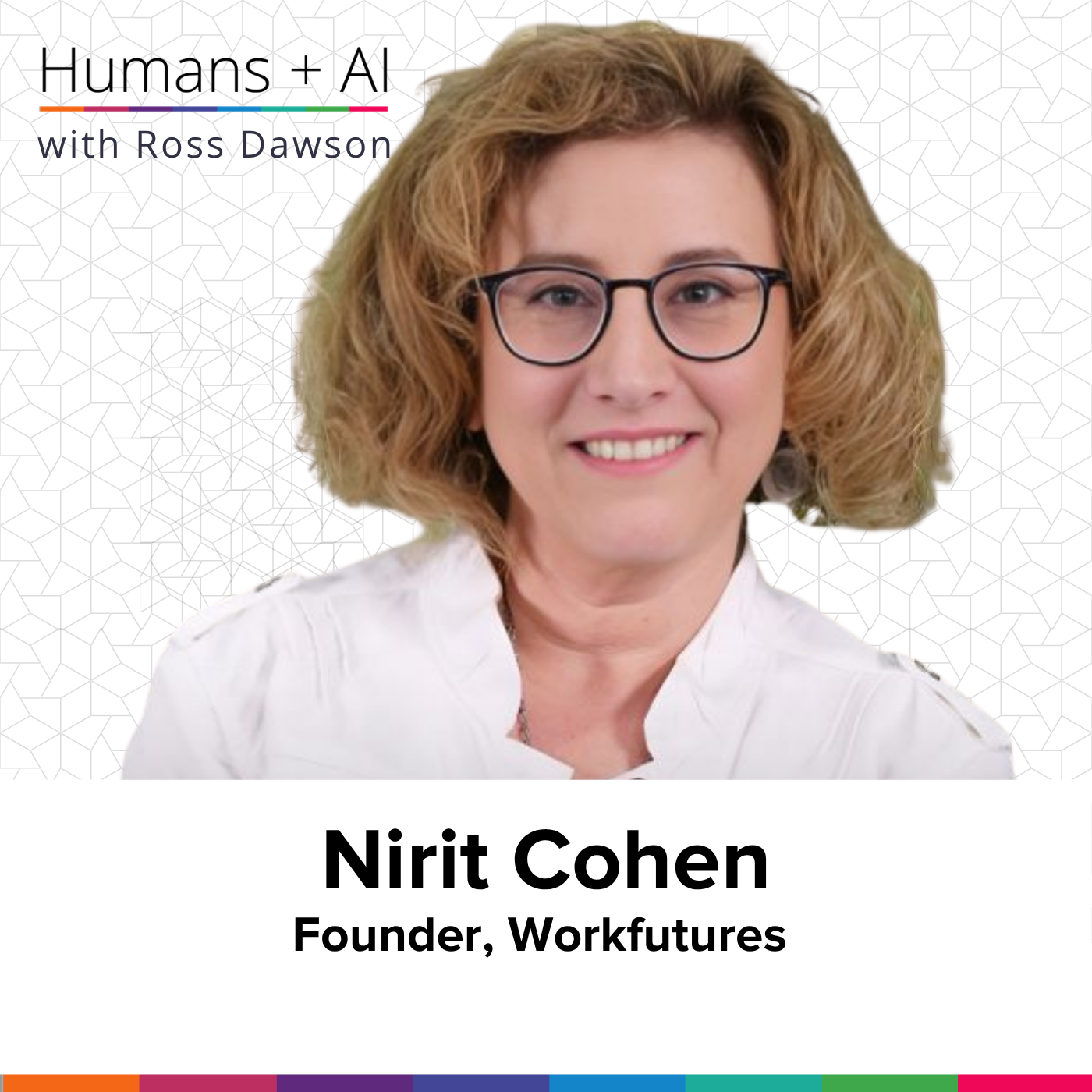


"We're continuously removing the boundaries between the physical and the digital world, and creating a different kind of relationship with the world around us."
–Nirit Cohen

About Nirit Cohen
Nirit Cohen is founder of Workfutures, where she helps organizations and leaders with keynotes, strategy sessions, and brand-building content. She formerly played senior global people roles at Intel, and is a Forbes contributor.
What you will learn
- How the boundary between work and life is being redefined by technology
- Why uniquely human contributions remain essential in a digital workplace
- The risks of viewing people and AI as interchangeable in organizations
- The importance of uncovering hidden, value-creating aspects of work
- Challenges of growing expertise when entry-level roles are automated
- Why asking the right questions matters more than having definite answers
- How organizations can nurture adaptability, collaboration, and experimentation
- The critical role of leaders in facilitating human-centered transformation
Episode Resources
Transcript
Ross Dawson: Nirit, it is wonderful to have you on the show.
Nirit Cohen: Thank you, Ross, for inviting me. It's a really great topic to be discussing these days.
Ross Dawson: Yes, well, a lot of us have been talking about the future of work for a long time, and I think the future is here. So, just thinking back and towards today, I mean, where are we today as we are in this ever-unfolding future of work?
Nirit Cohen: You know, I was going to pause on that very first statement, right? The future that we talked about a decade ago is here, but there's still a future evolving, right? So it's always interesting to think about. It always helps me to think back. So if you think about 2006, just before the smartphone, the iPhone, and the apps, and all these things that we take for granted today, that we have at our fingertips, literally, that allow us to navigate, listen to music, and communicate—those were unheard of and not possible back in 2006, right?
So the future is a lot of things that are unheard of and not possible today that are evolving as we speak. I had to say that because we keep thinking it's almost like we've arrived. It's like, no, no, no, we've not arrived. This is a journey.
Ross Dawson: No, absolutely. I've been writing about the future of work for getting close to three decades now, and there's been a lot of change along the way. I think in some ways a little less than I expected, but then again, if you think how different it is today, as you say, it's been quite a journey.
Nirit Cohen: Yeah, I agree. I think one of the challenges we have these days is that some of the basic infrastructure of how we live and work is shifting, right? The relationship we have with the digital world has been evolving. I started this conversation with back when the iPhone basically helped bring a lot of the digital world into our fingertips and pockets, and on the go. Part of what transformed work at the time was that we got disconnected from all cables that connected us to the walls. Wireless, the cloud, the laptop, and the ability to move around.
I think some of this is happening now at a much bigger and more transformative scale, where we're continuously removing the boundaries between the physical and the digital world, and creating a different kind of relationship with the world around us, and the redefinition of what it is and the players on the field. I think it's even bigger than work. I think it's work and life, right? It's really talking to the world and having it talk back at us, to us, with us, and converse in a different way than we did before.
As we look at that, I think it's really transforming how we live and work in ways that we can't possibly fully understand, which is part of the problem because we think linearly. As you see organizations struggle with implementing AI these days, we're still doing a lot of what we are used to, which is implementing a technology on top of what we do, how we do it, who does it, and then expect maybe the same indicators to show better performance—faster, more of the same—and that's probably not how this will end up.
Ross Dawson: So right now, there are plenty of leaders and also people within organizations who are trying to chart a course because there is a transition now. AI has already significantly changed work in most organizations, even if just by people using an LLM, it's already starting to change work, and obviously the potential and what we're seeing in some organizations is far more dramatic. So, how should leaders be thinking about this?
Obviously, it's very context dependent, but in this idea of having talented people, and they will continue to do things which certainly AI can't for a very long time, but we've got AI as well. So, what is the high-level framing we should be thinking about?
Nirit Cohen: So I think that one of the things that is blurry right now is that we think of people and technology as interchangeable because for a really long time, work was the hard stuff—and I mean "hard" in quotes. We called the soft skills "soft," and we said hard skills were your profession and the things you do, supposedly. AI comes in and takes over large portions of the work that we defined as work, and so we're confusing ourselves in thinking that that means they're interchangeable.
I think what we will learn over the next few years are the nuances of uniquely human contribution that we don't even have the visibility or the right words to describe, that went into the work as we did the work. Let me give you a simple example: PowerPoint, a presentation. I have a keynote to give, and technically I could use tools these days to generate the presentation, and I've tried, and it does wonderful designs that I would never be able to do, but it can't really tell the story the way I can. Maybe it's me, maybe over time I will get better at it, but the way I'm used to working—
I'm using the word "work" literally here—I'm used to building a PowerPoint presentation as building the story and the transformation that I want to take you through as you listen to my story. It's not about the slides; it's about how I want to take you through a journey that leaves you with something at the end. I haven't figured out yet how to tell the tools that story of my journey and then have it build the slides for me. So what happens is it's not building the slides I need it to build.
I've heard this repeatedly, over and over again, where even simple things, like someone telling me in an interview about replacing hiring scheduling of interviews—which is an obvious thing to do, right? You don't need AI for that; it's simple automation—but replacing a hiring person's scheduling with a tool, and realizing suddenly that as the hiring professional was having conversations with leaders around so-called scheduling, they were actually better understanding the content, creating clarity around what they needed to hire, the bigger stories, the environment, the things that never came through the paperwork. When the scheduling tool came in, there was no alternative to create that very important knowledge.
These are maybe simple examples that we can clearly figure out how to fix, but I think what we will discover is the tools are just that—they're tools. They're vanilla. Everybody has them. Your competitors have them. Your customers have them. Your suppliers have them. If everybody just uses the tools and assumes that people don't matter, then what makes you you? What makes you unique? What makes one company different from another?
We'll all be wearing the same white T-shirt, right? I don't believe that's the case. I think there are nuances we don't understand in words like culture and people, and what makes you different than me that has you not just asking different questions, but following up with different requests and creating different processes that generate an outcome that is uniquely yours that I will not be able to replicate.
Ross Dawson: The question is: What is unique and distinctive about humans that technology cannot replicate for the foreseeable future? And I think that's a great example—the scheduling—where, in fact, the value created was not just gathering information; it was the interactions, some of the flows of knowledge or messages in the organization. This goes to—I used to do a lot of organizational network analysis, which essentially showed that there are all of these layoffs or reorganizations and so on, which ignored the realities of how work was actually done in the communication between people, and then, because that was invisible, that just sort of all fell apart.
I think that's exactly the same case as you point out today. So if you start to suddenly say, "Oh, that person's job was this," well, part of their job was that, but there are also these invisible parts of the job as well, which you need to perceive. So I suppose the question then is, how do we start to perceive or bring to the fore or make prominent these hidden value creation aspects of people and the way they work together in organizations?
Nirit Cohen: Yeah, and I think that's part of where we're seeing the transformation evolve. If the first layer was, let's bring technology in or AI in and then expect more productivity, we're now thinking, can we look at the workflow—which is, by the way, very different from the org chart, right? The workflow can cut across functions and jobs—and then analyze it to understand what happens in that workflow and how do you split that workflow between the things you can hand over to technology and the things that people need to do, whether they're gateways or checkpoints or true value add, or things you never realized they did in the process, but they do.
Then there's also the fact that tools are only as good as the data they know how to use, and because people have done this for a really long time, a lot of that data is in people's heads, and it's been handed over from person to person through mentoring and how we grow professionals, and not through documentation. So there's also that—how do you really truly understand what goes into the work, and have you given even the things that you hand over to tools, have you given those tools what they need?
I always think of examples like context. If you know this is a human, you walk into a room, and two people will say the same comment, but it doesn't generate the same result because maybe one person is more influential, or one person has more professional say in the organization, or one person's the manager and the other isn't. I don't know why, but there's context that is deeply human and very specific. The tools—they can't answer it unless they know it. Maybe one day they will have eyes and ears everywhere, and they will figure out the context. But right now, we're very far from that.
So, really, truly understanding how the work flows, how you separate it between people and tools, and making sure that what you're asking the tools to do, they have all the information to do, and if not, that you're building in the human in there.
Ross Dawson: I'm very glad to see that you have been writing about developing judgment and expertise, and I think that's one of the key things which I see: if you start to just stick in AI all over the place and leave humans as approval mechanisms or whatever, that's naturally going to erode judgment and expertise. So we have to design systems where AI is doing useful and valuable things—some things which humans may have done before—but where the role of the human increases their judgment and expertise over time. So, how do you think we should be doing that?
How do we design that? How do we make sure that the people who are working in these systems, in conjunction with these extraordinary technologies, are and continue to improve their capabilities?
Nirit Cohen: I think this is one of the interesting questions that are surfacing. I'm not sure they're being given a lot of attention yet in organizations. We see this even in macro data. We're not hiring entry-level jobs because entry-level jobs are technically about the simple work that AI can do, and we are realizing that experienced people are important because experienced people add that extra layer of professional human expertise that the tools are not able to do yet, at least. We also know that they know when to ask and when not to ask and when to challenge and all that. But how are you going to get the experienced people of tomorrow if you're not growing them?
The experienced people got here because they once did—they ran the Excel, they wrote the code, they analyzed the report, they made the mistakes, they had to go through the process that built their expertise.
We say words like judgment, but judgment comes today from the fact that we used to do all the work that led us to be able to review it by someone else and have judgment. But if I've never seen what good versus bad looks like, how will I be able to tell? So we get words like "work slop," where people generate beautiful PowerPoints and reports and graphs. But if you've ever worked with data, you know that you can do whatever you want with data. It's just a matter of how you decide to position it. So a nice graph doesn't mean anything. Is it the right graph? Did you ask the right question?
I think one of the most interesting questions that we will have to grapple with as organizations is how do we grow expertise if we no longer need to go through the process of doing the work ourselves on the way to become experts at doing it.
Ross Dawson: All right. Well, let me ask you the question then: How do we grow expertise in this environment? So, what's the answer to the question?
Nirit Cohen: Let me say something, Ross, about answers these days. I think they're very dangerous. I actually like questions better. We all grew up in an education system that assumed there was the right answer, and the teacher taught you the right answer, and then you were able to reproduce it in a test, and then you got an A. I don't know that we have right answers, and I think part of what we are doing these days, if we're doing justice to the process, is stopping before an answer surfaces.
We used to talk about the things you don't know you don't know, right? When you think about how you grow yourself in terms of understanding things you don't know you don't know. I think in this time and age, there's also the things you don't realize you know, and you're assuming that because you know, you have the answer and you're going to give me the answer, and I'm thinking, well, maybe you have an answer but I'm not sure it's the right answer.
One of the interesting metaphors someone gave me on this was the difference between a map and a compass. A map—you can only navigate with it if the terrain is the one that the map is mapping. But if the terrain changed, a map will not help you. But a compass might, because it can help you navigate in a general direction, even if you don't understand exactly what the terrain is.
So I think understanding that we have a gap in how we grow expertise is really important. Understanding that we cannot ask a young person who's never done the work to employ judgment, because how would they know what right looks like compared to not right, or recognize the assumptions that were made? Understanding that is an important first step to then asking, so how do we create the next step.
I've heard a lot of interesting suggestions. Some of them have to do with actually mapping the knowledge inside people's heads, so documenting it, which we haven't done. Can you structurally map the process of how you grow someone or how you create a professional capability or expertise and judgment and the nuances of thought that go on in someone's head as they were reviewing something? Can you run this process? I'm not sure that we can. Maybe if we got the right tools to do that—they would interview you as you were making judgment, and they would learn from that, and then they could teach it to someone. These are all interesting things to explore. I don't know that there is an answer yet.
Ross Dawson: So I mean, you gave me obviously not the definitive answer. You gave me an answer, and I think that's really important because there's a real danger where people say, "Oh, we no longer have any pathways for entry-level people, we have no longer ways to develop judgment," and they give up. They may ask that question rhetorically, as in saying, "Well, there is no way." So I think we have to ask the question, but we always have to believe that there is an answer.
You've given one or more possible answers, and that's critical because then you can say, well, that has some promise, and maybe there might be some other ones. There's a lot of people that are asking that question, basically saying, look at how entry-level pathways and judgment development have been destroyed, but not framing that there can be an answer. I think we just need to ask the question in a way that we are saying yes, there can be. And of course, there are always answers, always solutions.
Nirit Cohen: And you have worked in the future workspace for a really long time, so we know that the fact that something doesn't look like what it used to look like doesn't mean it's not the right thing to happen at a given time. So, no, we're not growing professions the same way. I think there's a pre-question there: What does being a professional mean now? Maybe we shouldn't be growing them the same way because what makes you professional and what makes you an expert and what keeps you professional and an expert are not going to be the same things as they used to be. It's no longer about learning a body of knowledge that gives you the ability to call yourself professional, and then working in that body of knowledge for 30 years.
If we understand that, then we understand that what we need to be growing and what we need to be becoming better at as we move up in our professional experience is probably different than what used to be. So it's not just the pathway; it's even the content that a pathway is meant to do. We're in the middle of this, so it's complicated.
Ross Dawson: It is. It's definitely complicated. You've written and spoken quite a bit about the capabilities and the skills and the attitudes, mindsets of both leaders and all of us, in terms of how we can guide our careers. So, is there anything you can point to in terms of what we need to be nurturing in ourselves or those in our organizations to be as ready as possible for what's happening now?
Nirit Cohen: So we've touched on the part where recognizing that what got us here won't necessarily get us to the next phase, so not necessarily using those automated responses that got you here. But I think it's a really good question because there's also the part where we have to understand that humans are humans, and this is a deeply transformative, probably also painful and difficult process because it's a lot of change for people. Most of them didn't choose to go through that change.
Did not expect to have—if you think about somebody with 20 years of experience, and you're telling them, you know what, a lot of that is no longer that important, and tools may be coming in, and you have to start learning all over again how to do your job, and oh, by the way, we don't know what your job is going to be. And they might say, "Wait a minute! I've got 20 years of experience. This was the period of my life where I was supposed to coast on everything that got me here, and you changed the rules, and I don't want to." And my answer is, does it matter if you want to?
These are human conversations that cannot be ignored around the organization struggling to transform. If people do not want to help you transform the work, they won't. The organizations that rule through fear, that basically say you either learn AI or you're out of here—I always wonder what exactly they think is going to happen to how the work will end up transforming.
It's not just the ability to manage this from the top. There are way too many layers here and of transformation, and there are way too many nuances of work that you can't manage from the top that will be going through change.
I think part of why we've been talking about implementing AI and hardly seeing it hit the bottom line is because it's not a technology transformation. It's a people transformation. It's a business transformation. It's a transformation of lots of dimensions of work, and the impact is deeply human.
If you're a manager and you're in the middle of this, I think the better you are at having open, honest, authentic conversations with your people about what you know, what you don't know, what they can and can't do, how this impacts a lot of layers of the work, the people, the structure, the team—the more you have this, the more you get people to work together. Even if people don't know where this is going, if they're in the middle of this in a good way, they're gaining skills and capabilities that will serve them well in their careers. It's not about promising what you don't know how to promise. But the more you do this together, the more you bring in hearts and minds.
When we talk about technology and people, we're used to thinking again linearly. Technology replaced—machines replaced working hands. Then we had this technology come in and supposedly challenge our ability to be the only ones that have thinking minds. So, if we're just hands and minds, then we're no longer needed. No, we're also heart. There's the why are you doing this work, why does it matter—there's a lot of layers of human in there that we seem to be ignoring in this transformation.
Ross Dawson: Yes. So, are there any examples, either things of direct experience that you've seen, or just what you've read, or which you think are instructive examples of successful shifting towards humans plus AI organizations, or things which have gone wrong? Just in terms of pulling this down to the real world. What would you point to in terms of bringing to life any of these things, just what you've seen?
Nirit Cohen: I have to admit that I don't know that I can say we've seen successful. I think we start seeing pockets of whether they're people who are doing this well, or sometimes teams and tasks. But it's easier for me—and I'm wondering whether we want to go there—but it's easier to look at the places where it's not, and I think that clearly thinking about this as running faster, doing the same thing, is probably not it.
I'm wondering how many Nokia moments we have these days—whole companies who were trying to implement AI in a business model that would never have come to life today, and therefore maybe that's not the right thing to do. These are really tough questions. I'm not assuming it's easy, but I think I see way too many conference rooms where the leaders are talking amongst themselves, trying to figure out how to do this, which is clearly not the right way.
There's a lot more. In fact, one of the interesting interviews I had last year was a president of a really large multinational, and he talked about—not hiring entry-level people was a stupid move. He basically said, "I'm learning more from the challenges and questions that the young people coming in with no prior supposed organizational knowledge are asking about how we do things and why we do this and why we don't do something else, than I am from talking to my peers." So I think this is a really good time to understand that you don't understand and that you don't have to have all the answers.
When you look at the ones that are doing this better than others, they're the ones that are looking for the people—and there's always that 10, 15% who are ahead of the game, not just professionally, just because it's their passion. Organizations that have figured out how to find these people and give them the gold card—the authority, the time, the ability to not just do the things for their own job or even their team but actually help grow everyone else around them, that are building these horizontal knowledge sharing capabilities, where the ones that bring in something are even encouraged and measured on how they are able to help others get it, as opposed to, for example, telling the people that are using AI that they're getting promoted and the others are not. So if I just discovered some really cool tool, I'm going to keep it to myself and not share with anybody because we're in a competition here.
It's really rethinking the processes that we use—from who are the managers that we encourage and promote, as opposed to, you know, we're used to promoting the visible managers, the decisive managers, the ones that get things done. Are those the right managers right now, or should we be actually helping the managers that act a lot more like coaches, that are not coming in telling people how to do, but actually trying to organize the right people around the right questions and find the solutions together?
You think about how we allocate work to people—is it through jobs and structures, or are we asking who's the right person for this task, regardless of where they are and what's their job? It's almost like creating intentional disruption, and I've actually had a general manager say this in an interview last week. He called it chaos. He actually said, "Sometimes I give more than one team the same charter," which we'd never do in the past, to intentionally create chaos to see who's going to use a more interesting solution, tools, way to solve this, given that we don't know how to do things, or that we no longer assume that we know what the right way is.
I think those are the places where you see pockets of success—the people who are willing to not do it the way we've always done it, whether it's manage, allocate work, even schedules.
If you're measuring productivity, then people want to just generate more, faster. I heard a manager explain this when they said they actually challenged everybody to create agents, and some function came in with their scheduled monthly process on target, but there was no agent involved. She stopped them and said, "Why is there no agent?" They said, "I did it like I always did it. There was no time." She said, "No. Go back and redo the process and add an agent, even though we're not going to be on schedule," and that created, of course, a process where the next time the person would not just go ahead and do it the way they've always done it. These are examples of pockets of change.
Ross Dawson: Yes, absolutely. And I think exactly that point is with us. This is experimentation. There's no guidebook. We are exploring. Every organization is unique. So this is way of attitude of finding and exploring and pushing in what you at least imagine is the right direction. So where can people go to find out more about your work?
Nirit Cohen: I have a Substack newsletter called The Future of Less Work. By the way, not because of the dystopian version, but I actually think it's time to do less of what doesn't matter and more of what does. You can find me on LinkedIn. My podcast is also called The Future of Less Work, so any of the podcast platforms. But the Substack newsletter or the LinkedIn newsletter will always include all of that content.
Ross Dawson: Fantastic! Thank you so much for your time and your insights, Nirit.
Nirit Cohen: Thank you for having me, Ross.
Podcast: Play in new window | Download