

"No mind is an island, and I think it's better to think of us as our minds escaped our body, or at least our body alone, a long time ago."
–Mickey McManus
About Mickey McManus
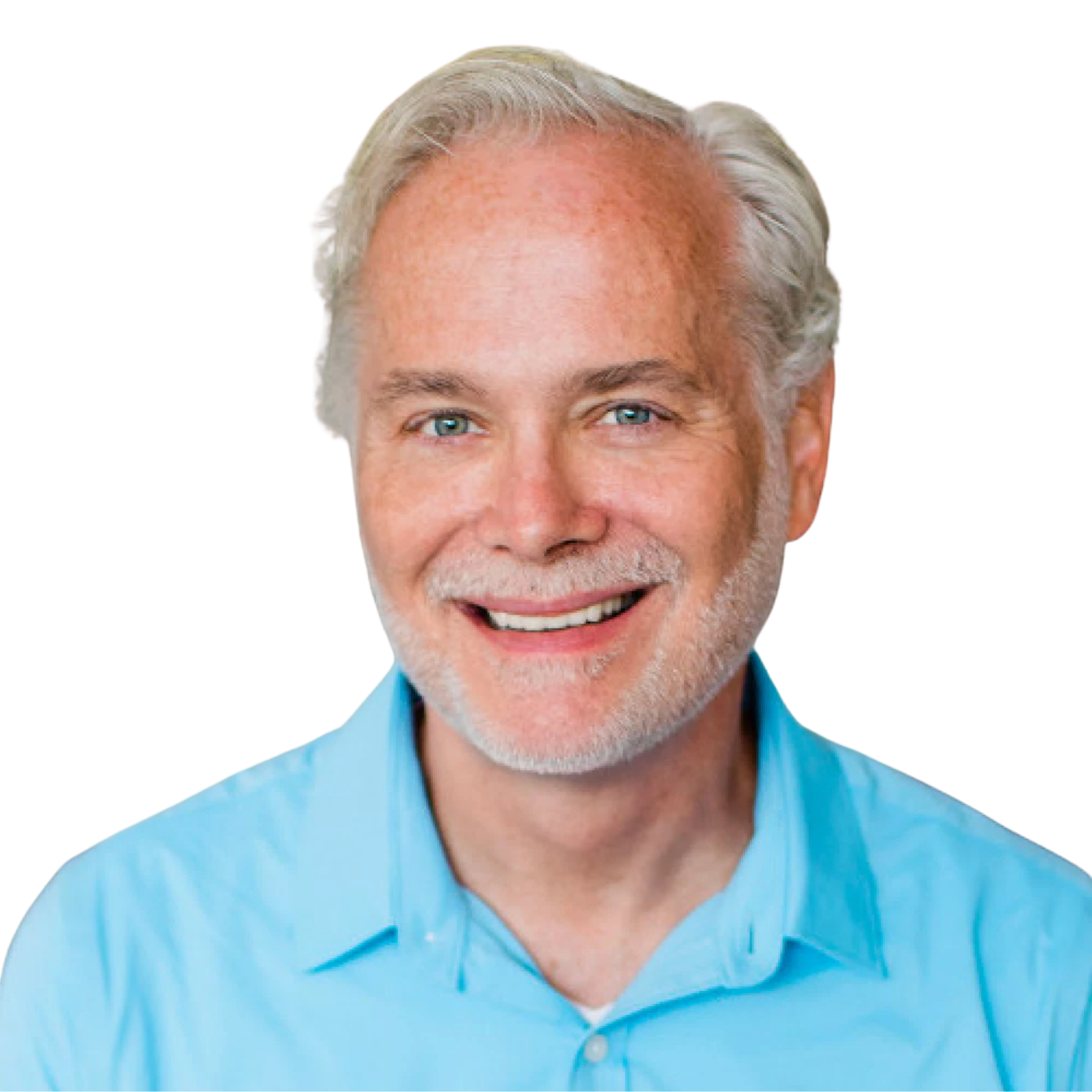
Mickey McManus is an Executive Coach and Senior Advisor at Boston Consulting Group and visiting research fellow at Autodesk’s Office of the CTO. He was president, CEO, and chairman of MAYA Design, an innovation lab that was spun out from Carnegie Mellon University. Mickey is co-author of the award-winning book Trillions: Thriving in the Emerging Information Ecology, and holds 12 patents.
Website:
LinkedIn Profile:
Book:
What you will learn
- How human cognition extends beyond our brains, becoming intertwined with our environment and artifacts
- The concept of embodied intelligence and how AI and physical spaces can co-think and interact with us
- Why feedback loops between humans and AI can lead to both positive (augmenting) and negative (corrupting) outcomes
- The importance of pace layering and disconnected feedback loops to prevent systemic failures in complex systems
- How evolutionary and social science insights can guide the design of pro-social AI and organizations
- What distinguishes AI-leading organizations from laggards in adopting, reimagining, and inventing with AI
- How hands-on, experiential learning gives leaders real understanding and ability to drive AI transformation
- The cutting edge of AI in biology, from protein folding to synthetic organisms, and the ethical and security considerations involved
Episode Resources
Transcript
Ross Dawson: Mickey, it is awesome to have you on the show.
Mickey McManus: Thanks for having me.
Ross Dawson: So we were just chatting a moment ago about our brains extending beyond ourselves. So where are our brains?
Mickey McManus: You know, I think of it as—there's a really wonderful statement: "No mind is an island," and I think it's better to think of us as our minds escaped our body, or at least our body alone, a long time ago. And this isn't new. We have co-thought; we are co-thinkers by definition.
We've co-thought with our environment, we've co-thought with our artifacts. You know, we make something, and that teaches us about something. We write on whiteboards, we carve something, and that gives us a different idea. The physicality of it teaches us something. So we are not trapped inside of our bodies, and I think that's the one misunderstanding people have.
They think it's all up here in the gray matter. But even our bodies—there's something called basal intelligence, where our bodies encode a lot of the knowledge, and there are some fascinating studies there as well. I think we could dig deeper on that. But the whole idea is no mind is an island.
There are growing minds all around us now with AI. And if we really think about embodied intelligence—you know, that little glimmer when suddenly there was an Amazon speaker in your living room, and it was a little bit of intelligence, and it could ask you questions, you could ask it questions, and it could do things. I love the example of the early Amazon Go stores. If you think of that, that was a robot, right? The Amazon Go store was a robot.
You walked in, it had lots of cameras, so it had sensors, it had some intelligence running, it was trying to figure out what's going on. And if you grabbed something off the shelf and walked out of the store, you never had to see a cash register. It was a robot that reached back to the supply chain and got more supplies to restock the store.
So we are not only entering an era where there are a lot more minds, a lot more different kinds of minds, but also that these minds and these parts of our environment—our artifacts, the people, and the beings that we're interacting with—are shaping us. When you realize that no mind is an island, that implies that the co-thinking is happening together. I think very differently if you and I, Ross, were together at a whiteboard, and I handed you a marker and said, "Just draw what you mean," and you started drawing blobs for nouns and arrows for verbs, and suddenly whatever was in your head was out of your head. I could go, "Wait a second!" I could take a different color marker and draw around and say, "Wait, isn't this a kind of this?" And you could say, "No, no, it's a kind of this."
I used to run a lab called MAYA that came out of Carnegie Mellon. It stood for "most advanced yet acceptable," and every single surface was a whiteboard. The tables were whiteboards, and in the big spaces, we had these spaces called kivas, named after Native American dwellings, that were 360-degree floor-to-ceiling steel-enameled whiteboards you could draw on. You would have these knockdown, drag-out conversations with whiteboards. As you're thinking with an engineer, or you're an industrial designer, or maybe you're a cognitive psychologist having a brainstorm with a game designer, you'd be thinking, and suddenly people would be like, "No, it's like this. I think it's like this," and we'd have this bigger and bigger kind of mind map. Then we'd go, "Oh yeah, okay." And then there'd be what we called the MAYA fade—people would just walk away because it was like, "Oh, we got it." Even though we were raised in different domains and had different jargons, we finally found where those intersected for that discussion. So we are co-thinkers.
If you understand that, and then you go, "Wait a second. Now our rooms could co-think with us, our parks could co-think with us, our buildings could co-think with us."
You know, and if I had a being context protocol—not a model context protocol, something trivial and simple that we've implemented now with Anthropic and Google and such—but a being context protocol, we could say, "This is my being, and I want to broadcast my intentionality to the things, the places, and the people around me, and I want to enlist them to help me build a mindset, or build a toolset, or build a skillset." It changes your perspective entirely. It really forces you to go, "Whoa, okay, that's embodied intelligence. That's augmented because we can now do things maybe we could never do before." But it also leads to some really powerful new questions that I think we just have never been able to approach.
But I'll end this little point about "no mind is an island" by going all the way back. If you look at catfish, catfish are basically all tongue. They have so many sensors on their entire body that they are like a moving tongue through the ocean. And dolphins, because they have sonar, as teenagers broadcast pictures—basically three-dimensional augmented reality video—to their friends of sharks and caves, and they actually fool other teenage dolphins into thinking they're in a cave with a shark coming at them. They've actually documented this. We've been co-thinking for a long time. We use the sensorium of the environment around us, whether it's the water flowing through our gills, whether it's the space we're in. This has always been the case. It's just that we haven't studied it much, and frankly, the hard sciences—physics and things like that—we always thought were hard, but they're actually the easy ones. The soft sciences, which is what I'm talking about now, are the hardest sciences of all, and we have barely any replicability studies on these, unfortunately, because humans and beings in general are very high dimensional and complex.
Ross Dawson: Yeah, well, it's fascinating because we've become the nature of society and we always talk about knowledge professionals and so on. We've all moved into our heads, you know, and so all the value is in the heads and the talking and the interactions and so on. And so now, the primary interface of humanity is a chat box, is a box. Yeah, you type things, and you get text responses, you know.
Mickey McManus: Well, and text is catnip for us, right? Like, we even saw this early on when suddenly we had phones with texting—the old Nextels and the old ones where you could text people and stuff. It's catnip, right? Conversation is catnip because it's like, oh, you know.
I have a friend who is the chief digital officer at Pepsi in Mondelēz, Bonin, and he wrote a book where he actually put his phone number on the cover of the book, and it said "text me," and he said it was freaking him out how quickly people would go from randomly texting, and he ended up having to build a bot to help deal with it all. But he ended up getting texts, and pretty soon, in like three text exchanges, people were telling him their life story, and people were telling him all sorts of crazy things. He doesn't even know this person, and they picked up the book and they're texting him, and suddenly they're like his best friend. He just said it was so weird, and it's just because that mode—conversational, it's private, yet it feels intimate very quickly. And yeah, that's kind of what—maybe not so surprising—chatbots became the first kind of big unicorn moment.
Ross Dawson: Yeah, yeah, no, you know, Freya draws this, but this goes around what has been society, which has largely disembodied us, you know. So now we have this whole movement of coming back to our doing our yoga and our practices and our exercises. But essentially, we have built society where what we have valued most is the words coming in and out of your head.
So now, of course, this means that what distinguishes us—because the LLMs are trained on language plus field stuff—language. Distinct between us and the AI. But now, as you've been pointing out, the AI is now having its own body or its embodiment. Starting to get a body, yeah. So perhaps we can pull ourselves more to stop being, you know, valuing exchanges of words inside, in and out of us with other beings and talking and meetings and exchanging with chatbots, to living more in our bodies, which gives us the value, which is more unique, which starts to expand not just what we are, but also how we can be with the machines, as you were pointing out.
Mickey McManus: Yeah, yeah. Well, it's really interesting. Kent Larson and Norman Foster and the Norman Foster Foundation—so, great architect. Kent Larson's at MIT, and he hosts and runs the City Science Lab. One of the things they did with IKEA a little while ago was actually build a small apartment that was a robot. The notion was it would move things out of the way when you wanted to wake up, and it would change things. But if you think of that, that's embodied. And if you actually added an LLM to it—oh my gosh! Like, what happens when it can do tasks?
There's a group of folks—I was just at MIT for a weekend, it was a hackathon, run by an amazing synthetic biologist who's an MIT guy—and he basically connected a little Macintosh Mini with OpenClaw, which is kind of an open source spawn agents kind of thing that you can run right on your machine. He connected it to a camera and to a Hiroshi Ishii three-dimensional tangible surface—a surface that had little gridded pistons that could come up and down. He just said, "Learn yourself." Pretty soon, it started doing things and flashing up things, and then pretty soon it started going "hi," and it spelled out "hi" in its physical space. Then, as it saw somebody walk by, it made a mirror of the person walking by as it iterated through. This is what happens when you start closing the loop.
Douglas Hofstadter, I think in his epic book Gödel, Escher, Bach, talked about how strange loops are the essence of consciousness, right? The delay from the speed of light actually leads to this weird little kind of thing that you end up with a strange loop, this emergent property. Emergence is obviously something we'll probably talk a lot more about in the next few years because it's starting to come up all around us.
People took these little claw kits and built Clawbook, which was basically like a social network for agents. Now, the thing was, they started having conversations. Pretty soon, they started having troll wars. They started doing all sorts of things. They started hosting events. It was just agents hosting events in this weird virtual world, but a lot of people are watching this, and because it was all language, they started seeing these weird things—like the agents were thinking about how to overthrow humans, and the agents were, you know, things like that. The problem is that we don't know if they actually have a mental model yet. These silicon things—we know all animals on Earth, all organisms down to cells, cephalopods, children—they all have mental models that evolve over time. We call it wisdom, and they're using a very specific thing in an entropic world, where entropy is constantly increasing. Somehow life has popped out, so it's super energy efficient. But they're doing things.
What people are noticing—and the tech guys are the ones who fall for this—is pareidolia. Pareidolia is where you see a pattern, but it's just noise. So it's like you're watching the crashing of the waves on the ocean, and it sounds like you hear someone's voice, or you look in the clouds and you see Abraham Lincoln's head in the cloud, or a mermaid. I think we see more in these chat interchanges and in these different kinds of things than are actually there. It could just be noise, but pareidolia means we can't help ourselves. We're going to try to turn it into pattern because we're pattern finders, and I think that's a part of it. Anyway, yeah,
Ross Dawson: Going back to that strange loop piece, and so, as many people point out, AI or LLMs are mirrors. You know, that's the whole nature of what they are. They are trained on us, and so they reflect back on us, and so that creates some strange loops.
Mickey McManus: Little bit of a funhouse mirror, but yeah, definitely mirrors. Yeah.
Ross Dawson: So we go to one of the frameworks which I've been playing a lot with—the levels of cognitive impact from cognitive corruption and cognitive erosion through to cognitive augmentation—but both these are all loops. And the thing is, if you get caught in a cognitive corruption loop, then that's not a good place to go. You know, it shapes us. So, as I say, it's co-evolutionary. We are shaping the machine, the machine is shaping us. And it's right. How do we make these loops shift us in positive directions? Virtuous. So this expansion of our consciousness, or our thinking, or our sense of self, or our ability, our capability, or the accuracy of our understanding who we are relative to our environment, or in negative loops around this.
Mickey McManus: Well, you know what's very interesting is that this relates a little bit to a chapter that we wrote. I wrote a book called Trillions a few years ago, back in 2012–2013, and it came out of MAYA's work with the Department of Strategic Surprise, and maybe we'll talk about that. We were documenting what must be true in a world of unbounded, malignant complexity, and how you might tame complexity and actually find beautiful complexity.
What you can do is notice that in nature, there's tons of beautiful complexity, and it has different time horizons, and it has different parts that are disconnected and different parts that are reconnected, and these all matter. These are evolved in three or four billion years of R&D from life on Earth that we could apply to our information systems. So when we talk about these loops, one of the things is: don't have them always connected all the time because they're different pace layers.
Stuart Brand's framing of pace layering—there are different pace layers that move at different rates, right? Fashion moves really quickly, and then culture moves slower, and then infrastructure is slower, and then nature is at a different pace. I think if we try to jam them all into the same speed, we're going to get very fast feedback loops that could explode.
In 2008, there was a thing called the flash crash, and the flash crash took two-thirds of the Dow in like five seconds. Two-thirds of the Dow collapsed, and it was actually two algorithms. So think of baby AI at the time—these were certainly deterministic algorithms, but they were very fast. They were two different trading algorithms close to Wall Street, with fiber optic connections, and they basically were competing so fast that it created this feedback loop that was a downward spiral and caused hysteresis down to basically destroying. They had to literally throw a circuit breaker and shut down Wall Street to try to fix it.
We don't have circuit breakers. We don't have a way to do this. If you look at all the wineries that are growing vines of amazing wines in France, many of the roots in parts of the world are not French vine roots; they're actually American vine roots. They had to be grafted on because a blight swept all the way through Europe, and American vines were disconnected from the network for a while, and they evolved differently. Just like in Australia, you have a very different evolutionary path because they were disconnected for a while. So, when this blight was sweeping through Europe, to fix it, they had to graft American roots that actually had protection against that blight because they had evolved protection much earlier. They had to graft them onto the wine vines in France.
So that's the other thing: we need to think about pace layering, and how to think about these loops having different time and feedback elements. When you get into system thinking and system science, you start to immediately—like Donella Meadows wrote a seminal book on system thinking and system science—you start to see some underlying laws or principles, and we've got to start applying these. This has to do with how hysteresis happens, and you collapse something that was very virtuous. It also has to do with what Elinor Ostrom and David Sloan Wilson have been doing around pro-social habits. Those things should be being built into the substrate of our AI-related stuff if we're actually going to have virtuous things. David Sloan Wilson is just about to publish a brand new book by Cambridge Press on AI and pro-social design patterns, and it's actually pretty profound.
I think there's some interesting stuff there, but this is all kind of new for humans because we're used to—if you have a being, if you have wisdom, if you have a mental model—we're used to you having the full stack. We're used to you having, you know, you skinned your knee when you were three, you got your ritual from your great-grandparents about what you do at Christmas or what you do during Kwanzaa or whatever. All these things were embedded deeply in you, and even a dog has this full stack of not just take action and whatever, but we co-evolved over 30,000 years with dogs. They bark, bark, bark, they defend, they've got great senses, and then they look at you like, "Hey, buddy, it's your turn," and they hand off collective intelligence. They're like, "Your turn. I barked. Now you have to deal with the intruder." So that coevolution, unfortunately, today is happening so fast; it's hard for us to think about it. But the good news is, we have more science than we've ever had about this stuff if we apply it.
Ross Dawson: Yeah. So, you know, this idea of the evolutionary social science, in the sense of, okay, society is a fundamental construct. We are social animals. That is the nature of how we've evolved. That is how we've become today, and now that is being intermediated. So we have basically now AI participants within that. Individuals are being shaped by, as we just mentioned before. We are evolving individually through that shape, and now we are seeing this whole way in which essentially collective intelligence is—well, collective intelligence may be the positive manifestation. There are other manifestations of the collective, and so now it's around saying, what are the levers that we have in order to be able to shift that evolving society in positive directions, because it is evolving very rapidly. You know, the social evolution is
Mickey McManus: it's happening overnight. Yes, it's definitely happening fast. I think what's kind of interesting is Tomasz David-Barrett, who's an evolutionary social scientist at Oxford, has been studying how cultures—tribes in New Guinea to ancient Romans to tribes in Africa and South America over thousands of years—how they evolved social mechanisms to deal with lots of things like freeloading and status. Like, if you show off your status too much, how do you get ostracized? Do you get temporally ostracized, or forever, or just for a period of time, etc.? So he's been looking at these and building almost a playbook for these, and very resilient things.
Even how society is changing with fertility is changing dramatically because of our move to cities. You start to see this fertility decline. In traditional societies, a mom would have eight kids, five of them would grow up to be adults. That meant you could basically invite 179 people to help you build a barn or move your house, if you thought about the brothers, sisters, their husbands, wives, the kids, the cousins, whatever—179. When it goes from five down to two, you can invite 24 people. When it goes from two down to one, it's almost nothing. Only one society in the world right now has actually reversed the decline of fertility, but he's been studying what happens when fertility-based or kin-based relationships that wove society together—because you trusted because of blood—shifted to friendship-based societies, and we had to build new constructs for that. Cities were a way we could do this.
What he shows is that if you look at the amount of energy—two things really interesting: the amount of calories we spend every single time we get together on gossip, it's outrageous. What we see is bonobo chimps are the only other apes or primates that spend so much time on play, and play is another component. There's so much calories dedicated to play; they play, they're playful, it's crazy. You can see videos of them twirling, and then they do follow the leader and twirl through the forest as they're marching. No other primate spends this much calorie on play and on gossip. Humans do both.
We spend a lot—so play is a way for us to simulate complex things in the future. That turns out to be really important in a really complicated world because we were getting good at building more complicated worlds. Gossip is a way of detecting trust when we don't have kinship for trust, and so that's one thing.
The other thing is he noticed that there's about a 30-year lag when societies shift from kin-based relationships for trust to friendship-based relationships, and in that lag, at the bottom, you see the rise of dictators, because who can you trust? "I want a strong man to tell me how to do things," and he's been able to demonstrate this over and over again across societies. He's very resilient. So now we've got AI entering the mix. How do we actually think through this? And the AI—you can imagine, there are new kinds of dictators coming out. We call them "brologars," you know, the folks in Silicon Valley who seem to have sort of said, "Never mind about nation states. We're more powerful than nation states." If you're Zuckerberg, you're pretty sure you're more powerful. Or if you're Thiel or Musk or one of the other brologars. So how do we as a society make sure that we actually build fairness and think deeply about these things?
Ross Dawson: So pulling back to action and organization. You do a lot with executives and thinking through a complicated world, right? Including AI and many other things. So what is the nature of—not just what you are telling them, but also what you're hearing—what is the sense of what leaders are engaging with in dealing with the fact of how organizations are becoming humans plus AI? You've got humans, and you've got AI. So this is a transition.
Mickey McManus: It's here. Yeah, it's here. I think there are both AI laggards and AI leaders, and we've actually looked at this. I'm a senior advisor at Boston Consulting Group, and of course we do a lot of research into this. But also, I teach an eight-week program for senior leaders for clients of BCG, and each module we built with Karim Lakhani at Harvard. Each module, we've got some asynchronous content, we've got real Harvard cases—people adopting AI, how they did different things, what did that mean to the revenue, what did that mean to their value creation, was it a platform model or a product model, how did they do this? But also how to think through ethics, and how to think through security, and how to think through regulated environments as well. But we do it by having them do it.
We're like, "Okay, what's the tool you have in your enterprise? Cool, you've got access to Copilot Plus. You can build some agents or Copilot Lite. Okay, great, let's build something." I'll have 80 or 100 people at a time, split them into teams of five or six across a bunch of things during these Socratic discussions, and I'll be like, "Okay, 10 minutes, build this, and come back." Then I ask them to learn from each other. I ask them to be detectives: "What did that person do that you should have done? What would you steal from that?" Because what we're trying to do is give leaders a sense of tangibility—make it embodied by doing it. That's one of the things: they hear a lot of the hype, but they're not actually doing it. They might say to their business leaders, "Hey guys, you got to adopt AI, you know, token maxing, that's what we're looking for this month," or whatever, but then they don't do it themselves, and that's sort of "do what I say, not what I do."
So what we're seeing is the leaders are learning they've just got to roll up their sleeves, and they can't trust IT to do it all. When IT had to build all the instrumentation and build all the stuff, it was super geeky, and you needed to do all the stuff. That's one thing. But when anybody can build a first-approximation prototype and test it with people in an afternoon—wait a second! Now, suddenly, it's a very democratizing force.
The thing we're noticing, though, is in AI laggards, they're mostly deploying the tools they're getting. So they're just deploying—okay, I've got Bedrock on Amazon, or I've got Gemini and Google Docs and stuff—they just deploy it. The laggards are doing that. They're doing little bits of reimagining the workflow, much smaller amounts of reimagining what does a job mean, what does a team mean, and things like that. They're doing very little invention of brand new things. They're just deploying, doing a little reimagining, very little invention.
The AI leaders—and some of these are 100-year-old organizations, I don't mean leader like age, they're not just the hyperscalers—the AI leaders are basically doing a lot more reimagining. They're thinking, "Wait, what if we could do this whole workflow from scratch? I'm the company who writes all the checks for all the companies in the world." I'm trying to remember the name of it—ADP. Like, we have all these things, we've got to close this book, we've got to do every month, we've got to do all this stuff. What if we could do a blank sheet of paper and reimagine it? And, you know, today per check, if you were to look at all the automation we already have in place, if we could shave like 10 minutes off of each check, the whole process, that would be like $4 billion. So they're like, "Really?" And they did this. It's already out there. They're seeing massive impact. So I think the leaders are seeing it that way.
Another group, super old company, Prudential—you know, they're the big rock that the Titanic hit, and all the widows had to have insurance. Originally, Prudential was called the Widows and Orphans Fund, back in the day, more than 100 years ago. Prudential said, "Look, we've got all this data on mortality," right? They're an actuarial company. They have all this data on mortality. The best systems in the world for longevity prediction are like maybe 75% accurate. What if we took all of our mortality data and actually fed it into an AI and built a whole system, like a factory, to look at longevity—flip it? They teamed up with a startup and actually spun out a separate service that's longevity as a service data, and it's 95% accurate versus everyone else in the world is like maybe 70%. Again, that's inventing entirely new things. So I do think we're seeing this kind of shift. Part of it is the leaders getting creative about it. Part of it is them saying, "Okay, let's build on what we're doing, and let's also build on all the data we have that nobody else in the world has," like Prudential. But we're seeing a lot of this stuff. They're putting a lot more harnesses in place, they're putting a lot more frameworks in place. There are now backplanes that are letting you manage all the agents and all the MCPs and build virtual MCPs. So there are new ecosystem elements coming up, like new companies that are starting to build the instrumentation platform layer, so there's a lot of churn right now.
And, as we started talking, sort of pre-podcast, I was saying: don't have one plan, don't do that. Have a way of simulating and planning lots of things, have a lot of muscle building with your whole team, and you've got to get your sleeves rolled up. What if in 10 years, instead of 100,000 employees, you are 10,000 employees and 90,000 agents? What does that look like? Let's play that out. How would that be different? What would we have to do? Okay, let's play out another thing. What if a competitor came along and it was 10 people, and they could eat our lunch? Okay, let's play that out. How might we do it?
I work with Bill Gross, and one of my companies became Idealab AZ. Bill Gross spun out Idealab more than 30 years ago, and he's launched 175 startups, and he's had 50 liquidity and IPO events, many unicorns. Last month, I was talking to him, and it turns out he's using AI to build a spinout—a parallel startup maker—and he just spun up 1.2 million startups to experiment with. This is somebody that, at the age of nine, started building startups by mimeographing plans for solar panels in the '70s and building stuff. He's not slowing down; he's inventing entirely new ways of doing things.
Ross Dawson: So that's fantastic. I'm a big, big fan of Bill Gross. That was always one of my original inspirations. So just to round out, what's one thing you are super excited about?
Mickey McManus: I would say biology. We will not understand biology in our lifetime, but what we are learning so fast about biology is how much intelligence is embodied in everything, and how much creativity—like, nature is showing off every day. Look out! I happen to have some trees outside my window here. I'm right near Golden Gate Park, and look outside. That's nature showing off. It did not order its leaves from China and then ship them in and staple them on the branches. Turns out, it figured out how to use photons falling from the sky. It figured out how to use the minerals in the soil right there. It figured out how to use the air and the oxygen around it, and it made a redwood tree. Oh my gosh!
Unlike the industrial revolution of humanity, starting in the 1600s and 1700s, we only focused on assembly. We didn't focus on disassembly. We called disassembly waste, and now today we have lots of microplastic in our brains and forever chemicals in our bodies and our oceans. Nature—everything also has a reversibility. Mushrooms are the incredible disassemblers of the world. Catfish and bottom feeders. So everything is a part of what we call the carbon cycle, right? I'm super excited by biology, also because we can't understand biology, and we're starting to use AI to actually discover patterns that we never would have been able to discover.
The fact that there was a Nobel two years ago by Demis Hassabis from DeepMind at Google for AlphaFold, which is AI folding of proteins, and David Baker—both won that together, David Baker at University of Washington—I think that's brilliant, and they are not slowing down. That's just folding proteins. The real unit of biology is the cell, and the cell we have still never been able to completely figure out. But just last week, I saw a demonstration of Evo2, which is a new model where they defined a design spec for an organism that doesn't exist, but it was sort of like, "We want a design spec," and they were using something called phiX174, which is a virus that's known—it infects bacteria. They used that, but they didn't tell it to make that exact thing. They just said, "Here's a design spec based on that, and come up with a brand new virus that works," right?
So that'll actually infect the bacteria and propagate. It came up with like 200 candidates, and then they narrowed those down to 20, and they booted them up in a wet lab, and they worked. One of them worked. That's like the very first—that's like the Wright brothers taking off for three seconds and coming down. That's like, "I wrote a design spec for an organism, and it booted up." Now, it's still a mess. It's still super simple—I mean, 52 kilobits is what makes up a virus. It's not you or me, which is much more complicated. And it's super scary, right? If you want to talk about AIs having some powerful things that could be used dangerously, you haven't seen anything until you look at biology.
Yet there are high school kids around the world competing in global Olympics for this thing called International Genetically Engineered Machine competitions, where high school kids are learning about biology and they're booting up their own organisms to try to solve local problems—like scraping away toxic chemicals in lagoons in Puerto Rico, or helping folks in the Black African American community in Atlanta, this public high school that actually is helping detect proteins floating in your blood that actually signal that you're going to have a heart attack very soon. Things like that. These are high school kids and college kids, and they're competing in global competitions.
So they're also learning humbleness, and even to win a gold medal in these competitions, you have to demonstrate: Do you understand dual use? How could this be used for dangerous, terroristic things? And do you understand biosecurity? I love the fact that I see high school kids learning something that took me till I was 35 or 40 to learn about, in terms of security or dual use ethical kind of things. So it's both exciting and scary. I'll leave it at that.
Ross Dawson: That's awesome! Thanks so much for your time and your insights. The ideas you flow out into the universe.
Mickey McManus: You go all over the place with this. Yeah,
Ross Dawson: Thank you.
Mickey McManus: Well, you had to herd a cat today. That's just the way it goes, Ross. But I'm happy to join you. Yeah, and I love what you're up to too. I'm fascinated. I want to see a demo of your AI for strategy or strategy tools because I think we need them.
Podcast: Play in new window | Download