

"The value is created in the friction, in the engagement between humans and AI—the pushing back by the humans, the pushing back by the machines."
–Ross Dawson
About Ross Dawson
Ross Dawson is a futurist, keynote speaker, strategy advisor, author, and host of Amplifying Cognition podcast. He is Chairman of the Advanced Human Technologies group of companies and Founder of Humans + AI startup Informivity. He has delivered keynote speeches and strategy workshops in 33 countries and is the bestselling author of 5 books, most recently Thriving on Overload.
What you will learn
- The dangers of aiming for a frictionless experience between humans and AI
- Why meaningful engagement—rather than passive approval—between humans and AI is crucial for cognitive augmentation
- How human judgment and reasoning differ, and where AI excels versus where humans add irreplaceable value
- The four key pitfalls of the traditional 'human in the loop' approach to decision-making with AI
- Why too much delegation to AI can erode human vigilance, judgment, and accountability
- The importance of adversarial, not just assistive, collaboration with AI for complex, high-stakes tasks
- How 'living strategy'—AI-augmented, continuously updated organizational strategy—addresses the limitations of static strategic planning
- The role of AI in surfacing diverse perspectives, supporting dialogue, and enabling truly adaptive decision-making
Episode Resources
Transcript
Ross Dawson: I love speaking to the wonderful guests I have on my podcast. I always learn an enormous amount, but in this episode, I’ll share a little bit of an update for myself and delve into a few interesting things I’ve been seeing and doing lately, including some of the most interesting research papers I’ve seen on humans plus AI lately, looking at human in the loop and the ways in which we should be thinking about that, and AI and strategy.
So, just a quick scan of what’s going on in humans plus AI. I’ve been traveling quite a bit, doing a lot of keynotes as much as possible on humans plus AI, and the resonance around the theme is really rising very rapidly. In fact, somebody recently mentioned that humans plus AI was a cliché, or just overworn at the moment. Since I first started using the phrase three and a half years ago, I think it’s wonderful that now it is gaining a lot of currency. People are talking about it, framing that. Yes, some phrases outlive their usefulness, but I think I’ll stick with humans plus AI for the foreseeable future.
The research papers I’ve been looking at are focused on essentially cognitive augmentation and erosion, and that’s this critical domain where it’s not really clear around whether, or in which circumstances, our cognition erodes, and what it is we can do to make it augmenting.
One of the excellent papers is titled Cognitive Agency Surrender: Defending Epistemic Sovereignty via Scaffolded AI Friction. It’s a bit dense, but it has some great research and analysis in it. The key finding, which it begins with, is that in human-computer interface research literature over the last while, we saw that last year, 2025, there was a big, big rise in this idea of driving human sovereignty in how it is we interact with computers. However, since last year to the first part of this year, we’ve in fact seen that fall dramatically, where the human sovereignty paradigm is reducing dramatically, and we are seeing this big rise in what is called the frictionless paradigm, saying: how do we get as little friction as possible between humans and AI?
There are a number of really important points made in the paper, and really, the starting point is saying that we should stop treating frictionless AI as the goal. If we start to be frictionless, that is starting to essentially take the human out of the loop. The nature of humans is that we need to engage, we need to think, so we need to start building devil’s advocate agents into the systems and to aim for this thing where we start to have both this high degree of engagement with the AI, but also high friction.
That friction is where we are trying to, essentially, the more complex one rising, having more and more friction, and in lower frictions, it’s just more so. Label tasks, but where we’re not just showing the reasoning, giving people the ability to think through tasks and how they think about that, but to be able to challenge, actively challenge people as they are thinking through things.
More broadly, ensuring that the way in which we are designing systems is not emphasizing this frictionless, seamless flow between humans and AI, because that is where the value is created: in the friction, in the engagement between the humans and AI, the pushing back by the humans, the pushing back by the machines, to be able to drive us and move us forward.
Some really interesting research here, which was very much echoed in another very interesting paper called A Task-Driven Human-AI Collaboration: When to Automate, When to Collaborate, When to Challenge. This idea is essentially saying that the default mode for complex, high-stakes work should be adversarial, not assistive. This is, again, obviously, looking at what types of tasks or what types of situations we’re in as to adjust how the machine works, but when we are working in the complex world, we need to be pushing back around the way people’s thinking. It becomes easier, and we’re not looking for the path of least resistance. We’re looking for ones where we’re adversarial.
In fact, you can really see that there is no middle, what’s called this. There is no AI zone, which is in the middle, where essentially the intermediate tasks are ones where, in fact, involving AI can, or involving AI to human decision, involving human and AI decision, is not necessarily the best path. And so, what we need to focus on is the ends of the spectrum, where it becomes a truly collaborative task, or it is purely AI or purely human.
This actually goes very neatly and smoothly into the work which I’ve been doing around human in the loop. People have been talking human in the loop all the time; it’s a very common framing. But what I’ve come to realize, and in fact, my research has borne this out, is that in the vast majority of cases when people say human in the loop, what they actually mean is that the human gives a stamp of approval at the end. An AI makes the decision, then the human says yes or no, or overrides it.
That means that they are accountable, whoever the human is at the end. But there are a number of fundamental problems with this structure, four in particular.
One is that people tend to defer to the AI. AI is usually right, and so, essentially, more and more, you are deferring to the machine. A number of studies have borne out this figure of a 93% approval rate in human approval on an AI or automated system, so very high levels of approval. This starts to become, “Well, by default, I’m going to accept this,” which tails to the second point, which is the decay of vigilance.
Essentially, over time, you are paying less and less attention. It is easier and easier for the human to essentially pay attention and say, “It was probably right. It seems to be good.” My mind is wandering, and I’m not necessarily going to be taking the full attention, which my accountability should point to.
This goes on to the next point, where this role of putting the human at the end of a decision actively erodes their judgment. In one of the frameworks which I shared a little while ago, there was the decision between reasoning and judgment. Reasoning, going through multiple steps, is something which actually AI can do. It’s looking at the different logic, looking at the steps, looking at the relationships, and being able to make a sequence of logic leaps to be able to get to a point.
Judgment is the human part. That is the context, that is the thinking, that is the richness, that is the values, that is the ethics, that is what we bring to bear through the full extent of our human experience. So that is exactly what the human in the loop is: the human applying their judgment to something the AI has done.
But if that is all the human does, provide a judgment at the endpoint, it actively erodes their judgment because they aren’t seeing all of the richness of the reasoning which went through to be able to create that decision. They are potentially being stuck in one single point and taken away from the richness of the context and the experience, which gives them that ability to be judgment.
So, sticking a person in that human in the loop basically erodes their judgment and makes them less valuable over time, and essentially, obviously, is setting us up for a world where that human eventually gets taken out. The fourth problem is simply that this model cannot scale, where we are going to have more and more decisions. We need more and more accountability in systems, and just sticking people at the end of the human in the loop means that that’s going to limit how well we can build decisions that have an impact and have value.
So these are some fundamental challenges. I guess this relates to some upcoming work, or some work which I have been spending a lot of time on, and which I’ll be releasing pretty soon now, which is around some very deep, detailed structures around humans plus AI decision-making.
Those who have followed my work for a while may recall that around three years ago, I released 12 levels of AI delegation on decisions, from AI automation only at the bottom through to human only at the top, and all cascading ways of different ways in which AI and humans are involved in complementing each other in better decision-making.
Now, there are some decisions and some types of decisions where that human in the loop does make sense, where it does make sense to have the AI do things and have a person approve that. But that is, I think, a relatively small proportion of decisions, and most decisions really require a richer integration.
Essentially, AI is involved — sorry, humans are involved — in different points of the decision, including in framing it, including being able to provide different context along the way, to be able to be involved in a process from which a decision comes, rather than the AI doing the decision and the human approving at the end.
This comes back to understanding that there are different types of decisions with different characteristics, and in most cases, that human in the loop, or what I describe as human at the end, because that’s what we normally mean by human in the loop, is something which we should not be designing as the system.
This pulls us in a way to this final topic, which is around AI in strategy. There are some deep failures in strategy as we currently know it, and it’s essentially limited because the strategy has tended to be static. We do a strategy offsite, we create a strategy document, we do a strategy presentation, and that becomes the strategy until the next time the strategy is updated, which may be in a year or a quarter or three years, depending on the organization.
The organization is continually evolving. The world is continually evolving as it happens faster and faster. So, that’s one key challenge: traditional strategy is static.
One of the next key points is that because the strategy is, again, a crystallization, or there’s all of our thinking that we’ve crystallized into an output, which is our strategy, that means that all of the differences of opinion, all of the perspectives that were brought to bear from the board and the executive and the stakeholders and the organization are all collapsed into one thing.
It takes away: did we all agree on this, or did we have a great deal of disagreement around this? Might we start changing our mind if we started to think about this bit differently, or some different evidence comes to light? All of that richness of the diversity of the thinking which forms strategy starts to collapse out of that.
So these are just some of the challenges with the way strategy has been done. Now, this points to a world in which we can have humans plus AI strategy. Strategy, I believe, will always be human, and human first, but I think we will not have strategy which is human only, because there are so many ways in which AI can provide very rich analysis around that.
My platform, Fraxios, so this is probably the thing I’ve been spending the most time on over the last couple of years, is building this platform for AI-augmented strategy. I guess this goes to the points which I’ve been raising. One is it makes strategy alive. It is this living strategy where it’s continually reflecting current thinking, changes in the environment, and opportunities as they emerge.
It is being able to surface the full extent of possibilities for strategy, assessing those in a rigorous way, being able to explore those and develop those. But because this is a true humans plus AI platform, it is really trying to tap the collective intelligence of the people involved in the strategy process. You are identifying where it is that there is agreement, where there is disagreement, and what the issues are.
This is a foundation for constructive dialogue between humans, facilitated by AI to support a strategy which is both living, always evolving, and being able to address and keep the organization moving at the pace of change in the external environment.
So that’s just a few top-of-mind things that I’m currently spending a lot of my cognitive capacity on: these ideas of how it is the research, and being able to bring back these ideas of how it is we can best augment our cognition, our thinking, as we engage with these AI tools, which can be very helpful, but with too much delegation start to erode our cognition; being able to look at the decision-making structures and how those emerge, and with one, I think, particular problem or challenge being around this, the way conception of human in the loop and how that’s manifest.
I’m hoping to release and write a paper on this to be able to support that, and then finally being able to look at this AI-expanded strategy.
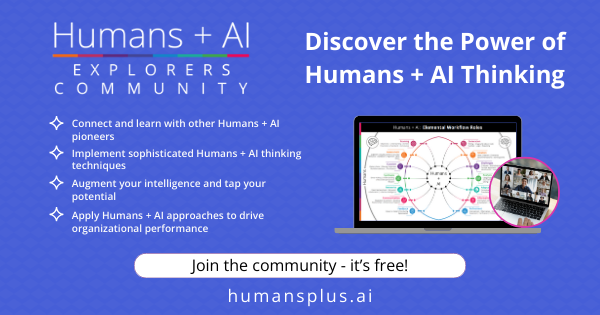
So, as always, please check in on Humans Plus AI, humansplus.ai. I’ll be sharing stuff on LinkedIn, and we’ll be back with some wonderful guests in the next few weeks. Thanks.
Podcast: Play in new window | Download